




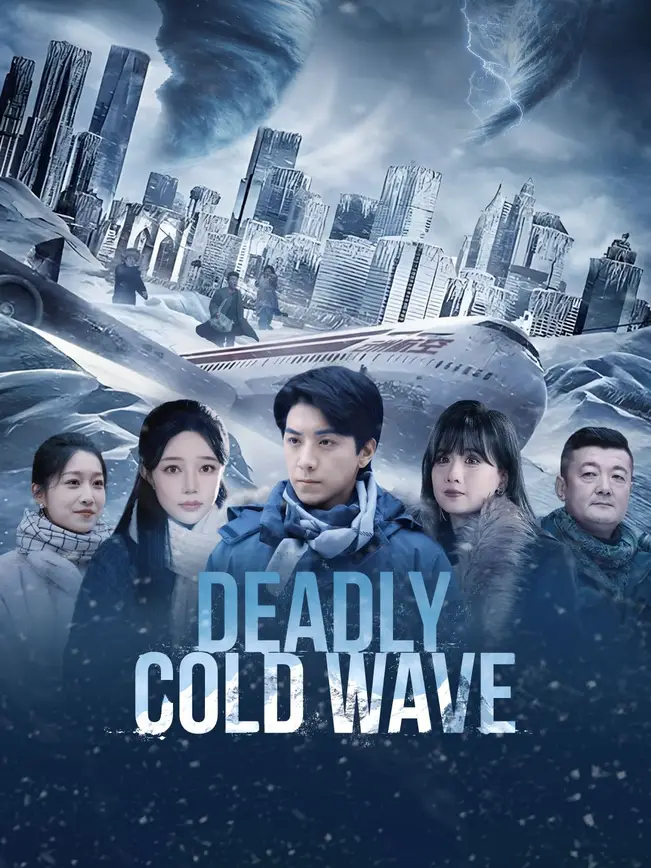
Deadly Cold Wave Storyline
Deadly Cold Wave More details
Genres:Revenge/Return of the King/Rebirth
Language:English
Release date:2024-12-18 10:00:00
Runtime:95min
Redefining the Apocalyptic Genre with Heart
Deadly Cold Wave redefines the apocalyptic genre by focusing on heart and resilience. Phil Stark’s character arc from betrayal to becoming a beacon of hope is inspiring. The blend of personal drama with larger-than-life stakes is executed brilliantly. It’s rare to find a story where you’re rooting f
A Masterclass in Suspense and Storytelling
If you’re a fan of suspenseful storytelling, Deadly Cold Wave is for you! The plot twists and Phil’s strategic mind make for a gripping narrative. The creators have crafted a world that feels both familiar and terrifyingly real, and Phil’s transformation is a testament to the human spirit. The antic
Chillingly Captivating and Deeply Human
This short drama is a chillingly captivating tale of survival and second chances. Phil Stark's emotional journey from heartbreak to heroism is beautifully portrayed. The apocalyptic setting provides a stark backdrop for exploring themes of trust and betrayal. It’s not just about surviving a cold wav
An Icy Adventure with a Twist
Deadly Cold Wave is a thrilling ride into a frozen future! Phil Stark’s journey from betrayal to redemption kept me on the edge of my seat. The rebirth theme adds a fresh twist to apocalyptic tales, and the way he prepares for the storm is both ingenious and inspiring. The world-building is top-notc
Deadly Cold Wave: When a Scarf Tells More Than Words
Let’s talk about the scarf. Not just any scarf—the gray-and-black fringed knit draped around Zhang Hao’s neck in *Deadly Cold Wave*, a seemingly minor detail that, upon closer inspection, functions as the film’s emotional barometer, its moral compass, and ultimately, its tragic irony. In a story saturated with fur coats, leather gloves, and winter layers, this humble accessory becomes the most revealing element of all. Zhang Hao wears it like a badge of honor, yet every time he gestures wildly—pointing, clutching his chest, snapping his fingers—the scarf trembles, frays, swings like a pendulum marking the erratic rhythm of his rage. It’s never neatly arranged; it’s always slightly askew, mirroring his instability. Compare that to Chen Xiao’s scarf: structured, geometrically patterned, folded with precision, tucked securely beneath his coat collar. It doesn’t move unless he moves. It’s controlled. Intentional. Where Zhang Hao’s scarf flails, Chen Xiao’s stays put—because he *chooses* where his energy goes. That contrast isn’t accidental; it’s the visual thesis of *Deadly Cold Wave*. The film opens with Li Wei, her long black hair swept back, her red lipstick stark against the muted tones of the garage. She’s the emotional center, the one who *feels* everything, yet says almost nothing. Her silence isn’t emptiness—it’s accumulation. Every time Zhang Hao raises his voice, her eyes narrow, her jaw tightens, and her gloved hand presses harder against Chen Xiao’s arm. She’s not clinging; she’s bracing. She knows what’s coming. And what’s coming is not a physical fight, but a psychological dismantling—one executed not by fists, but by a man in a tie who walks in smiling, as if arriving at a dinner party rather than a crisis. That’s the genius of *Deadly Cold Wave*: it subverts expectations at every turn. We anticipate shouting, shoving, maybe even a slap. Instead, we get silence, a watch-check, a phone raised like a trophy, and a single word—perhaps “Lawyer?” or “Board?”—that collapses Zhang Hao’s entire worldview in under two seconds. Zhang Hao’s arc is heartbreaking in its inevitability. Watch his expressions across the sequence: at 00:03, he’s startled, confused; by 00:10, he’s indignant, teeth bared; at 00:22, he’s pleading, almost begging; then, around 00:54, a flash of manic hope—*he thinks he’s winning*. His grin is too wide, his eyes too bright, his finger jabbing the air like he’s sealing a deal. But the camera doesn’t cut to Chen Xiao’s reaction immediately. It lingers on Zhang Hao’s face, letting us sit in his delusion. And that’s when the tragedy deepens: he’s not evil. He’s *convinced*. Convinced he’s righteous, convinced he’s been wronged, convinced the world owes him restitution. His fur coat, once a symbol of dominance, begins to look like a costume he’s outgrown. By 01:13, his mouth is open, his brow furrowed—not in anger now, but in dawning disbelief. The scarf hangs limp. He’s been disarmed not by force, but by truth. And truth, in *Deadly Cold Wave*, is colder than any winter wind. Meanwhile, Li Wei’s transformation is quieter but no less profound. At first, she’s reactive—flinching, glancing, holding on. But around 00:24, something shifts. Her gaze lifts, her lips part—not in shock, but in realization. She sees the newcomer before anyone else does. Her hand doesn’t release Chen Xiao’s arm; it *repositions*, fingers spreading slightly, as if preparing to intervene—or to step aside. That subtle shift is everything. She’s no longer just a bystander; she’s becoming an agent. And when the newcomer arrives, her eyes lock onto his, and for a split second, there’s recognition. Not familiarity, but *understanding*. She knows what he represents. She knows what this means for Zhang Hao. And she doesn’t look away. That’s the power of Li Wei: she observes, she absorbs, she waits. In a world of loud men and dramatic entrances, her stillness is revolutionary. Chen Xiao, for his part, remains the enigma. His neutrality isn’t indifference—it’s strategy. Every time Zhang Hao escalates, Chen Xiao’s expression remains unchanged, but his body language tells another story: the slight tilt of his head, the way his thumb brushes the edge of his pocket, the moment he checks his watch (00:36)—these aren’t ticks of impatience; they’re markers of timing. He’s waiting for the right moment to speak, to act, to *end* this. And when he finally does point at Zhang Hao at 01:18, it’s not accusatory—it’s definitive. A period, not a question mark. That single gesture, combined with the newcomer’s arrival, completes the triangulation of power: Zhang Hao is isolated, Li Wei is aligned, and Chen Xiao is in command. The scarf, once Zhang Hao’s signature, now looks like a relic—something he wore before he knew the game had changed. *Deadly Cold Wave* thrives in these micro-moments. The way Zhang Hao’s breath fogs the air when he shouts, the way Li Wei’s earrings catch the green light as she turns her head, the way Chen Xiao’s scarf stays perfectly in place even as chaos erupts around him—these details build a world that feels lived-in, authentic, *real*. This isn’t melodrama; it’s human behavior under pressure. And the most chilling aspect? The violence isn’t physical. It’s verbal, psychological, systemic. The real deadly cold isn’t the temperature—it’s the moment Zhang Hao realizes he’s been playing chess while everyone else was playing Go. His fur coat can’t protect him from that kind of exposure. His scarf can’t hide the tremor in his hands when the newcomer speaks. The film’s title, *Deadly Cold Wave*, takes on multiple meanings by the end. Yes, it’s literal—the setting is frigid, the characters are bundled against the chill. But it’s also metaphorical: the wave of realization that hits Zhang Hao is icy, paralyzing, fatal to his illusion of control. It’s the cold dread that settles in Li Wei’s stomach as she watches the pieces fall. It’s the clinical detachment in Chen Xiao’s eyes as he assesses the new variables. And when the newcomer walks away at 01:27, waving his phone like a conductor’s baton, the green lights flicker, and the camera pulls back—not to reveal a grand resolution, but to leave us in the aftermath, where the real drama begins: the silence after the storm. That’s where *Deadly Cold Wave* lingers longest. Not in the shouting, but in the breath held afterward. Not in the fur coats, but in the scarves that tell the truth no one dares speak aloud. Zhang Hao thought he was the main character. He wasn’t. He was the catalyst. And sometimes, the deadliest waves don’t crash—they seep in, silently, until the foundation cracks from within.
Deadly Cold Wave: The Fur-Coat Tyrant and the Silent Couple
In the dim, green-tinged glow of what appears to be an underground parking garage—cold, sterile, yet charged with human tension—the short film *Deadly Cold Wave* unfolds like a slow-burning fuse. There’s no explosion yet, but every frame hums with the potential for one. The central trio—Li Wei, Chen Xiao, and the volatile Zhang Hao—don’t just occupy space; they *reshape* it with their presence, their postures, their silences. Li Wei, wrapped in a plush beige puffer coat trimmed with silver-gray fur, stands like a statue caught mid-thought: lips parted, eyes wide, gloved hands clutching the arm of Chen Xiao, who wears a sleek black parka layered over a tan sweater and a gray-and-black checkered scarf. His expression is unreadable—not indifferent, not hostile, but *measured*. He watches. He listens. He calculates. Meanwhile, Zhang Hao, draped in a heavy, textured faux-fur coat that screams wealth and aggression, dominates the visual field with his gestures: pointing, clenching fists, baring teeth in what might be a laugh or a snarl. His face is a canvas of shifting emotion—outrage, disbelief, then sudden, almost manic glee—as if he’s just realized he holds all the cards. That shift, from fury to triumph, is where *Deadly Cold Wave* reveals its true texture: it’s not about the argument itself, but about the power dynamics hidden beneath the winter layers. The setting is crucial. This isn’t a cozy café or a sunlit street—it’s a liminal zone, half-indoor, half-outdoor, lit by harsh overhead LEDs and intermittent green exit signs that pulse like warning signals. The air feels thick, not just with cold, but with unspoken history. When Chen Xiao glances at his wristwatch—a subtle, deliberate motion—he’s not checking the time; he’s signaling impatience, control, perhaps even a deadline. It’s a tiny gesture, but in the context of Zhang Hao’s escalating theatrics, it becomes a quiet rebellion. Li Wei’s grip on Chen Xiao’s arm tightens slightly each time Zhang Hao raises his voice, her knuckles whitening inside those cream-colored gloves. She doesn’t speak much, but her eyes do all the talking: concern, fear, resignation, and, in one fleeting moment around 00:24, something sharper—recognition? Contempt? It’s ambiguous, and that ambiguity is the film’s greatest strength. *Deadly Cold Wave* refuses to spoon-feed motives. We’re left to wonder: Is Li Wei protecting Chen Xiao—or restraining him? Is Zhang Hao genuinely wronged, or is he performing victimhood for effect? Then enters the fourth figure: a man in a formal black coat, white shirt, and navy tie, emerging from the corridor like a deus ex machina. His entrance is cinematic—slow, deliberate, smiling faintly as he waves a phone in the air, as if announcing his arrival with a flourish. The camera lingers on his face, calm, composed, utterly out of sync with the emotional storm surrounding him. Zhang Hao’s reaction is immediate and visceral: his mouth drops open, his shoulders tense, his entire posture recoils. For the first time, the fur-coat tyrant looks *small*. That moment—01:28—is the pivot. The power structure fractures. Chen Xiao’s expression shifts from stoic to subtly amused; Li Wei exhales, almost imperceptibly. The new man doesn’t need to speak to change everything. His mere presence rewrites the script. And that’s when *Deadly Cold Wave* transcends its genre: it’s not just a domestic dispute or a lovers’ quarrel—it’s a study in social hierarchy, in the way authority manifests not through volume, but through timing, attire, and the quiet confidence of someone who knows he’s already won. What’s especially compelling is how the film uses clothing as narrative shorthand. Zhang Hao’s fur coat isn’t just warm—it’s armor, a declaration of status, a shield against vulnerability. Chen Xiao’s layered, practical parka suggests pragmatism, resilience, a man who prepares for the long haul. Li Wei’s soft beige coat, with its delicate fur trim and chain-strap bag, speaks of femininity under pressure—elegant, but not fragile. Even the newcomer’s crisp suit and tie, worn over a winter coat, signal institutional power: he belongs to a world where rules are written, not shouted. The contrast between Zhang Hao’s frantic gesticulations and Chen Xiao’s stillness creates a visual rhythm that mirrors internal conflict. Every time Zhang Hao points, the camera cuts to Chen Xiao’s neutral face, then to Li Wei’s anxious glance—this triad of reactions forms a silent chorus, commenting on the spectacle without uttering a word. The dialogue, though sparse in the frames provided, is implied through micro-expressions. When Zhang Hao’s lips twist into that grimace at 00:10, you can almost hear the words spilling out—accusations, threats, desperate pleas. His eyes dart, his breath fogs the air, and his scarf, frayed at the ends, seems to echo his unraveling composure. Meanwhile, Chen Xiao’s silence is deafening. At 00:29, he turns fully toward Li Wei, his gaze softening for a fraction of a second before hardening again. That flicker of tenderness is the emotional core of *Deadly Cold Wave*: beneath the tension, there’s love, or loyalty, or something equally binding. Li Wei’s hand remains on his arm—not possessive, but grounding. She’s his anchor in the storm Zhang Hao is whipping up. And then, the twist: the newcomer isn’t just another player. At 01:32, he speaks—his mouth moves, his expression shifts from polite to authoritative—and Zhang Hao’s face goes slack. Not defeated, exactly, but *disarmed*. The fury evaporates, replaced by confusion, then dawning horror. It’s as if someone has just revealed a secret Zhang Hao thought was buried forever. The green lights above seem to pulse faster. The camera circles slightly, capturing the four figures in a loose tableau: the triumphant outsider, the stunned antagonist, the calm protagonist, and the silent witness. In that moment, *Deadly Cold Wave* achieves what few short films manage: it makes you lean in, heart pounding, wondering not *what* will happen next, but *why* it had to happen this way. Who is this man? What does he know? And why did Zhang Hao think he could win this fight alone? The final frames linger on Zhang Hao’s face—eyes wide, mouth agape, fur coat suddenly looking less like a throne and more like a cage. He’s been outmaneuvered, not by force, but by information. That’s the real chill of *Deadly Cold Wave*: the coldest weapon isn’t anger or violence—it’s knowledge, delivered with a smile and a wave of the hand. The film leaves us suspended, breath held, in that green-lit corridor, where winter isn’t just outside—it’s inside the characters, in the spaces between their words, in the weight of what hasn’t been said. And that, dear viewers, is how a three-minute scene becomes unforgettable. *Deadly Cold Wave* doesn’t shout its themes; it whispers them into your ear as the elevator doors close behind you.
Deadly Cold Wave: When the Sash Hides the Scars
There’s a particular kind of tension that only arises when people pretend everything is fine—while standing inside a room full of guns. *Deadly Cold Wave* opens not with sirens or explosions, but with the soft clink of glassware and the rustle of fabric as six individuals settle around a pale wooden table. The setting is deliberately dissonant: industrial shelving stacked with firearms, a vintage clock ticking off seconds like a countdown, and a whiteboard covered in handwritten Chinese phrases that read like a survivalist’s manifesto. ‘Medical supplies—stockpiled.’ ‘Water purification—tested.’ ‘Armed response teams—on standby.’ This isn’t a startup pitch. It’s a covenant signed in silence, sealed with eye contact and unspoken agreements. At the center of it all is Li Wei—played with chilling charm by Zhang Hao. He doesn’t command the room; he *invites* it into his vision. His laughter is warm, his gestures expansive, his suit immaculate. Yet every time he leans forward, the camera catches the slight tremor in his left hand—a detail most would miss, but one that tells you he’s not just confident. He’s *invested*. When he pulls out his phone and displays the satellite image of the cyclone—the infamous ‘Deadly Cold Wave’ that gives the series its title—the room doesn’t gasp. They *study*. Chen Yu, in his beige field jacket, tilts his head like a scientist observing a specimen. Lin Xiao, in black, taps her fingernail against her glass—once, twice—then stops. Her gaze never leaves Li Wei’s face. She’s not assessing the storm. She’s assessing *him*. What’s fascinating about *Deadly Cold Wave* is how it weaponizes normalcy. The fruit tray in the middle of the table—apples, oranges, a single banana—feels absurdly domestic against the backdrop of tactical gear. A potted pothos sits beside it, green and thriving, as if mocking the impending collapse. The characters sip water, adjust their sleeves, exchange polite nods—all while discussing triage protocols and ammunition quotas. It’s not dystopian fiction. It’s *pre*-dystopian realism. The horror isn’t in the future. It’s in the present, disguised as collaboration. Zhao Ran is the quiet architect of the group. He listens more than he speaks, but when he does, his words land like stones in still water. In one pivotal exchange, Li Wei says, ‘We prioritize functionality over sentiment.’ Zhao Ran replies, without looking up: ‘Sentiment is what keeps people from turning their guns on each other.’ The room freezes. Even Li Wei pauses. That’s the core conflict of *Deadly Cold Wave*: not man vs. nature, but man vs. the myth of his own rationality. Then there’s the woman in cream—the one whose hands rest on her abdomen. Her name is never spoken aloud in the meeting, but later, in the intimate apartment scenes, we learn she’s Mei Ling. She’s pregnant. Not by accident. Not by chance. By choice—made in the shadow of the coming wave. Her silence during the bunker meeting isn’t ignorance. It’s calculation. She knows that in a world where resources are finite, a child is both a vulnerability and a legacy. And she’s decided the latter matters more. The transition to the award ceremony six months later is jarring—not because it’s implausible, but because it’s *plausible*. Red banners. Gold lettering. Applause that sounds too loud, too synchronized. Li Wei stands beside Lin Xiao, who now wears a sash that reads ‘Outstanding Youth’ in bold gold characters. She accepts her ‘Honorary Credential’—a red velvet folder stamped with ‘Honorary Certificate’—with a smile that doesn’t quite reach her eyes. The camera lingers on her hands: the same manicured nails, the same delicate bracelet, now paired with a sash that feels less like honor and more like branding. Back in the modern office, the team watches the ceremony on a screen. They clap. They smile. But their body language tells another story. Chen Yu crosses his arms. Zhao Ran rubs his temple. Mei Ling—now visibly further along in her pregnancy—sits upright, her posture rigid, as if bracing for impact. The irony is thick: they’ve been celebrated for saving lives, yet none of them look like they’ve slept in weeks. The true climax isn’t in the bunker or the stage. It’s in the apartment, where Mei Ling opens a wooden box handed to her by Chen Yu. Inside: a dried sunflower, pressed between sheets of wax paper, and a note in Li Wei’s handwriting: ‘For when the sky clears.’ No grand declaration. No apology. Just a flower—and the implication that he knew. He knew she’d choose life. He knew Chen Yu would protect her. He knew the world would keep turning, even if it turned colder. When Chen Yu kneels—not with a ring, but with his hands open—Mei Ling doesn’t cry. She doesn’t speak. She simply places her palm over his, then guides his hand to her belly. It’s not a proposal. It’s a pact. A refusal to let the wave drown their humanity. The final sequence is pure visual poetry. Snow falls outside the window, thick and silent. The glass is fogged, streaked with breath and time. In the reflection, you see the couple—but also, faintly, the outline of that rifle rack from the bunker. The past isn’t gone. It’s just waiting. And the most chilling line of the entire series isn’t spoken aloud. It’s written in the silence between frames: *We built a new world. But we brought the old one with us.* *Deadly Cold Wave* succeeds not because it predicts the end of the world, but because it forces us to ask: what parts of ourselves do we carry into the storm? Do we become Li Wei—efficient, decisive, morally flexible? Do we become Lin Xiao—adaptable, ambitious, always two steps ahead? Or do we become Mei Ling—quiet, resilient, choosing hope even when logic screams otherwise? The answer, *Deadly Cold Wave* suggests, isn’t in the plan. It’s in the pause before you speak. In the way you hold someone’s hand when the lights flicker. In the decision to plant a seed—even if you’re not sure you’ll live to see it bloom. This isn’t just a survival thriller. It’s a mirror. And if you look closely enough, you’ll see your own reflection in the glass—standing beside the guns, sipping water, waiting for the wave to hit. The question isn’t whether you’ll survive. It’s who you’ll be when it’s over.
Deadly Cold Wave: The Meeting That Changed Everything
Let’s talk about the kind of scene that doesn’t just sit in your memory—it lodges itself there like a splinter you can’t quite pull out. In the opening sequence of *Deadly Cold Wave*, we’re dropped into a dim, concrete-walled room that feels less like a conference space and more like a bunker—complete with shelves lined not with binders or blueprints, but with rifles, pistols, and tactical gear. A whiteboard stands beside the table, its Chinese characters neatly written in colored markers: ‘Supplies’, ‘Water Source’, ‘Medical Facilities’, ‘Armed Equipment’. The phrase ‘Doomsday Rescue Coalition’ hangs above it all like a grim promise. This isn’t a corporate strategy session. It’s a prelude to collapse. At the head of the table sits Li Wei, played with unsettling charisma by actor Zhang Hao. He wears a navy suit, crisp white shirt, and a tie that looks like it’s been ironed within an inch of its life—yet his eyes gleam with something far more volatile than professionalism. He gestures, laughs, slams his palm on the table—not in anger, but in theatrical conviction. His energy is magnetic, almost hypnotic. When he pulls out his phone and displays a satellite image of a swirling cyclone—a storm so massive it dwarfs continents—the room goes still. Not because they’re afraid of the weather, but because they recognize the pattern. This isn’t just a hurricane. It’s the first domino. Opposite him, Chen Yu—played by the quietly intense Liu Jie—leans forward, fingers tapping the table like a metronome counting down. His expression shifts from skepticism to dawning horror in under three seconds. He doesn’t speak immediately. He watches Li Wei’s hands, his posture, the way he leans in just slightly too close when making a point. That’s when you realize: this isn’t just about survival logistics. It’s about power. Who gets to decide who lives? Who controls the water? Who holds the guns? The others around the table are equally telling. There’s Lin Xiao, the woman in black with the delicate gold pendant and long earrings—her nails manicured, her voice calm, but her eyes never blinking when Li Wei mentions ‘resource reallocation’. She’s not here to debate ethics. She’s here to negotiate terms. Then there’s Zhao Ran, the man in the beige field jacket—practical, observant, the kind of person who notices when someone’s left-handed before they even pick up a pen. He exchanges glances with Lin Xiao, subtle as smoke, but loaded with implication. And then there’s the quiet one—the woman in the cream turtleneck, hair pulled back, fingers resting gently on her abdomen. You don’t notice her at first. But by the third shot, you do. Her silence isn’t passive. It’s strategic. What makes *Deadly Cold Wave* so unnerving isn’t the weapons or the whiteboard—it’s how ordinary these people look. They could be your neighbors, your colleagues, your cousins. They drink water from identical glasses. They share fruit from the same tray. A potted plant sits in the center of the table, green and defiant against the gray backdrop. It’s absurd. It’s beautiful. It’s terrifying. Li Wei’s pitch is slick, rehearsed, almost poetic: ‘We don’t wait for the world to end. We build the new one *before* the lights go out.’ He points to the board, taps each line like a conductor guiding an orchestra of desperation. ‘Supplies—stockpiled in Sector 7. Water—filtered and rationed. Medical—triage protocols already drafted. Weapons—calibrated, tested, ready.’ He smiles. Not kindly. Not cruelly. Just… confidently. As if he’s already seen the aftermath and found it acceptable. Chen Yu finally speaks. His voice is low, measured. ‘And who decides who gets access?’ Li Wei doesn’t flinch. ‘Those who understand the cost of hesitation.’ That’s the moment the air changes. Lin Xiao exhales through her nose—almost a laugh. Zhao Ran’s hand drifts toward his pocket, where a small notebook rests. The woman in cream doesn’t move. But her fingers tighten, just slightly, over her stomach. Later, the camera lingers on the phone screen again—the cyclone spinning, relentless. The image flickers. For a split second, the storm’s eye seems to pulse, like a heartbeat. Is it a glitch? Or is the phone showing something *more* than satellite data? The film never confirms. It doesn’t need to. The ambiguity is the point. Six months later—cut to red banners, flashing lights, applause. The same faces, but transformed. Li Wei stands tall in a pinstripe suit, smiling for cameras. Lin Xiao wears a sash that reads ‘Outstanding Youth’ in gold thread, her expression serene, composed. She accepts a red velvet folder labeled ‘Honorary Credential’—the characters embossed in gold, elegant, official. The ceremony feels triumphant. Public. Legitimate. But then—the twist. The scene shifts to a modern office, clean and bright, where the same group sits around a sleek conference table. On the wall, a large screen plays the award ceremony footage. They’re watching themselves. Clapping. Smiling. And yet—no one speaks. The silence is heavier than the bunker ever was. Zhao Ran glances at Lin Xiao. She meets his eyes. A flicker. Nothing more. Then the final act: a quiet apartment, warm light, soft music. The woman in cream—now visibly pregnant—is reading a journal. Chen Yu enters, holding a small wooden box. He places it on the table. She opens it. Inside: a single, dried sunflower. And beneath it, a note in Li Wei’s handwriting: ‘For when the sky clears.’ She looks up. He kneels. Not with a ring. Not with words. Just his hands, open, waiting. She places her palm over his. Then, slowly, she lifts her other hand to her belly—and he covers it with his own. That’s when the camera pulls back, revealing the window behind them. Outside, snow falls—not gently, but thickly, silently, like ash. The glass is fogged, streaked with condensation. Through it, you can barely make out the silhouette of a streetlamp, glowing faintly in the dusk. And for a moment, the reflection in the glass shows not just the couple—but the faint outline of a rifle rack, just like the one in the bunker. A ghost of the past, superimposed on the present. *Deadly Cold Wave* doesn’t ask whether the apocalypse is coming. It asks: what do we become while we wait for it? Do we hoard? Do we bargain? Do we love anyway? The brilliance of the film lies in how it refuses to moralize. Li Wei isn’t a villain. He’s a pragmatist who believes order must be forged in fire. Chen Yu isn’t a hero—he’s a man trying to preserve humanity without losing himself. Lin Xiao? She’s the most dangerous of all: the one who adapts, who survives, who *wins*—and still wakes up wondering if the price was worth it. The final shot lingers on the couple’s joined hands, bathed in golden light, while outside, the snow keeps falling. The screen fades. White text appears: ‘The End.’ But you don’t feel closure. You feel dread. Because you know—this isn’t the end. It’s just the calm before the next wave. And somewhere, in a locked drawer, that red credential still waits. Ready to be used again. *Deadly Cold Wave* doesn’t show us the storm. It shows us the people who learn to dance in the eye of it—and the cost of every step they take.
Deadly Cold Wave: Scarves, Fury, and the Unspoken Truth
Let’s talk about scarves. Not as accessories, but as emotional barometers. In the tightly wound corridor of Deadly Cold Wave, where green walls hum with suppressed tension and overhead lights cast long, accusing shadows, the scarves worn by Li Wei, Zhang Lin, and even the enigmatic woman in the bowler hat become silent narrators of inner turmoil. Li Wei’s fringed gray scarf, layered over a black turtleneck, isn’t just warmth—it’s a shield. He tugs at it when agitated, wraps it tighter when cornered, lets it hang loose only when he’s momentarily triumphant. Each adjustment is a micro-drama: the scarf tightens as his voice rises, slackens as doubt creeps in. His fur coat, thick and imposing, swallows him whole, but the scarf remains exposed—vulnerable, like the truth he’s desperate to bury. When he points, finger jabbing the air like a dagger, his scarf trembles with the force of his gesture. He’s not just arguing; he’s performing righteousness, and the scarf is his costume’s only concession to humanity. Zhang Lin’s scarf tells a different story. Plaid, structured, folded with geometric precision—it speaks of order, of someone who believes in systems, even when the world around him collapses into chaos. He never touches it. Not once. While Li Wei fumbles with his fringe, Zhang Lin stands immobile, his scarf a fixed point in a swirling storm. That discipline is his power. His eyes, dark and steady, absorb every outburst, every false note in Li Wei’s rhetoric, and his scarf remains untouched—a visual metaphor for his refusal to be emotionally hijacked. When Chen Hao steps in, smooth-talking and tie-adjusting, Zhang Lin’s scarf doesn’t shift. It’s as if the fabric itself has decided: *I will not betray my wearer.* This isn’t passivity; it’s strategic stillness. In a scene where everyone else is vibrating with kinetic energy, Zhang Lin’s calm is revolutionary. His scarf isn’t hiding anything; it’s declaring sovereignty. Now consider the woman in the peach parka—her scarf is hidden, buried beneath layers of fabric, just as her intentions are concealed beneath polite smiles and downward glances. Yet her eyes, sharp and reflective, catch the light like polished glass. She’s the audience within the scene, the one who knows more than she lets on. When Li Wei spins mid-rant, catching sight of her, his voice hitches—not out of guilt, but recognition. She’s seen this before. She knows the script. Her lack of visible scarf feels intentional: she’s unencumbered by symbolism, free to observe without being observed in return. And then there’s the bowler-hatted figure, whose fur stole isn’t a scarf at all, yet functions as one—draped across her shoulders like a herald’s mantle. Her scarf-equivalent is performative, theatrical, a declaration that she belongs to a different genre entirely. When she enters, the air changes. Li Wei’s fury stutters. Zhang Lin’s gaze sharpens. Even Chen Hao pauses mid-sentence. She doesn’t need to speak; her presence rewires the scene’s emotional circuitry. Deadly Cold Wave thrives on these sartorial subtleties because they bypass exposition. We learn more about Li Wei’s insecurity from how he yanks his scarf than from any monologue. We understand Zhang Lin’s resolve from how he refuses to adjust his. The setting—a utilitarian corridor with stacked boxes, a blinking red light, and the faint echo of distant traffic—amplifies the intimacy of the clash. This isn’t a grand courtroom or a sunlit plaza; it’s a nowhere place where secrets fester and alliances fracture in real time. The camera work is surgical: tight on Li Wei’s knuckles whitening as he grips his coat lapel, then cutting to Zhang Lin’s relaxed hands, palms up, as if offering peace he hasn’t yet decided to give. The contrast is brutal. One man fights to control the narrative; the other waits for the narrative to reveal itself. Chen Hao, the tie-wearing mediator, is the tragicomic anchor. His blue patterned tie, crisp against his white shirt, clashes violently with the raw emotion around him. He’s trying to apply office politics to a primal confrontation, and it’s failing spectacularly. Watch how his gestures evolve: early on, he uses open palms, seeking de-escalation; later, he points—not accusatorily, but *diagrammatically*, as if explaining a flowchart no one asked for. His frustration isn’t loud; it’s in the way his eyebrows knit together, the slight slump in his shoulders when Li Wei interrupts him for the third time. He’s the embodiment of good intentions colliding with irreconcilable truths. And yet, he persists. Because in Deadly Cold Wave, neutrality is a luxury no one can afford. Even silence is a stance. The turning point arrives not with a shout, but with a sigh. Li Wei, after a particularly vitriolic rant, stops mid-sentence. His mouth hangs open. His scarf slips slightly off his shoulder. For a heartbeat, the fury evaporates, replaced by something raw and exposed—shame? Exhaustion? The camera holds on him, unflinching, as the green light washes over his face, stripping away the bravado. In that moment, Zhang Lin doesn’t move. He doesn’t gloat. He simply *sees*. And that seeing is more devastating than any retort. The unspoken truth hangs between them, heavier than winter air: Li Wei isn’t angry at Zhang Lin. He’s angry at himself. The fur coat, the scarf, the performative rage—it’s all scaffolding for a collapse he’s been denying. Deadly Cold Wave doesn’t resolve this tension; it deepens it. The final shot lingers on Zhang Lin’s profile, his scarf perfectly aligned, his expression unreadable. He knows the storm isn’t over. It’s just gone underground, waiting to erupt again—colder, sharper, deadlier. Because in this world, the most dangerous conflicts aren’t the ones that roar. They’re the ones that freeze you in place, scarfless, exposed, and utterly, terrifyingly aware.
Deadly Cold Wave: The Fur-Coat Tyrant and the Silent Observer
In the dim, green-tinged corridor of what appears to be an underground parking garage—or perhaps a backstage loading zone—the tension crackles like static before a storm. This isn’t just a scene; it’s a psychological standoff wrapped in winter layers, where every gesture, every shift in posture, speaks louder than dialogue ever could. At the center stands Li Wei, draped in a voluminous, grizzled fur coat that seems less like fashion and more like armor—his personal fortress against vulnerability. His scarf, gray with black fringe, hangs loosely, but his hands? They’re never still. Pointing, clenching, flailing—each motion is calibrated for maximum emotional impact, as if he’s conducting an orchestra of outrage. His face, caught in tight close-ups, cycles through disbelief, indignation, and something darker: desperation masked as authority. He doesn’t just speak—he *accuses*. And yet, no words are heard. That silence is deliberate, almost cruel. It forces us, the viewers, to lean in, to read the micro-expressions: the flare of his nostrils when interrupted, the way his jaw locks when someone else takes the floor. This is not a man used to being questioned. He’s accustomed to being the loudest voice in the room—and here, in this confined space lit by flickering emergency lights and the occasional red glow of a distant exit sign, he’s losing control of the narrative. Enter Zhang Lin, the quiet counterweight. Clad in a practical charcoal parka with a fur-trimmed hood and a neatly folded plaid scarf, he stands slightly apart—not aloof, but observant. His eyes don’t dart; they *track*. He watches Li Wei’s theatrics with the calm of someone who has seen this performance before. When Li Wei gestures wildly, Zhang Lin blinks once, slowly, as if recalibrating his internal compass. There’s no smirk, no eye-roll—just a subtle tilt of the head, a slight parting of lips that might signal surprise, or perhaps the first stirrings of a rebuttal he’s choosing not to voice yet. His restraint is magnetic. In a scene saturated with performative anger, Zhang Lin’s stillness becomes the most powerful action. He doesn’t need to raise his voice; his presence alone destabilizes Li Wei’s dominance. The camera lingers on him during Li Wei’s outbursts, framing him in soft focus behind cardboard boxes labeled with indecipherable characters—reminders that this confrontation is happening in a liminal space, neither public nor private, where identities are fluid and power is up for grabs. Then there’s Chen Hao, the man in the puffer jacket and tie—a jarring juxtaposition of corporate formality and street-level pragmatism. His attire suggests he’s either just come from a meeting or is trying desperately to look like he belongs somewhere respectable. He interjects with measured tones, his gestures open-palmed, conciliatory. But watch his eyes: they flick between Li Wei and Zhang Lin, calculating, assessing. He’s not neutral; he’s triangulating. When Li Wei points at Zhang Lin, Chen Hao steps forward—not to defend, but to *mediate*, his smile tight, his posture rigid. He’s the diplomat in a warzone, and his diplomacy feels increasingly fragile. At one point, he raises a hand, palm out, as if to say *Enough*—but his voice, though unseen, likely carries the weight of compromise rather than conviction. His role is crucial: he represents the institutional veneer that tries to contain chaos, even as the chaos threatens to spill over into the fluorescent-lit corridors beyond. His tie, patterned with diagonal lines, subtly echoes the grid-like tension in the scene—order trying to impose itself on entropy. The women in the periphery add another layer of texture. One, in a peach-colored parka with a plush collar, watches with a faint, knowing smile—her expression unreadable, yet deeply intentional. She’s not a bystander; she’s a participant who chooses silence as her weapon. Her gloved hands rest calmly at her sides, but her gaze locks onto Li Wei with unnerving steadiness. Then there’s the woman in the black coat and bowler hat, fur stole draped like a regal mantle—her entrance is brief but seismic. Her wide eyes, heavy with kohl, take in the scene with theatrical shock, yet there’s intelligence behind it. She doesn’t gasp; she *registers*. Her appearance feels like a callback to noir cinema, a visual cue that this isn’t just a domestic dispute—it’s a morality play dressed in modern winter wear. When she glances toward Zhang Lin, there’s a flicker of recognition, or perhaps alliance. These women aren’t decorative; they’re silent arbiters, their reactions shaping the emotional temperature of the room as much as the men’s shouting. What makes Deadly Cold Wave so compelling here is how it weaponizes environment. The green walls aren’t just background—they’re oppressive, almost sickly, casting shadows that deepen the moral ambiguity. The cardboard boxes suggest transience, impermanence; this conflict isn’t rooted in solid ground but in temporary structures, both physical and emotional. The lighting is low-key, chiaroscuro-style, with pools of illumination isolating faces while leaving motives shrouded in half-darkness. Every time Li Wei lunges forward, the camera pushes in, tightening the frame until his face fills the screen—his fury becomes our claustrophobia. Conversely, when Zhang Lin speaks (or prepares to), the shot widens slightly, giving him breathing room, implying his perspective is broader, less entangled. The absence of audible dialogue is genius. It transforms the scene into a universal language of body and affect. We don’t need subtitles to understand that Li Wei feels betrayed, that Chen Hao is exhausted by the cycle, that Zhang Lin is gathering evidence—not for a court, but for his own conscience. The repeated motif of pointing fingers—Li Wei does it constantly, Chen Hao does it once with precision, Zhang Lin never does—tells us everything about their relationship to blame. Li Wei externalizes; Zhang Lin internalizes. And in that gap lies the heart of Deadly Cold Wave: it’s not about *what* happened, but *how* each character metabolizes consequence. When Li Wei finally laughs—a sharp, brittle sound that cuts through the tension—it’s not relief. It’s the sound of a dam breaking, of reality refusing to conform to his script. Zhang Lin’s reaction? A slow exhale, shoulders relaxing just a fraction. He sees the unraveling. He’s ready. This sequence isn’t filler; it’s the fulcrum upon which the entire arc turns. In Deadly Cold Wave, winter isn’t just weather—it’s the emotional climate. The fur coats aren’t luxury; they’re insulation against truth. And in that cold, cramped space, where breath hangs visible in the air, four people are redefining who holds power, who gets to speak, and who will be left standing when the last accusation fades into silence. The real drama isn’t in the shouting—it’s in the pause before the next word. That’s where Deadly Cold Wave earns its title: not because of temperature, but because the chill comes from within, radiating outward until even the walls seem to shiver.

Rebirth
.jpg~tplv-vod-rs:651:868.webp)
.jpg~tplv-vod-rs:651:868.webp)


Return of the King





Revenge
.jpg~tplv-vod-rs:651:868.webp)



 Download

Ep Review