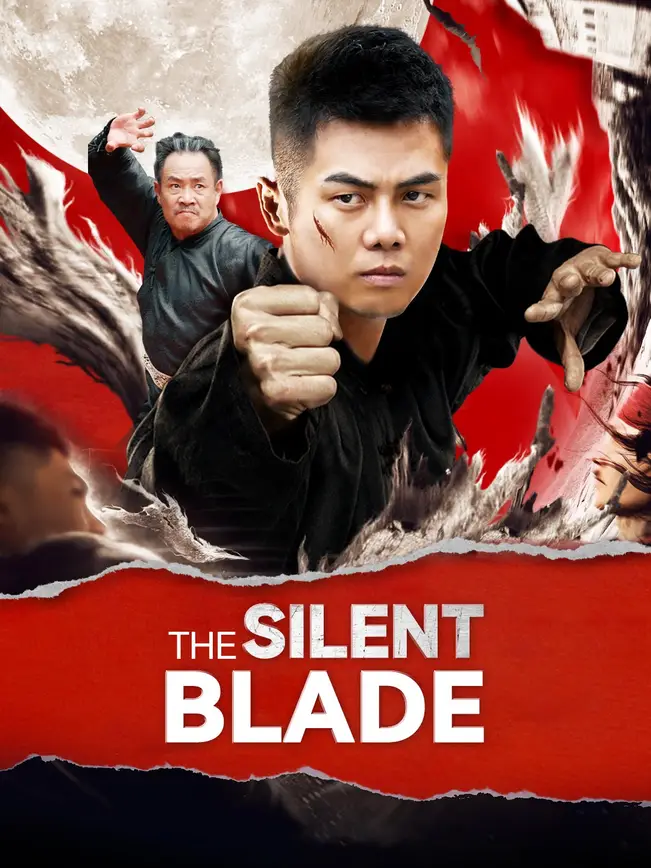
The Silent Blade Storyline
The Silent Blade More details
Genres:Underdog Rise/Revenge/Return of the King
Language:English
Release date:2025-01-10 19:10:00
Runtime:95min
The Silent Blade: The Proclamation That Shattered the Chair
There’s a moment in *The Silent Blade*—just after the third candle flickers out—that redefines everything. Not with a strike, not with a shout, but with a single sheet of paper slapped onto a wooden beam. The hands that place it are steady, practiced, almost ritualistic. They smooth the edges, press down firmly, as if sealing a fate. The paper bears two red circles at the top: ‘Notice’, ‘Proclamation’. Below, dense vertical script—classical, formal, unforgiving. It’s not a letter. It’s a summons. A declaration of war disguised as etiquette. And it’s addressed, implicitly, to Zhou Wei—the man in the wheelchair, the man whose white tunic is speckled with old blood, the man who spends the first half of the sequence looking down, as if the floor holds answers he’s too afraid to read. Let’s unpack the staging here, because every detail is deliberate. The courtyard scene with Lin Qian is pure spectacle: exaggerated gestures, metallic armor gleaming under overcast skies, red carpet like a stage for tragedy. Lin Qian isn’t just performing—he’s *performing for failure*. He wants Zhou Wei to see him, to feel small, to confirm his own irrelevance. But Zhou Wei doesn’t look up. Not until the paper appears. That’s the turning point. The visual language shifts instantly: from wide, theatrical shots to tight close-ups of hands, eyes, breath. We see Zhou Wei’s fingers twitch on the wheelchair armrest—not in panic, but in calculation. He’s not weak. He’s *waiting*. And when the disciples finally help him lean forward, it’s not to assist him in collapsing—it’s to position him for the inevitable rise. Their hands are firm, but not controlling. They’re offering scaffolding, not salvation. Xiao Lan’s role here is masterful. She doesn’t speak much. She doesn’t need to. Her entire presence is built around the bundle she cradles—a baby? A relic? A symbol? The ambiguity is intentional. What matters is how she holds it: protectively, yes, but also as a counterweight to Zhou Wei’s instability. When he finally stands, her breath catches. Not in relief, but in recognition. She sees the man she knew before the injury—and the man he’s becoming now. Her tears aren’t for his pain; they’re for his refusal to let it define him. That’s the emotional core of *The Silent Blade*: it’s not about martial prowess. It’s about dignity under duress. About how a person rebuilds their identity when their body betrays them. Now, consider Li Feng. He’s the loyal disciple, the one who kneels beside Zhou Wei, who whispers encouragement, who grips his arm like he’s afraid Zhou Wei might dissolve into smoke. But watch his eyes during the standing sequence. They don’t just show concern—they show *doubt*. He believes in Zhou Wei, yes, but he also remembers the fall. He knows how fast hope can shatter. His hesitation when Zhou Wei pushes away his help isn’t disloyalty; it’s reverence. He’s letting Zhou Wei claim his own victory, even if it costs him balance, even if it risks collapse. That’s the kind of loyalty most stories ignore—quiet, painful, self-effacing. And then there’s Chen Hao. The second disciple. Calm, observant, dressed in crisp white like a monk who’s seen too much. He doesn’t rush to help. He watches. When Zhou Wei takes his first unaided step, Chen Hao doesn’t smile. He *narrows his eyes*. Because he knows what comes next. The proclamation wasn’t just a challenge—it was a trap. Lin Qian didn’t issue it to provoke a duel. He issued it to force Zhou Wei into the open, where his weakness would be undeniable. And now Zhou Wei has risen—not to fight, but to *refuse the narrative*. By standing, he invalidates the premise of the notice. He says, without words: I am not the man you think I am. I am not broken. I am unfinished. The cinematography reinforces this beautifully. Early shots are static, wide, emphasizing isolation. Later, the camera moves with Zhou Wei—handheld, slightly shaky, mirroring his instability. When he stands, the frame tilts just enough to suggest vertigo, but never quite loses him. He remains centered. Even when he stumbles, the focus stays on his face, not his fall. That’s directorial intention: the body may falter, but the spirit holds the frame. What makes *The Silent Blade* so compelling is how it subverts expectations. We expect the wheelchair-bound hero to be inspired by a speech, a flashback, a divine sign. Instead, he’s moved by *paper*. By bureaucracy. By the cold logic of a challenge that dares him to prove he’s still worthy of the name he once carried. And his response isn’t grand. It’s messy. He sweats. He grimaces. He needs help—but only to start. After that, he’s alone in the act of rising. That’s the truth the film dares to show: recovery isn’t linear. It’s jagged. It’s humiliating. It’s done in front of witnesses who love you and fear for you in equal measure. The final shot—Zhou Wei standing, breathing hard, surrounded by disciples who now look at him differently—isn’t triumphant. It’s solemn. Because he hasn’t won yet. He’s merely re-entered the game. The real test is coming. Lin Qian is still out there, grinning, holding his broken cup like a trophy. The proclamation is still posted. And Xiao Lan still holds the bundle, her eyes asking the question no one voices aloud: What happens when he walks toward the fight? Will he carry the weight of expectation? Or will he forge a new path—one where *The Silent Blade* isn’t a weapon, but a promise? This isn’t just a martial arts short. It’s a study in resilience, rendered in silk, sweat, and silence. It reminds us that the loudest declarations are often written on paper—and the quietest revolutions happen when a man lifts himself off a chair, one trembling inch at a time.
The Silent Blade: When the Wheelchair Rises
Let’s talk about something rare—not just in martial arts cinema, but in human storytelling itself. The opening sequence of *The Silent Blade* doesn’t begin with a fight, a sword flash, or even a monologue. It begins with a man screaming into the sky, arms wide, chest armored like a relic from another era, standing on a crimson carpet that looks less like celebration and more like a warning. That man is Lin Qian, bald-headed, thick-browed, wearing a striped robe over a segmented white cuirass—part warrior, part clown, all desperation. His voice cracks not with rage, but with theatrical anguish, as if he’s been rehearsing this moment for years, waiting for an audience that never showed up. Behind him, red lanterns sway lazily; the courtyard is ornate, traditional, yet eerily quiet except for his cry. No one rushes to him. A few figures stand at a distance—some in purple robes, others in white uniforms—watching, not intervening. One man, younger, sharp-eyed, dressed in flowing ink-wash silk, points directly at Lin Qian, not with accusation, but with chilling certainty. He doesn’t speak. He doesn’t need to. His finger is a verdict. Then we cut to another man—Zhou Wei—seated in a wheelchair, blood spattered across his white tunic like accidental brushstrokes. His face is tight, eyes darting, lips parted as if trying to form words that won’t come. Around him, others in identical white tunics hover like attendants at a funeral. They don’t touch him yet. Not until later. Not until he collapses forward, head bowing low, shoulders shaking—not sobbing, but *straining*, as though his body is resisting its own collapse. That’s when they finally reach out. Hands land on his back, his shoulders, his arms—not to lift, but to hold him upright, to prevent him from vanishing into himself. Zhou Wei’s expression shifts subtly: from exhaustion to defiance, then to something quieter—recognition. He sees Lin Qian again, now grinning wildly, holding up a broken glass cup, red liquid dripping down his wrist. Is it wine? Blood? It doesn’t matter. What matters is the symbolism: Lin Qian isn’t just showing off—he’s *proving* something. That he survived. That he’s still dangerous. That Zhou Wei’s weakness is visible, measurable, and public. The real pivot comes not in the courtyard, but indoors, where the air grows heavy with candlelight and silence. Zhou Wei sits again, now in modern black trousers and a dark jacket over a plain white shirt—the contrast deliberate, almost rebellious against the period aesthetic. His hands rest on his knees, fingers twitching. Sweat glistens on his temples. A woman—Xiao Lan—stands nearby, clutching a swaddled bundle, her hair tied with a white ribbon, her dress patterned with blue bamboo motifs. Her eyes are wet, but not crying. She’s *waiting*. Waiting for him to move. To speak. To become something else. Beside him, a younger disciple—Li Feng—leans in, whispering urgently, gripping Zhou Wei’s forearm like he’s trying to anchor him to the earth. Li Feng’s face is earnest, desperate, loyal—but also uncertain. He doesn’t know what Zhou Wei will do next. None of them do. Then the paper appears. A weathered proclamation, stamped with two red seals reading ‘Notice’ and ‘Proclamation’. Hands press it onto wooden surfaces—first a door, then a table, then the floor—as if trying to make it stick, to make it *real*. The text is dense, classical Chinese, but the intent is clear: a challenge has been issued. A duel. A reckoning. And it names Zhou Wei—not as a victim, but as a participant. As someone who *must* respond. The camera lingers on the paper, then cuts back to Zhou Wei’s hands. They clench. Then unclench. Then grip the armrests so hard the knuckles whiten. Sweat beads on his wrists. This isn’t just physical strain—it’s psychological rupture. He’s been defined by his injury, by his chair, by the pity in Xiao Lan’s eyes. But the notice changes everything. It forces him to be seen not as broken, but as *chosen*. What follows is one of the most physically honest sequences I’ve seen in recent short-form drama. Zhou Wei doesn’t leap up. He doesn’t rise with a heroic swell of music. He *heaves*. With a guttural sound that’s half-scream, half-prayer, he pushes himself upward, using the wheelchair’s frame like a crucible. Li Feng and another disciple rush to support him, but their hands barely touch him before he jerks away—too proud, too raw. His legs tremble. His breath comes in ragged bursts. His face contorts—not in pain alone, but in *reclamation*. Every muscle fights against gravity, against memory, against the narrative that he’s finished. And then… he stands. Not tall. Not steady. But *upright*. His feet find the stone floor. His spine straightens. His gaze locks onto Xiao Lan, who watches, tears finally falling, but her mouth set in something like awe. She doesn’t say ‘You did it.’ She doesn’t need to. Her silence says more. The final act is subtle, almost cruel in its restraint. Zhou Wei takes a step. Then another. Li Feng steps back, stunned. Another disciple—Chen Hao—steps forward, not to help, but to *block*. His posture is defensive, questioning. Zhou Wei doesn’t speak. He simply raises his hand—not in surrender, but in dismissal. A flick of the wrist. Chen Hao hesitates. Then bows slightly, stepping aside. The room holds its breath. Candles flicker. In the foreground, scrolls lie unrolled on a table—ancient texts, perhaps manuals of technique, perhaps letters of betrayal. They’re out of focus, but their presence is weighty. They remind us: this isn’t just about one man standing. It’s about legacy. About whether *The Silent Blade*—the title itself, whispered in earlier scenes, referenced in hushed tones—is a weapon, a philosophy, or a curse passed down through generations. Zhou Wei’s journey in this segment isn’t about regaining mobility. It’s about reclaiming agency. Lin Qian’s theatrics were loud, but hollow. Zhou Wei’s silence, his sweat, his trembling legs—they’re louder. Because they’re *true*. The film doesn’t glorify suffering; it dissects it. It shows how trauma lives in the body long after the wound closes. How shame can sit heavier than iron armor. And how sometimes, the bravest thing a man can do is stand—not to fight, but to *be seen* as he is, broken and rebuilding, in front of the people who love him most. Xiao Lan doesn’t rush to hug him. She just holds the bundle tighter, her eyes fixed on his face, as if memorizing the moment he chose to return to the world. That’s the power of *The Silent Blade*: it understands that the most devastating battles aren’t fought with swords, but with the decision to rise when no one expects you to—and the courage to let others witness it.
The Silent Blade: The Rug Beneath the Fall Holds More Than Blood
Let’s talk about the rug. Not the ornate red carpet laid on the courtyard stage—though yes, that one matters—but the *texture* of it. The way the floral motifs swirl in faded gold and ivory, how the edges fray slightly where Chen Wei’s knee grinds into it during his third collapse. That rug is the silent narrator of *The Silent Blade*, absorbing tears, sweat, and the quiet detonation of a life unraveling in public. From the first frame, we’re invited not to watch a duel, but to *witness* a dissection. Li Dazhu, bald-headed and armored like a relic from a bygone era, doesn’t stride onto the platform—he *settles* onto it, as if the weight of history has already anchored him there. His headband, woven with threads of crimson and ash, isn’t decoration. It’s a binding. A reminder of vows made and broken. When he lifts his hand, palm open, toward Chen Wei, it’s not a challenge. It’s an invitation to confess. And Chen Wei, in his indigo robe—simple, unadorned, almost monkish—accepts it not with courage, but with resignation. His movements are too clean, too practiced, for someone caught off-guard. He knows the script. He’s just hoping the audience won’t notice the missing lines. The fight itself is a masterclass in misdirection. Chen Wei feints left, ducks right, lands a clean strike to Li Dazhu’s forearm—yet the older man doesn’t flinch. Instead, he *leans* into the blow, using Chen Wei’s momentum to pivot, twist, and send him sprawling. Not with brute force, but with geometry. With memory. Each roll, each stumble, each time Chen Wei’s cheek meets the rug, we see not just pain, but recognition. His eyes flicker—not toward the crowd, but toward the wooden table where Liu Xiao Yu stands, clutching the baby like a shield. Her qipao is pale blue, painted with bamboo stalks that seem to bend under invisible wind. She doesn’t cry. She *calculates*. Her gaze darts between Chen Wei, Master Guo, and the pendant hanging loosely from Wu Jie’s belt—the same pendant that once belonged to Zhang Lin, Chen Wei’s brother, now lying in a shallow grave outside the city walls. The film never shows the burial. It doesn’t need to. The absence speaks louder than any eulogy. What makes *The Silent Blade* unforgettable is how it treats silence as a character. When Chen Wei lies prone for the fourth time, mouth open, breath shuddering, the drums cease. The crowd holds its breath. Even the sparrows pause mid-flight. In that vacuum, we hear the rustle of Liu Xiao Yu’s sleeve as she shifts her weight, the creak of Master Guo’s chair as he rises—not to intervene, but to *acknowledge*. His face is unreadable, yet his fingers tremble slightly around the edge of the teacup. He knows. He’s known since the night Zhang Lin vanished, leaving behind only a torn sleeve and a half-finished letter addressed to ‘the boy who carries my name.’ Chen Wei isn’t fighting Li Dazhu. He’s fighting the ghost of his brother. And Li Dazhu? He’s not the antagonist. He’s the keeper of the ledger. The man who remembers every debt, every lie, every whispered promise made under the old willow tree behind the temple. The turning point arrives not with a shout, but with a sigh. Chen Wei pushes himself up, slow, deliberate, his knuckles bleeding onto the rug’s pattern. He doesn’t wipe them. He lets the red seep into the ivory vines, staining the design permanently. Then he looks directly at Wu Jie—the young disciple who’s been watching with unease—and says, voice barely above a whisper: *‘You held the door open. You always did.’* Wu Jie flinches. Not because he’s guilty, but because he’s *remembered*. The camera lingers on his face, the realization dawning like dusk: he wasn’t just standing guard that night. He was waiting. For someone to walk through. For the truth to follow. Meanwhile, Li Dazhu steps back, removing his armored vest with a single, fluid motion. Underneath, he wears a plain gray tunic—no embroidery, no rank, no pretense. He places the vest on the table beside the teapot, as if shedding a skin. Then he walks to the edge of the platform and picks up a small clay jar—unmarked, unsealed. He opens it. Inside: a bundle of dried herbs, a lock of dark hair tied with red thread, and a folded slip of paper. He doesn’t read it aloud. He simply holds it up, letting the wind catch the edge. The crowd leans in. Master Guo’s composure cracks—for half a second, his lips part, and we see the man beneath the title. The father. The liar. The one who chose legacy over love. The final sequence is wordless. Chen Wei kneels—not in submission, but in offering. He extends his hand, palm up, toward Li Dazhu. Not for mercy. For *exchange*. Li Dazhu hesitates, then places the clay jar in his palm. Chen Wei closes his fingers around it, the herbs pressing into his skin. He stands. Turns. Walks toward Liu Xiao Yu. She doesn’t step back. She opens her arms—not to embrace him, but to let him see the baby’s face. The child stirs, eyes fluttering open: dark, intelligent, eerily familiar. Zhang Lin’s eyes. The camera pulls back, revealing the full courtyard—the opera stage, the drums, the yellow lanterns now dimming as clouds gather overhead. *The Silent Blade* doesn’t end with a resolution. It ends with a question, suspended in the air like incense smoke: *What do you do when the truth is heavier than the lie you built your life upon?* The rug remains. Stained. Sacred. Waiting for the next fall. And somewhere, deep in the archives of Changzhou Opera House, a scroll lies sealed—not with wax, but with silence. *The Silent Blade* reminds us that the most dangerous weapons aren’t forged in fire. They’re whispered in the dark, carried in a mother’s arms, and buried beneath the feet of men who thought they’d already paid their dues. This isn’t just a martial arts drama. It’s an elegy for the stories we refuse to tell—and the people we become when we finally stop hiding them.
The Silent Blade: When the Drum Stops, the Truth Begins
In the courtyard of Changzhou Opera Stage—a place where tradition breathes through every carved beam and yellow lantern—the air hums with anticipation. Not just for performance, but for reckoning. The opening frames of *The Silent Blade* do not begin with a sword clash or a whispered oath, but with a bald man in layered armor, his headband frayed like a forgotten vow, his eyes scanning the crowd as if searching for someone who’s already left. His name is Li Dazhu, a former martial arts instructor turned arena enforcer, and his posture—slightly hunched, shoulders braced against invisible weight—tells us he’s been carrying more than just leather and rivets. He speaks, though no subtitles are offered; his mouth moves with practiced cadence, each syllable weighted like a stone dropped into still water. The camera lingers on his gloved hand, fingers curled around a small metal disc—perhaps a token, perhaps a weapon disguised as ritual. Behind him, blurred figures shift, their expressions unreadable, yet their tension palpable. This is not a festival. This is a trial dressed in silk and drumbeats. Then enters Chen Wei, the younger man in indigo robes, black sash tied low at the waist like a belt of restraint. His entrance is not grand—it’s hesitant, almost reluctant—as if he knows what awaits him on that red-carpeted platform is less about victory and more about exposure. Their confrontation begins not with fists, but with silence. A beat. Then movement: Chen Wei lunges, not with aggression, but desperation, his footwork precise yet unbalanced, as if his body remembers technique while his mind fights memory. Li Dazhu counters—not to injure, but to *unmask*. He twists Chen Wei’s wrist, spins him mid-air, and slams him down with controlled force onto the rug. Not a kill. A statement. Chen Wei lies there, face pressed into the floral pattern, breath ragged, eyes squeezed shut—not from pain, but from shame. The crowd gasps, but not uniformly. Some recoil. Others lean forward, hungry. Among them stands Master Guo, in his dragon-embroidered jacket, hands clenched, jaw tight. He does not shout. He does not intervene. He watches, as if this fall is the final act of a play he’s rehearsed in his head for years. What follows is the true genius of *The Silent Blade*: the aftermath. While Li Dazhu raises his arms in mock triumph—his expression neither cruel nor triumphant, but weary—the camera cuts to Chen Wei’s face, now twisted in silent agony. His lips move. No sound. But we see it: he’s whispering a name. *Xiao Yu.* And suddenly, the scene fractures. A cutaway reveals a woman—Liu Xiao Yu—in a blue-and-white qipao, clutching a swaddled bundle, her eyes wide with fear, not for herself, but for the child in her arms. Her hair is pinned with a white ribbon, a symbol of mourning or purity—unclear which. The fabric of the blanket is coarse, unevenly stitched, suggesting haste, secrecy. Then another cut: a different woman, blood trickling from her lip, gripping a man’s sleeve, her voice raw with grief. That man? It’s Chen Wei’s older brother, Zhang Lin, his face streaked with soot and sorrow, holding a broken jade pendant—the same one Li Dazhu wore around his neck in earlier scenes, now missing. The implication hangs thick: this fight was never about honor. It was about inheritance. About betrayal buried under layers of silence. Back in the courtyard, Chen Wei pushes himself up, knuckles scraped raw, his indigo robe stained with dust and something darker. He doesn’t look at Li Dazhu. He looks past him—to the wooden table where Master Guo stands, flanked by disciples in white uniforms, their faces rigid with discipline. One of them, a young man named Wu Jie, shifts uncomfortably, glancing at the baby in Liu Xiao Yu’s arms. There’s recognition there. A flicker. The camera zooms in on the infant’s tiny fist, wrapped in the same rough cloth as the blanket. And then—Chen Wei rises fully. Not with rage, but with resolve. His stance changes. His breathing steadies. He doesn’t charge. He *steps forward*, one deliberate motion at a time, eyes locked on Master Guo. The drums, which had fallen silent after the fall, begin again—slow, resonant, like a heartbeat returning after near-death. Li Dazhu watches, his arms lowering, his expression shifting from performer to witness. He knows what’s coming. He’s seen this moment before—in dreams, perhaps, or in the reflection of a cracked mirror. The brilliance of *The Silent Blade* lies not in its choreography—though that is crisp, grounded, devoid of flashy wirework—but in how it uses physicality as language. Every stumble, every grip, every glance across the courtyard is a sentence in a grammar of guilt and grace. Chen Wei’s fall isn’t defeat; it’s surrender to truth. Li Dazhu’s victory isn’t triumph; it’s exhaustion after bearing witness. And Master Guo? He stands like a statue carved from regret, his embroidered dragons seeming to writhe under the weight of unsaid words. The yellow lanterns sway gently above, indifferent. The red ribbons flutter like unanswered pleas. The stage is set—not for drama, but for confession. When Chen Wei finally speaks, his voice is hoarse, barely audible over the drums, yet the entire courtyard leans in: *‘I didn’t take the scroll. But I knew who did.’* And in that instant, the real battle begins—not with fists, but with silence. *The Silent Blade* cuts deepest when no blade is drawn. It’s a story about how the loudest truths are often spoken in whispers, and how the most violent falls leave no blood on the ground, only cracks in the soul. Liu Xiao Yu tightens her hold on the baby. Wu Jie takes a half-step forward, then stops. Li Dazhu closes his eyes—and for the first time, we see the man beneath the armor. The film doesn’t tell us what happens next. It dares us to imagine. Because in *The Silent Blade*, the ending isn’t written in ink. It’s etched in the space between breaths.
The Silent Blade: The Crowd’s Breath Holds Longer Than the Sword
There is a particular kind of tension that settles over a courtyard when the air itself seems to wait. Not the tense silence before a storm, nor the hushed reverence of a temple—but the charged stillness of a live performance where everyone knows the rules, yet no one dares predict the outcome. That is the atmosphere captured in this fragment of The Silent Blade, a work that operates less like a narrative and more like a ritual performed in broad daylight, witnessed by dozens who have come not for entertainment, but for confirmation. Confirmation that the old ways still hold weight. That pain can be purposeful. That a man can bleed and still stand taller than he did before the fall. Let us begin with Master Liang—not his title, but his presence. He is not lean, not sculpted by modern gym regimens, but solid, grounded, his body shaped by decades of repetition: rising at dawn, striking the sandbag until his knuckles split, meditating until his breath matches the wind through the bamboo grove. His robe is blue-and-white striped, a pattern reminiscent of river currents—fluid, persistent, unbroken. The metal plates strapped to his torso are not ornamental; they are functional, riveted with care, each seam polished by years of use. He wears them not as protection, but as testimony. When he spreads his arms wide at the opening, it is not bravado—it is surrender. He offers himself to the test, to the gaze, to the inevitable. Behind him, two disciples in white gis stand like statues, their expressions neutral, their hands resting at their sides. But watch closely: the younger one blinks too fast. The older one shifts his weight once, twice. They are not immune to the gravity of the moment. They are part of it, complicit in the theater. Then Chen Wei enters. His entrance is understated, almost dismissive—he walks in as if he’s late for tea, not for a trial by force. His indigo tunic is simple, practical, the cuffs turned back to reveal forearms corded with muscle that speaks of labor, not vanity. His hair is cropped short on the sides, longer on top—a style that says ‘I belong here, but I don’t need your approval.’ He does not address Master Liang directly. He addresses the space between them. He studies the angle of the light, the grain of the rug, the way the wind catches the red ribbons tied to the lantern posts. This is not arrogance. It is calibration. In The Silent Blade, every gesture is data. Every pause is calculation. Chen Wei is not fighting a man; he is solving an equation written in posture and pressure. The first contact is subtle: a palm strike to the left shoulder guard, delivered with the heel of the hand, not the fist. Master Liang staggers—not from impact, but from surprise. His eyes widen, not in fear, but in dawning realization: *He’s not aiming to hurt me. He’s aiming to expose me.* The second strike comes faster, a whip-like forearm press to the lower back plate, forcing Master Liang to arch backward, his spine bending like a willow in floodwater. The crowd inhales. A woman in a silver-gray qipao—Xiao Mei, perhaps—tightens her grip on the bundled cloth in her arms. Her smile remains, but her knuckles whiten. She knows this script. She has seen it before. Maybe she lived it. Then the spin. Chen Wei pivots on his left foot, his right leg whipping upward in a crescent kick that connects not with bone, but with the hinge of the armor’s rear plate. The sound is sharp, metallic, like a bell struck wrong. Master Liang flies backward, arms flailing, and lands hard on the stone, his head snapping sideways. For a full three seconds, the world stops. The pigeons freeze mid-flight. The lanterns cease their sway. Even the breeze holds its breath. Then—blood. Not a trickle, but a gush, bright and shocking against the gray flagstones. Master Liang pushes himself up, one knee planted, the other leg trembling. He spits again, and this time, the red arcs through the air like a warning flare. His face is contorted—not in agony, but in revelation. He looks at Chen Wei, and for the first time, there is no defiance in his eyes. Only understanding. This is where The Silent Blade transcends mere martial display. It becomes psychological archaeology. What is Master Liang seeing? Is he remembering his own teacher, decades ago, standing in this same spot, blood on his chin, pride shattered? Is he realizing that the armor he wore to prove his invulnerability has become the very thing that betrayed him? The plates were meant to absorb force—but they also trapped the shock, magnified it, turned it inward. Chen Wei didn’t break the man. He broke the myth. The crowd reacts in layers. First, silence. Then, murmurs. Then, a single clap—Old Man Hu, seated in the front row, his brocade robe shimmering with gold dragons, his fingers steepled. He does not smile. He simply nods, once, as if confirming a hypothesis. Behind him, a group of younger men in white uniforms begin to cheer, their voices rising like steam from a kettle. But their enthusiasm feels performative, rehearsed. They are cheering the spectacle, not the substance. Xiao Mei, however, does not cheer. She watches Chen Wei walk away, her expression softening into something like sorrow—and respect. She knows the cost of such clarity. She has held the bundle long enough to know that some truths are heavier than swords. Later, as the sun dips behind the tiled roofline, Master Liang sits on a low stool, a cloth pressed to his mouth, his breathing slow and deliberate. Chen Wei stands nearby, arms crossed, watching the horizon. No words pass between them. None are needed. The Silent Blade teaches us that the most profound dialogues occur in the spaces between action—where blood dries, where breath steadies, where a man chooses whether to rebuild his armor or burn it. What lingers after the scene fades is not the violence, but the aftermath. The way Master Liang’s hand trembles as he reaches for the teapot. The way Chen Wei’s shadow stretches long across the rug, merging with the stain of blood until they are indistinguishable. The Silent Blade is not about who wins. It is about who remains standing—not on legs, but on principle. And in that courtyard, surrounded by yellow lanterns and whispered histories, both men are still standing. Just differently. Just truer. The crowd disperses, some talking loudly, others silent, carrying the weight of what they’ve witnessed. Because in the end, the most dangerous blade is not the one held in hand—but the one that cuts through illusion, leaving only the raw, bleeding truth behind.

Underdog Rise


.jpg~tplv-vod-rs:651:868.webp)


Return of the King

Revenge
.jpg~tplv-vod-rs:651:868.webp)



 Download