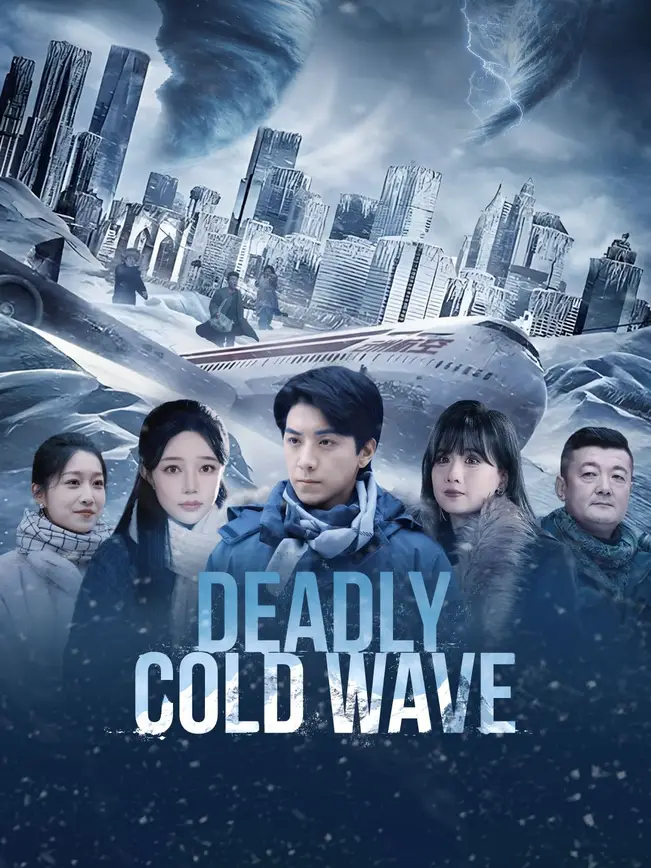
Deadly Cold Wave Storyline
Deadly Cold Wave More details
Genres:Revenge/Return of the King/Rebirth
Language:English
Release date:2024-12-18 10:00:00
Runtime:95min
Redefining the Apocalyptic Genre with Heart
Deadly Cold Wave redefines the apocalyptic genre by focusing on heart and resilience. Phil Stark’s character arc from betrayal to becoming a beacon of hope is inspiring. The blend of personal drama with larger-than-life stakes is executed brilliantly. It’s rare to find a story where you’re rooting f
A Masterclass in Suspense and Storytelling
If you’re a fan of suspenseful storytelling, Deadly Cold Wave is for you! The plot twists and Phil’s strategic mind make for a gripping narrative. The creators have crafted a world that feels both familiar and terrifyingly real, and Phil’s transformation is a testament to the human spirit. The antic
Chillingly Captivating and Deeply Human
This short drama is a chillingly captivating tale of survival and second chances. Phil Stark's emotional journey from heartbreak to heroism is beautifully portrayed. The apocalyptic setting provides a stark backdrop for exploring themes of trust and betrayal. It’s not just about surviving a cold wav
An Icy Adventure with a Twist
Deadly Cold Wave is a thrilling ride into a frozen future! Phil Stark’s journey from betrayal to redemption kept me on the edge of my seat. The rebirth theme adds a fresh twist to apocalyptic tales, and the way he prepares for the storm is both ingenious and inspiring. The world-building is top-notc
Deadly Cold Wave: When a Scarf Tells More Than Words
Let’s talk about the scarf. Not just any scarf—the gray-and-black fringed knit draped around Zhang Hao’s neck in *Deadly Cold Wave*, a seemingly minor detail that, upon closer inspection, functions as the film’s emotional barometer, its moral compass, and ultimately, its tragic irony. In a story saturated with fur coats, leather gloves, and winter layers, this humble accessory becomes the most revealing element of all. Zhang Hao wears it like a badge of honor, yet every time he gestures wildly—pointing, clutching his chest, snapping his fingers—the scarf trembles, frays, swings like a pendulum marking the erratic rhythm of his rage. It’s never neatly arranged; it’s always slightly askew, mirroring his instability. Compare that to Chen Xiao’s scarf: structured, geometrically patterned, folded with precision, tucked securely beneath his coat collar. It doesn’t move unless he moves. It’s controlled. Intentional. Where Zhang Hao’s scarf flails, Chen Xiao’s stays put—because he *chooses* where his energy goes. That contrast isn’t accidental; it’s the visual thesis of *Deadly Cold Wave*. The film opens with Li Wei, her long black hair swept back, her red lipstick stark against the muted tones of the garage. She’s the emotional center, the one who *feels* everything, yet says almost nothing. Her silence isn’t emptiness—it’s accumulation. Every time Zhang Hao raises his voice, her eyes narrow, her jaw tightens, and her gloved hand presses harder against Chen Xiao’s arm. She’s not clinging; she’s bracing. She knows what’s coming. And what’s coming is not a physical fight, but a psychological dismantling—one executed not by fists, but by a man in a tie who walks in smiling, as if arriving at a dinner party rather than a crisis. That’s the genius of *Deadly Cold Wave*: it subverts expectations at every turn. We anticipate shouting, shoving, maybe even a slap. Instead, we get silence, a watch-check, a phone raised like a trophy, and a single word—perhaps “Lawyer?” or “Board?”—that collapses Zhang Hao’s entire worldview in under two seconds. Zhang Hao’s arc is heartbreaking in its inevitability. Watch his expressions across the sequence: at 00:03, he’s startled, confused; by 00:10, he’s indignant, teeth bared; at 00:22, he’s pleading, almost begging; then, around 00:54, a flash of manic hope—*he thinks he’s winning*. His grin is too wide, his eyes too bright, his finger jabbing the air like he’s sealing a deal. But the camera doesn’t cut to Chen Xiao’s reaction immediately. It lingers on Zhang Hao’s face, letting us sit in his delusion. And that’s when the tragedy deepens: he’s not evil. He’s *convinced*. Convinced he’s righteous, convinced he’s been wronged, convinced the world owes him restitution. His fur coat, once a symbol of dominance, begins to look like a costume he’s outgrown. By 01:13, his mouth is open, his brow furrowed—not in anger now, but in dawning disbelief. The scarf hangs limp. He’s been disarmed not by force, but by truth. And truth, in *Deadly Cold Wave*, is colder than any winter wind. Meanwhile, Li Wei’s transformation is quieter but no less profound. At first, she’s reactive—flinching, glancing, holding on. But around 00:24, something shifts. Her gaze lifts, her lips part—not in shock, but in realization. She sees the newcomer before anyone else does. Her hand doesn’t release Chen Xiao’s arm; it *repositions*, fingers spreading slightly, as if preparing to intervene—or to step aside. That subtle shift is everything. She’s no longer just a bystander; she’s becoming an agent. And when the newcomer arrives, her eyes lock onto his, and for a split second, there’s recognition. Not familiarity, but *understanding*. She knows what he represents. She knows what this means for Zhang Hao. And she doesn’t look away. That’s the power of Li Wei: she observes, she absorbs, she waits. In a world of loud men and dramatic entrances, her stillness is revolutionary. Chen Xiao, for his part, remains the enigma. His neutrality isn’t indifference—it’s strategy. Every time Zhang Hao escalates, Chen Xiao’s expression remains unchanged, but his body language tells another story: the slight tilt of his head, the way his thumb brushes the edge of his pocket, the moment he checks his watch (00:36)—these aren’t ticks of impatience; they’re markers of timing. He’s waiting for the right moment to speak, to act, to *end* this. And when he finally does point at Zhang Hao at 01:18, it’s not accusatory—it’s definitive. A period, not a question mark. That single gesture, combined with the newcomer’s arrival, completes the triangulation of power: Zhang Hao is isolated, Li Wei is aligned, and Chen Xiao is in command. The scarf, once Zhang Hao’s signature, now looks like a relic—something he wore before he knew the game had changed. *Deadly Cold Wave* thrives in these micro-moments. The way Zhang Hao’s breath fogs the air when he shouts, the way Li Wei’s earrings catch the green light as she turns her head, the way Chen Xiao’s scarf stays perfectly in place even as chaos erupts around him—these details build a world that feels lived-in, authentic, *real*. This isn’t melodrama; it’s human behavior under pressure. And the most chilling aspect? The violence isn’t physical. It’s verbal, psychological, systemic. The real deadly cold isn’t the temperature—it’s the moment Zhang Hao realizes he’s been playing chess while everyone else was playing Go. His fur coat can’t protect him from that kind of exposure. His scarf can’t hide the tremor in his hands when the newcomer speaks. The film’s title, *Deadly Cold Wave*, takes on multiple meanings by the end. Yes, it’s literal—the setting is frigid, the characters are bundled against the chill. But it’s also metaphorical: the wave of realization that hits Zhang Hao is icy, paralyzing, fatal to his illusion of control. It’s the cold dread that settles in Li Wei’s stomach as she watches the pieces fall. It’s the clinical detachment in Chen Xiao’s eyes as he assesses the new variables. And when the newcomer walks away at 01:27, waving his phone like a conductor’s baton, the green lights flicker, and the camera pulls back—not to reveal a grand resolution, but to leave us in the aftermath, where the real drama begins: the silence after the storm. That’s where *Deadly Cold Wave* lingers longest. Not in the shouting, but in the breath held afterward. Not in the fur coats, but in the scarves that tell the truth no one dares speak aloud. Zhang Hao thought he was the main character. He wasn’t. He was the catalyst. And sometimes, the deadliest waves don’t crash—they seep in, silently, until the foundation cracks from within.

Rebirth
.jpg~tplv-vod-rs:651:868.webp)
.jpg~tplv-vod-rs:651:868.webp)



Return of the King





Revenge
.jpg~tplv-vod-rs:651:868.webp)



 Download