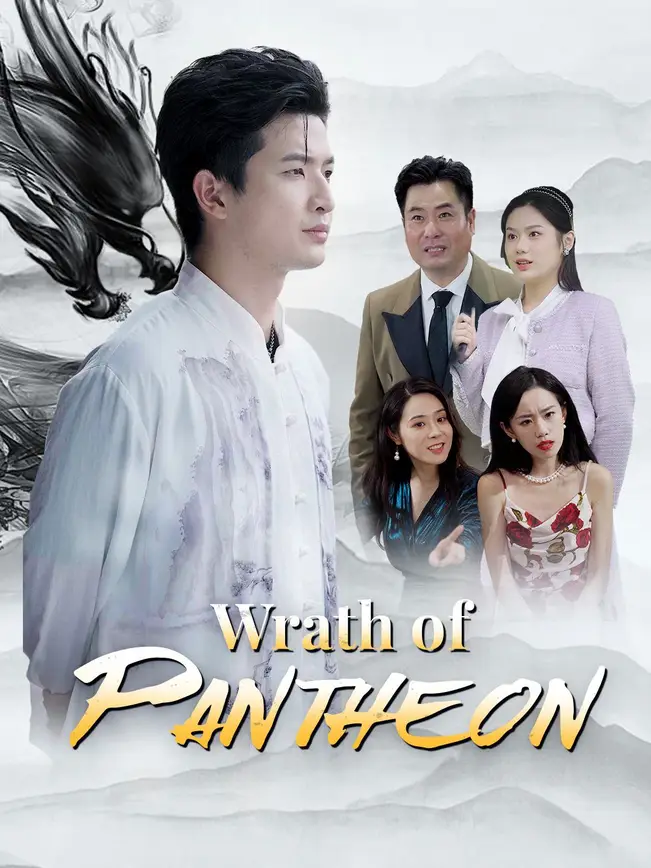
Wrath of Pantheon Storyline
Wrath of Pantheon More details
Genres:Underdog Rise/Revenge/Return of the King
Language:English
Release date:2025-02-20 21:31:00
Runtime:110min
Wrath of Pantheon: When the Umbrella Becomes a Confessional
Let’s talk about the umbrella. Not as prop, not as weather gear—but as silent third character in the slow-burn symphony of Li Wei and Chen Xiao’s reconnection. In Wrath of Pantheon, objects don’t just sit in the frame; they *participate*. That black umbrella—water-beaded, slightly worn at the edge, its handle polished smooth by repeated use—is the stage upon which two fractured souls attempt reconciliation. From the very first frame, where their feet tread the same grass but avoid alignment, we sense the dissonance: he in practical denim and sneakers, she in structured elegance and delicate heels. Their footwear alone tells a story—his grounded, hers elevated, neither willing to compromise terrain. But the umbrella? It’s neutral ground. A temporary truce zone. And yet, how they hold it, share it, fight over it—metaphorically—reveals everything about where they stand emotionally. Chen Xiao enters the scene already armed: not with anger, but with poise. Her lavender ensemble is a masterclass in controlled femininity—tweed tailored to perfection, buttons gleaming like tiny promises, the white bow at her collar not childish, but strategic. It’s a visual echo of her personality: soft on the surface, rigid underneath. She grips the umbrella with both hands initially, a defensive posture, as if shielding herself from more than just rain. When Li Wei approaches, she doesn’t flinch—but her eyes widen, just once, a micro-expression that betrays the shock of his presence. He’s not supposed to be here. Or rather, he’s not supposed to be *here* like this: calm, composed, holding his jacket like a man who’s made peace with waiting. His light gray shirt is slightly rumpled at the cuffs, suggesting he’s been moving, thinking, perhaps pacing before this encounter. He doesn’t rush her. He gives her space to breathe, to decide. That’s the first clue: Li Wei has changed. Or maybe he’s just stopped pretending. Their dialogue—fragmented, punctuated by glances and silences—is where Wrath of Pantheon shines. Chen Xiao speaks in clipped phrases, her voice steady but her fingers restless, twisting the umbrella handle like a rosary. She asks questions that aren’t really questions: ‘You came all this way?’ ‘Did you think I’d answer?’ Each one is a probe, testing the integrity of the wall she built between them. Li Wei responds with quiet precision, his words measured, his gaze never leaving hers. He doesn’t deflect. He doesn’t justify. He simply *is*. And in that stillness, Chen Xiao begins to unravel. Watch her face during the middle segment—when she looks away, then back, her lips parting as if to say something vital, then sealing shut again. That’s the moment the dam cracks. Not with a sob, but with a sigh she doesn’t let escape. Her earrings—delicate floral studs—catch the light each time she tilts her head, tiny flashes of silver like Morse code for ‘I’m still here.’ Then comes the phone call. Ah, the phone call. The narrative grenade tossed into the center of their fragile equilibrium. Chen Xiao pulls it out not with urgency, but with theatrical deliberation. She doesn’t step aside. She stays under the umbrella, forcing Li Wei to remain in the periphery of her attention—even as her voice softens for the person on the other end. That’s the cruelty of modern romance: we can be physically present and emotionally absent in the same breath. Li Wei watches her, his expression unreadable at first, then slowly hardening—not with jealousy, but with dawning realization. He understands now: this isn’t just a chance meeting. This is a test. And he’s failing it by being too patient, too kind. When she ends the call and turns to him, her eyes are wet, but not with tears. With exhaustion. The kind that comes from holding too many truths at once. She doesn’t apologize. She doesn’t explain. She simply says, ‘You knew I’d call him.’ And in that sentence, the entire history of their relationship spills out: betrayal, loyalty, ambiguity, love that refused to die even when it was buried. The final sequence—the close-up shots, the near-embrace, the way Li Wei’s thumb brushes her wrist as he adjusts the umbrella overhead—is where Wrath of Pantheon transcends cliché. This isn’t about kissing. It’s about consent. About choosing, in real time, to stay. Chen Xiao could walk away. She has the phone, the excuse, the practiced exit strategy. Instead, she leans in. Just slightly. Enough for him to feel the shift in air pressure, enough for the audience to hold its breath. His hand hovers near her waist—not touching, but ready. The rain continues, indifferent. The trees sway. And in that suspended second, we understand: the wrath of the pantheon isn’t divine fury. It’s the storm inside two people who love each other too much to lie, but too little to trust. Li Wei’s final smile—soft, rueful, full of unspoken apologies—is the most devastating thing in the scene. He knows she’s still torn. He knows the call changed everything. And yet, he offers her the umbrella again. Not as shelter, but as symbol: *I’m still here. Even if you choose him. Even if you choose yourself.* That’s the heart of Wrath of Pantheon: love as endurance. Not grand gestures, but small surrenders. Not perfect endings, but honest beginnings. Chen Xiao doesn’t take the umbrella back. She leaves it in his hand. And in that refusal, she gives him something far more valuable: the chance to prove he’s worth the wait. The grass beneath them remains green, undisturbed. The world moves on. But for Li Wei and Chen Xiao, time has stopped—right under the black canopy, where every drop of rain sounds like a heartbeat counting down to truth.
Wrath of Pantheon: The Umbrella That Almost Broke Them
In the quiet, rain-dampened hills of what feels like a forgotten corner of modern romance, two figures emerge—not with fanfare, but with the subtle tension of people who’ve rehearsed silence better than speech. Li Wei and Chen Xiao are not just characters; they’re emotional archaeologists, unearthing buried layers of longing, resentment, and reluctant affection beneath the surface of a single black umbrella. The opening shot—low to the ground, grass blurred in the foreground, feet stepping in sync yet never quite touching—sets the tone: intimacy deferred, proximity without permission. Li Wei’s sneakers, slightly scuffed, contrast with Chen Xiao’s pearl-embellished heels, each step a quiet declaration of identity. She wears lavender tweed like armor, white bow at her throat not as innocence but as defiance—a refusal to be swallowed by the gray drizzle that clings to the trees behind them. He holds his jacket like a shield, folded neatly against his ribs, as if protecting something fragile inside. This isn’t just a meet-cute. It’s a collision of curated selves. The first exchange is deceptively simple: a glance, a pause, a flicker of surprise in Chen Xiao’s eyes when she turns and sees him already there. No grand entrance. Just presence. And yet—her breath catches. Not because he’s handsome (though he is, in that clean-lined, quietly intense way), but because he’s *unexpected*. In Wrath of Pantheon, timing is never accidental. Every beat is calibrated to expose vulnerability. When she lifts the umbrella higher, fingers tightening on the handle, it’s not just to keep dry—it’s to create a micro-dome of privacy, a temporary sanctuary where words can land without echoing too far. Her headband, studded with tiny crystals, catches the diffused light like a crown she didn’t ask for but won’t surrender. Meanwhile, Li Wei’s expression shifts through three states in under ten seconds: polite neutrality → mild curiosity → something warmer, almost amused. He doesn’t smile outright—not yet—but the corners of his mouth lift just enough to betray that he’s been waiting for this moment longer than he’ll admit. Their dialogue, though sparse in the clip, carries weight. Chen Xiao says little, but her pauses speak volumes: the hesitation before ‘You’re here?’ isn’t uncertainty—it’s calculation. She’s testing whether he remembers their last conversation, whether he’s changed, whether he still carries the same quiet disappointment she left him with. Li Wei responds with measured calm, but his eyes dart downward when she mentions the phone call later—*that* tells us everything. He knows what’s coming. He’s braced for it. What makes Wrath of Pantheon so compelling isn’t the rain or the fashion (though both are impeccably staged), but the way physical proximity forces emotional honesty. When Li Wei reaches for the umbrella handle—his fingers brushing hers—it’s not a romantic gesture. It’s a power play disguised as chivalry. She lets him take it, but only after a beat too long, her gaze locked on his, lips parted just slightly, as if daring him to misinterpret her compliance. That moment is the fulcrum of the scene. Everything before it is setup; everything after is consequence. Chen Xiao’s subsequent phone call—pulled from her pocket with deliberate slowness, held to her ear like a weapon—isn’t an interruption. It’s the climax. She doesn’t walk away. She stays under the shared shelter, voice low, eyes fixed on Li Wei even as she speaks to someone else. That’s the genius of the writing: the real conversation isn’t happening on the line. It’s happening in the space between her knuckles whitening around the phone and the way Li Wei’s jaw tightens, his posture shifting from relaxed to coiled. He doesn’t interrupt. He doesn’t leave. He waits. And in that waiting, we see the depth of his investment. This isn’t a man who walks away from unresolved business. This is a man who believes—perhaps foolishly—that some stories aren’t over until they’re spoken aloud, not whispered into a receiver. Later, when the call ends and she lowers the phone, her expression is unreadable. Not relief. Not guilt. Something more complex: resignation laced with hope. She looks at him, really looks, and for the first time, the lavender tweed doesn’t feel like armor. It feels like invitation. Li Wei steps closer—not invading, but closing the gap she’s been holding open for months. His hand rests lightly on her elbow, not possessive, but anchoring. And then—the near-kiss. Not a kiss, but the ghost of one. Their faces inches apart, breath mingling under the damp canopy of the umbrella, raindrops tracing paths down the fabric above them like tears they refuse to shed. Chen Xiao’s eyes flutter shut, then open again, wide and searching. Li Wei doesn’t move. He gives her the choice. That’s the core of Wrath of Pantheon: agency. Neither character is passive. They’re both choosing, constantly, in micro-decisions—how to hold the umbrella, when to speak, whether to look away. The film doesn’t tell us if they kiss. It doesn’t need to. The tension *is* the resolution. Because in love, sometimes the most profound moments are the ones that almost happen. The ones that hang in the air, suspended like raindrops before they fall. Chen Xiao’s final smile—small, private, trembling at the edges—isn’t happiness. It’s recognition. She sees him. Truly sees him. And for the first time in a long while, she lets herself be seen in return. That’s the real wrath of the pantheon: not divine punishment, but the unbearable weight of finally facing what you’ve been running from. Li Wei and Chen Xiao aren’t just lovers in waiting. They’re survivors of their own silence, standing in the rain, learning how to speak again—one hesitant syllable, one shared breath, one almost-kiss at a time. Wrath of Pantheon doesn’t give answers. It gives questions that linger long after the screen fades. And that, dear viewer, is how you know you’re watching something that matters.
Wrath of Pantheon: When Petals Fall and Power Shifts
The most devastating moments in Wrath of Pantheon aren’t marked by raised voices or shattered glass—they’re signaled by the quiet rustle of dried lotus petals slipping from an old man’s palm. That single visual motif—Master Chen’s trembling fingers releasing the fragile, brown-edged leaves—becomes the emotional fulcrum of the entire sequence. It’s not symbolism deployed for effect; it’s psychology made visible. Each petal that drifts downward mirrors a piece of authority detaching itself, floating helplessly toward the floor, where it will be stepped on, ignored, forgotten. And yet, no one moves to catch them. Not Lin Zeyu, standing rigid in his grey-and-black tuxedo hybrid, not Director Wu with his ornate red tie, not even Elder Li, whose beard quivers slightly as he watches the descent. They all stand still, complicit in the erosion. That’s the chilling brilliance of Wrath of Pantheon: it understands that power doesn’t collapse with a bang, but with the softest of sighs—and the loudest silence. Lin Zeyu’s costume alone tells half the story. The suit is modern, yes—sharp lapels, double-breasted symmetry—but the black satin trim along the collar and cuffs? That’s not fashion. It’s armor. A visual echo of mourning, of boundaries drawn in velvet. His shirt is black, his tie matte grey, his hair styled with military precision, save for that one defiant curl near his temple—a tiny rebellion against total control. When he speaks, his mouth forms words with surgical accuracy, but his eyes never leave Master Chen’s face. Not out of respect. Out of surveillance. He’s cataloging every micro-expression: the slight tremor in the elder’s lower lip, the way his left eyelid flickers when questioned, the fractional tilt of his head that signals surrender before the words are spoken. Lin Zeyu doesn’t need to raise his voice because he’s already inside Master Chen’s head, rearranging the furniture. His anger isn’t hot; it’s cold, distilled, aged like fine vinegar. And when he finally smiles—just once, at the 00:21 mark—it’s not triumph. It’s resignation. He’s seen the truth, and it disappoints him more than it angers him. Master Chen, meanwhile, is a study in unraveling dignity. His white Tang jacket, immaculate and traditional, should radiate authority. Instead, it looks like a shroud. The frog closures—those intricate knots of silk and wood—are tight, but his posture betrays fatigue. His shoulders are slightly hunched, not from age, but from the weight of unspoken confessions. He holds the cane not for support, but as a barrier—a physical line between himself and the inevitable. When he speaks, his voice is steady, but his breath catches on the third syllable of certain phrases, a telltale sign of suppressed panic. He keeps glancing toward the entrance, not for help, but for escape. Yet he never takes a step back. That’s the tragedy: he knows he’s losing, but pride won’t let him retreat. In Wrath of Pantheon, honor isn’t worn like a medal; it’s carried like a stone in the chest, heavy enough to sink you if you stop walking. The environment amplifies this tension like a resonating chamber. The background is a dreamscape of gold—chandeliers dripping light, floral arrangements sculpted from metallic leaves, walls embedded with circular perforations that cast halo-like spots across the floor. It’s beautiful, yes, but also suffocating. There’s no exit visible in any frame. Every doorway is either obscured by bokeh or framed by another guest, smiling vacuously, holding a flute of champagne like a shield. One such guest, a woman in a cream-colored blazer, raises her glass in a toast mid-scene—her smile fixed, her eyes darting between Lin Zeyu and Master Chen like a gambler calculating odds. She doesn’t belong to either side; she belongs to the spectacle. And that’s what Wrath of Pantheon forces us to confront: how often do we become spectators to our own demise, sipping wine while the foundations crack beneath our feet? Then there’s the ensemble—the silent chorus that gives the scene its operatic scale. Director Wu and Elder Li stand side-by-side, two pillars of the old guard, yet their reactions diverge sharply. Wu’s face is a mask of practiced neutrality, but his right hand keeps adjusting his tie, a nervous tic that betrays his internal disarray. Elder Li, by contrast, is openly agitated—his mouth opens slightly, his brows knit, and at one point, he leans forward as if to intervene, only to be checked by a subtle shake of Wu’s head. Their dynamic speaks volumes: Wu represents institutional continuity; Li embodies raw, emotional loyalty. Neither can act. Both are paralyzed by protocol. And in that paralysis, Lin Zeyu wins—not because he shouts, but because he waits. He lets the silence stretch until it snaps, and when it does, the sound is deafening in its absence. A crucial detail emerges around 00:49: the woman in Hanfu attire. Her entrance is brief, but her impact is seismic. She doesn’t speak. She doesn’t gesture. She simply *stands*, hands folded at her waist, her gaze level, unwavering. Her presence disrupts the binary of Lin Zeyu vs. Master Chen. She is neither heir nor elder; she is something else—perhaps the keeper of records, the archivist of oaths, the one who knows what’s written in the scrolls no one dares to open. Her hairpin, a silver blossom with a single jade drop, catches the light just as Master Chen’s petals hit the floor. Coincidence? Unlikely. In Wrath of Pantheon, nothing is accidental. Every texture, every shadow, every misplaced petal serves the narrative’s slow burn. The editing reinforces this meticulous construction. Shots alternate between tight close-ups—Lin Zeyu’s Adam’s apple bobbing as he swallows hard, Master Chen’s pupils contracting in the dim light—and wider frames that reveal the spatial politics: Lin Zeyu always positioned slightly forward, dominating the foreground, while Master Chen remains centered but visually smaller, dwarfed by the ornate backdrop. The camera rarely moves; it observes. Like a witness at a coronation—or a funeral. And perhaps that’s the dual nature of Wrath of Pantheon: it’s both. A passing of the torch and a burial of the past, happening simultaneously in the same gilded room. What’s most remarkable is how the scene avoids melodrama. No tears. No dramatic collapses. Just a series of small surrenders: Master Chen lowering his cane an inch, Lin Zeyu unclenching his jaw for a single breath, Elder Li blinking rapidly as if fighting back something wet and dangerous. These are the moments that linger. Because in real power struggles, the breaking point isn’t shouted—it’s whispered, then swallowed, then buried under layers of etiquette and tradition. Wrath of Pantheon doesn’t show us the war; it shows us the ceasefire, and somehow, that’s far more devastating. When Lin Zeyu finally turns his head—not away in defeat, but *aside*, as if scanning the room for the next move—we realize: this isn’t the end. It’s intermission. The Pantheon still stands. But its foundation is now cracked, and everyone in the room knows it. Even the waitstaff, moving silently behind the floral displays, pauses for half a second, sensing the shift in atmospheric pressure. That’s the mark of great storytelling: when the audience feels the earthquake before the ground shakes. And in Wrath of Pantheon, the tremors begin with a falling petal and end with a smile that promises nothing but change.
Wrath of Pantheon: The Silent Duel in Gilded Halls
In the opulent, softly blurred glow of chandeliers and golden floral arrangements, Wrath of Pantheon unfolds not with explosions or sword clashes, but with a tension so thick it could be cut with a ceremonial knife. The central confrontation—between Lin Zeyu, the impeccably tailored young heir in his charcoal-trimmed grey double-breasted suit, and Master Chen, the elder statesman in his pristine white Tang-style tunic—feels less like a dialogue and more like a psychological chess match played across three seconds of eye contact. Lin Zeyu’s hair is slicked back with precision, a single rebellious curl framing his temple like a dare; his posture is rigid, yet his fingers twitch subtly at his side, betraying the storm beneath the polished surface. When he points—once, sharply, with his index finger—it’s not an accusation, but a declaration of sovereignty. His lips part, revealing teeth clenched just enough to suggest restraint, not anger. He doesn’t shout. He *condescends*. And that’s what makes Wrath of Pantheon so unnerving: the violence is all in the subtext. Master Chen, by contrast, holds a fan of dried lotus petals in one hand and a dark wooden cane in the other—a juxtaposition of fragility and authority. His silver-streaked hair is combed neatly, his expression shifting from mild surprise to quiet alarm, then to something deeper: recognition. Not of guilt, but of inevitability. His eyes widen slightly—not in fear, but in dawning comprehension, as if he’s just realized the script has flipped and he’s no longer the director. He speaks sparingly, his voice low and measured, each syllable weighted like a jade coin dropped into still water. The camera lingers on his knuckles, pale and veined, gripping the cane as though it were the last anchor in a rising tide. In one fleeting moment, he glances sideways—not toward Lin Zeyu, but toward the periphery, where two older men stand frozen: Director Wu in the navy checkered suit with the embroidered red tie, and Elder Li, balding, bearded, wearing a striped navy tie that seems to pulse with nervous energy. Their presence isn’t incidental; they’re the chorus, the silent witnesses who know the stakes are higher than reputation—they’re about legacy, bloodline, and the unspoken oath that binds the Pantheon’s inner circle. The setting itself is a character. The background isn’t just ‘fancy’—it’s deliberately disorienting. Bokeh lights swirl like fireflies trapped in amber, suggesting celebration, yet the characters’ faces remain sharp, isolated, almost clinical. This isn’t a gala; it’s a tribunal disguised as a banquet. When the camera cuts to the peripheral guests—clinking glasses, forced smiles, eyes darting between the main players—the dissonance becomes palpable. A woman in a lavender dress sips champagne while her gaze locks onto Lin Zeyu with something between awe and dread. Another man in a beige vest gestures animatedly, oblivious, as if the world hasn’t tilted on its axis mere feet away. That’s the genius of Wrath of Pantheon: it weaponizes normalcy. The real horror isn’t what happens—it’s that *nothing* visibly happens, yet everyone feels the ground crack beneath them. Lin Zeyu’s transformation across the sequence is masterful. He begins with a mask of polite disdain, then slips into controlled fury—his nostrils flare, his jaw tightens, his eyebrows dip in a V-shape that reads as both challenge and sorrow. Then, unexpectedly, he smiles. Not a warm smile. A thin, asymmetrical curve of the lips, one corner lifted higher than the other, eyes narrowing just enough to suggest he’s already won. That smile haunts. It’s the smile of someone who’s just confirmed a suspicion he’s carried for years—and found it true. In that instant, Wrath of Pantheon reveals its core theme: power isn’t seized in grand gestures; it’s inherited in silence, asserted in micro-expressions, and surrendered when the elder finally looks away. Master Chen does look away—once, briefly, toward the gilded archway behind him, as if seeking refuge in memory. And in that glance, we understand: he remembers the boy Lin Zeyu was, before the suits and the scorn, before the Pantheon’s weight settled on his shoulders like a crown forged in iron. The editing rhythm mirrors this psychological escalation. Short cuts between faces—0.8 seconds here, 1.2 there—create a staccato tension, while lingering shots on hands (Lin Zeyu’s clenched fist, Master Chen’s trembling grip on the lotus petals) speak louder than any monologue. There’s no music, only ambient murmur and the faint clink of glassware—a sonic reminder that life goes on, even as empires tremble. One detail stands out: the lotus petals in Master Chen’s hand are dry, brittle, their edges curled inward. Symbolism? Perhaps. But more likely, it’s realism—the kind of detail that makes Wrath of Pantheon feel lived-in, not staged. These aren’t actors playing roles; they’re people caught in the aftershock of a truth too long buried. Later, the frame widens to include a woman in traditional Hanfu—white top, indigo skirt, a delicate floral hairpin holding her bun in place. Her expression is unreadable, serene, yet her fingers rest lightly on the sash at her waist, as if ready to draw something hidden beneath the fabric. Is she ally or arbiter? Observer or participant? Wrath of Pantheon refuses to tell us. Instead, it lets her presence hang in the air like incense smoke—fragrant, evanescent, and deeply intentional. Meanwhile, two younger men stand nearby: one with long hair and a blue textured suit, hands clasped tightly, eyes wide with disbelief; the other, clean-cut, in a grey blazer, staring straight ahead with the blank intensity of a bodyguard who’s just been ordered to stand down. Their silence is louder than any protest. What elevates Wrath of Pantheon beyond typical family-drama tropes is its refusal to moralize. Lin Zeyu isn’t a villain; he’s a product of expectation, trained to equate silence with strength and emotion with weakness. Master Chen isn’t a martyr; he’s a man who chose preservation over truth, and now watches the consequences bloom like ink in water. The real tragedy isn’t the confrontation—it’s the realization that neither of them wanted this. They’re both prisoners of the Pantheon’s mythology, bound by oaths spoken decades ago, in rooms lit by oil lamps, not LED chandeliers. When Elder Li finally speaks—his voice gravelly, his words clipped—the camera pushes in slowly, as if the room itself is leaning in. He says only three words: ‘You knew all along.’ And in that moment, the entire architecture of the scene shifts. Lin Zeyu doesn’t flinch. He nods, once, slowly. Confirmation. Not denial. The weight of that nod carries more consequence than any shouted revelation. The final shot lingers on Lin Zeyu’s profile, backlit by the golden haze, his expression now calm, almost peaceful. The storm has passed. Or perhaps it’s just gathering offshore. Wrath of Pantheon leaves us suspended—not in ambiguity, but in aftermath. We don’t see the resolution because the resolution isn’t what matters. What matters is the silence after the thunder, the way Master Chen’s shoulders slump just a fraction, the way Director Wu exhales through his nose like a man releasing a breath he’s held since childhood. This isn’t just a scene; it’s a turning point disguised as a pause. And in the world of Wrath of Pantheon, pauses are where legacies are rewritten—one unspoken word at a time.
Wrath of Pantheon: When the Fan Unfolds and the Truth Falls
There’s a particular kind of tension that only exists in spaces where wealth is ornamental and power is inherited—not earned. It’s the kind that hums beneath crystal glassware and embroidered table linens, where a misplaced glance can unravel decades of careful diplomacy. In this excerpt from Wrath of Pantheon, we’re thrust into such a space: a banquet hall draped in gold-leaf filigree, where light doesn’t illuminate so much as *caress* the surfaces, turning every edge into a promise of luxury. But beneath the glamour, something brittle is cracking—and it’s not the porcelain. It’s the facade of consensus. The central axis of this fracture is not Jian Yu’s defiant swagger or Elder Lin’s stoic gravitas, but Mei Ling’s fan. Yes, that small, lacquered object she holds with both hands, fingers poised like a calligrapher’s brush, is the true protagonist of this scene. Its presence is understated, yet its implications are seismic. In Chinese tradition, a fan is never just a cooling tool; it’s a cipher. Closed, it signifies restraint; half-open, intrigue; fully unfurled, revelation—or threat. And in Wrath of Pantheon, Mei Ling never opens it. Not once. Yet its mere existence alters the trajectory of every exchange. Let’s begin with Elder Lin. His white tunic, pristine and unadorned save for the subtle embroidery near the hem—a pattern of interlocking clouds, symbolizing longevity and celestial favor—speaks volumes. He is not a man who needs ornamentation; his authority is woven into his posture, his silences, the way he tilts his head just slightly when listening, as if weighing not just words, but souls. His cane, which he grips with the familiarity of a scholar holding a brush, is more than an accessory—it’s a metonym for his role: the keeper of balance. When he speaks, his voice is low, resonant, carrying the timbre of someone accustomed to being the last word. Yet watch his eyes during Jian Yu’s outbursts. They don’t narrow in anger; they *widen*, briefly, in surprise—then settle into something quieter: recognition. He sees not rebellion in Jian Yu, but reckoning. Jian Yu, for his part, is a study in controlled volatility. His grey suit—double-breasted, impeccably cut, with those dramatic black satin lapels—is a costume of modernity, but his gestures betray older instincts. The way he flicks his wrist when dismissing a point, the slight lift of his chin when challenged, the moment he points his finger not at Elder Lin, but *past* him, as if addressing an unseen audience—that’s the language of a man who’s rehearsed this speech in mirrors. His smile, especially in the later frames, is not friendly; it’s *architectural*. It’s built to hold weight, to deflect, to disarm. And yet, when Mei Ling enters the frame—her white blouse tied at the waist with a silk cord, her black skirt falling in clean lines, her hair secured with a silver blossom that catches the light like a star—he hesitates. Just a fraction of a second. Enough. Mei Ling is the fulcrum. She doesn’t speak often, but when she does, the room stills. Her line—‘The wind changes direction before the storm breaks’—is delivered not with drama, but with the quiet certainty of someone who has watched storms arrive before. She stands slightly apart, not excluded, but *elevated*. Behind her, two figures in dark suits wear sunglasses indoors—a detail so deliberately absurd it becomes symbolic: they are not bodyguards; they are sentinels of secrecy. Their presence implies that Mei Ling’s safety is non-negotiable, that her voice carries consequences beyond etiquette. Her fan remains closed throughout, but her hands shift minutely: sometimes resting on the grip, sometimes lifting it an inch, as if testing the air. That restraint is her power. In a world where men shout and gesture, her silence is the loudest sound. And when Elder Lin finally looks at her—not with paternal concern, but with the wary respect one reserves for a rival—everything recalibrates. He doesn’t address her directly; he addresses Jian Yu *through* her. His next line—‘She knows what you’re hiding’—isn’t an accusation. It’s an admission. He’s conceding that Mei Ling sees what he, in his pride, has refused to acknowledge: that Jian Yu’s ambition isn’t aimless; it’s targeted, precise, and rooted in truth. The supporting cast adds layers of subtext. Master Chen, in his navy suit and crimson tie, represents the old guard’s unease—he shifts his weight, adjusts his cufflink, avoids eye contact with Jian Yu. He fears change not because it’s dangerous, but because it exposes his own obsolescence. Uncle Wei, with his salt-and-pepper beard and striped tie, is the cynic. He smirks when Jian Yu speaks, not out of mockery, but out of recognition: he’s seen this play before. His muttered comment—‘Same script, new actor’—is overheard by no one but the camera, and it lands like a footnote to history. Meanwhile, the banquet guests in the background are not extras; they’re a Greek chorus. A woman in cream silk raises her glass, then lowers it, her smile frozen. A man in a tan vest leans toward his companion, whispering, ‘Did you hear what he said about the ledger?’ The rumor mill has already begun, and the real war isn’t happening on the main floor—it’s spreading through whispers and sidelong glances. This is where Wrath of Pantheon excels: it understands that power isn’t seized in grand declarations, but in the moments between breaths, in the hesitation before a toast, in the way a fan stays closed when the world expects it to fly open. What’s particularly masterful is how the director uses framing to underscore hierarchy. Elder Lin is often shot from a slightly low angle, reinforcing his stature—even when he’s standing still, he *occupies* space. Jian Yu, by contrast, is frequently framed against light sources, creating halos that both glorify and isolate him. Mei Ling is always centered, even when partially obscured; the camera circles her, never quite letting her go out of focus. Her stillness is the eye of the storm. And when Jian Yu finally turns to her, not with urgency, but with a slow, deliberate turn of the head—his expression softening, his lips parting as if to speak, then closing again—that’s the climax. He doesn’t need to say anything. The unspoken exchange is louder than any dialogue. She gives the faintest nod, almost imperceptible, and in that instant, the alliance is sealed. Not with oaths, but with optics. The fan remains closed. The truth remains hidden. But everyone in the room now knows it’s only a matter of time. This scene is a masterclass in restrained storytelling. No explosions, no swordplay, no dramatic music swells—just the creak of leather soles on marble, the clink of crystal, and the unbearable weight of what goes unsaid. Wrath of Pantheon doesn’t rely on spectacle; it weaponizes subtlety. Jian Yu’s final expression—half-smile, half-sigh, eyes alight with something dangerously close to hope—is the emotional payload. He’s not triumphant; he’s relieved. Because for the first time, he’s not fighting alone. Mei Ling’s presence transforms him from insurgent to heir apparent. And Elder Lin? He doesn’t bow. He simply steps back, hands releasing the cane, and lets the younger generation step into the light. That’s the true wrath of the pantheon: not the fall of gods, but the quiet surrender of thrones. The fan stays closed. The storm is coming. And we, the audience, are left waiting—not for the explosion, but for the first drop of rain.

Underdog Rise


.jpg~tplv-vod-rs:651:868.webp)


Return of the King

Revenge
.jpg~tplv-vod-rs:651:868.webp)

 Download