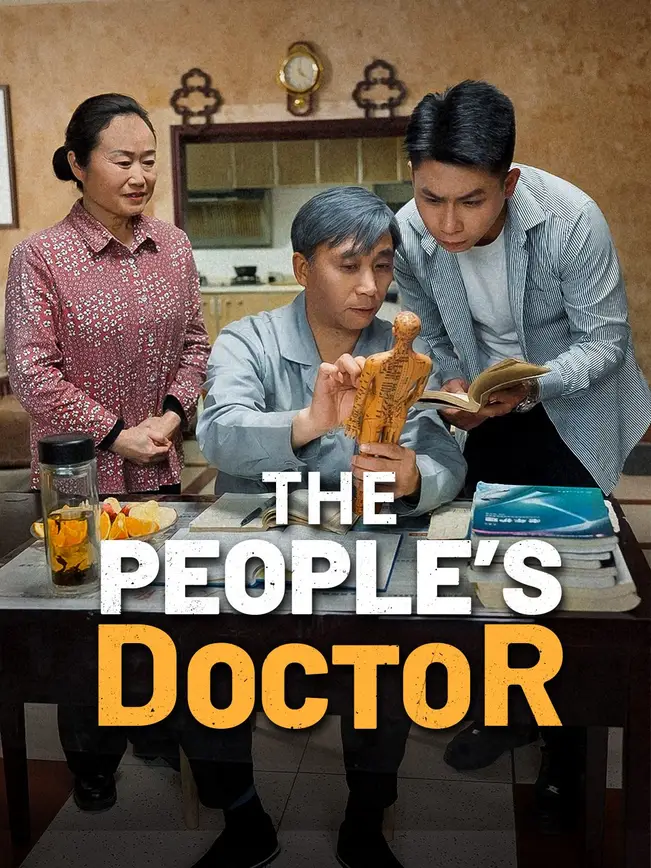
The People’s Doctor Storyline
The People’s Doctor More details
Genres:Underdog Rise/Return of the King/Men Coming-of-Age
Language:English
Release date:2024-12-10 17:00:00
Runtime:82min
A Heartfelt Tale of Redemption and Resilience
The People's Doctor is a masterclass in storytelling, weaving a tale of redemption that tugs at your heartstrings. Aaron's journey from a celebrated physician to a humble street sweeper and back to a hero is nothing short of inspiring. The chara
Medical Drama with Real Depth and Emotion
This series is more than just a medical drama; it's a profound exploration of human resilience and the power of humility. Aaron Lyle's character is beautifully crafted, showing how true genius doesn't need accolades to shine. The plot twists are
A Riveting Journey of the Unsung Hero of Medicine
Finally, a series that gives voice to the unsung heroes of medicine. Aaron Lyle's story is one of sacrifice, humility, and ultimate triumph. The People’s Doctor captures the essence of what it means to be truly dedicated to one's craft wit
Emotional Rollercoaster with a Touch of Brilliance
The People’s Doctor is an emotional rollercoaster that keeps you hooked till the end. Aaron's fall from grace and his eventual redemption is portrayed with such raw emotion that you can't help but feel every moment. The series highligh
The People’s Doctor: When Meridians Meet Money
There’s a moment in *The People’s Doctor*—just after the second handshake, when Guo Wenfeng’s grip tightens ever so slightly—that the entire room seems to inhale. Not dramatically. Not cinematically. Just… collectively. As if the air itself has recognized the shift. Lin Zhihao doesn’t pull away. He doesn’t stiffen. He simply exhales, slow and controlled, like a man releasing pressure from a valve he’s held shut for decades. That’s the genius of the series: it doesn’t rely on explosions or shouting matches. It builds tension in the space between breaths. In the way a teacup is lifted. In the hesitation before a sentence is completed. Let’s talk about the table. Not the food—though the plating is exquisite, each dish a miniature landscape of color and texture—but the *arrangement*. The abalone sits dead center, its shell polished to a dull sheen, a symbol of longevity and wealth. To its left: stir-fried shrimp, bright orange and crisp, representing vitality. To its right: a mound of black fungus and shredded carrots, earthy and grounding. The placement isn’t accidental. It’s feng shui as diplomacy. Every guest knows this. Guo Wenfeng certainly does. He doesn’t touch the abalone. He reaches instead for the shrimp—quick, decisive, almost dismissive. A man who takes what he wants, without ceremony. Lin Zhihao watches, his expression unreadable, but his fingers twitch once against the armrest of his chair. A reflex. A memory. Perhaps of a time when he, too, reached without asking. Madame Su, meanwhile, moves like a current—fluid, inevitable. She refills Guo’s water glass before he’s finished his first sip. She adjusts the napkin beside Lin’s plate, her fingers brushing the linen with the reverence of a priestess tending an altar. Her qipao rustles softly, a sound that cuts through the low murmur of conversation like a needle through silk. She speaks rarely, but when she does, her voice is honeyed, precise, each word chosen like a herb from a dried bundle. ‘The old masters said,’ she begins, and everyone stops. Even Chen Yifan, who had been scanning the room like a security detail, turns his head just a degree. Because Madame Su doesn’t quote textbooks. She quotes *people*. People who are no longer here. People whose names are etched into the banners hanging in the study later—banners that read ‘Cured the Incurable,’ ‘Saved Three Generations,’ ‘Hands That Never Tremble.’ And then there’s Xiao Mei. Oh, Xiao Mei. She’s the ghost in the machine of this elite gathering. Dressed in that pale blue dress—practical, clean, almost clinical—she stands near the service door, her posture straight, her gaze fixed on Lin Zhihao’s profile. She’s not taking notes. She’s *mapping*. Mapping the angles of his jaw when he’s skeptical, the way his eyebrows lift when he’s surprised, the minute dip of his shoulders when Guo mentions the ‘new investment fund.’ She’s learning the language of power not from lectures, but from observation. And *The People’s Doctor* gives us her perspective in fleeting cuts: a close-up of her earpiece (yes, she’s wearing one—subtle, silver, barely visible), a glance at her smartwatch vibrating silently on her wrist, a blink that lasts half a second too long when Lin finally speaks his first full sentence to Guo: ‘I’ve treated patients who walked in with nothing but hope. I’ve never treated one who walked in with a term sheet.’ That line lands like a stone in a pond. Guo Wenfeng doesn’t flinch. He smiles wider, nods slowly, as if acknowledging a clever joke. But his eyes—those sharp, intelligent eyes—narrow just a fraction. He knows he’s been named. Not accused. *Named*. And in this world, naming is the first step toward accountability. Chen Yifan shifts his weight, glancing at his superior, waiting for the cue. The younger man in the striped shirt—Li Jun—steps forward then, not aggressively, but with the quiet confidence of someone who’s been trained to intervene before the fracture becomes irreversible. He offers Guo a small ceramic cup of aged pu’er, poured from a thermos he carries like a shield. ‘For digestion,’ he says, his voice calm, neutral. Guo accepts, sips, and for the first time, his smile softens—genuinely. Not because of the tea, but because Li Jun didn’t ask permission. He acted. And in this hierarchy, action without deference is the rarest currency of all. The transition to the study is seamless, almost dreamlike. One moment, the banquet hall glows with artificial warmth; the next, the study is bathed in natural light, filtered through rain-streaked windows, the scent of old paper and camphor wood thick in the air. Lin Zhihao is no longer the host. He’s the scholar. The guardian. He sits at his desk, surrounded by stacks of books—some bound in faded blue cloth, others in leather cracked with age. A wooden anatomical model stands upright beside him, its surface worn smooth by decades of handling. Li Jun stands beside him now, not as an apprentice, but as a collaborator. He holds an open volume—‘Classical Acupuncture Theory, Vol. III’—and points to a passage, his finger tracing characters that look like constellations. Madame Su enters with the fruit tray, but this time, she doesn’t place it silently. She sets it down with a soft click, then leans in, her voice low: ‘He asked about the Xuehai point today. Said it was ‘overrated.’’ Lin Zhihao doesn’t look up. He flips a page, his thumb pressing hard on the corner. ‘Did he now?’ he murmurs. And then, for the first time, he smiles—not the polite smile of the banquet, but a real one, crinkling the corners of his eyes, revealing a dimple on his left cheek. It’s a smile of recognition. Of challenge. Because Xuehai—the Sea of Blood—isn’t just a point. It’s a philosophy. A belief that healing begins not in the organ, but in the vessel. And Guo Wenfeng, for all his polish, doesn’t understand that. Yet. *The People’s Doctor* excels at these layered contrasts: the banquet vs. the study, the public persona vs. the private ritual, the modern suit vs. the ancient text. It doesn’t vilify progress—it questions its soul. When Li Jun asks Lin why he still uses the wooden model instead of the digital hologram the clinic installed last month, Lin doesn’t answer immediately. He picks up the model, turns it in his hands, and says, ‘A hologram can show you the path. But only wood remembers the touch.’ That line—simple, poetic, devastating—is the thesis of the entire series. Medicine, in *The People’s Doctor*, is not a science to be optimized. It’s a craft to be inherited. A lineage to be honored. Even when the inheritors don’t believe in it anymore. The final sequence shows the three of them—Lin, Li Jun, and Madame Su—standing side by side at the window, looking out at the rain. No words. Just presence. The anatomical model sits on the desk behind them, catching the light. The fruit tray remains untouched. And somewhere, in another room, Guo Wenfeng is signing documents, his pen moving fast, sure, relentless. The two worlds coexist. They always have. The question *The People’s Doctor* leaves us with isn’t who will win. It’s whether the medicine can survive the men who wield it. Because in the end, the meridians don’t care about boardrooms. They only respond to hands that remember how to listen.

Men Coming-of-Age



Underdog Rise


.jpg~tplv-vod-rs:651:868.webp)


Return of the King

 Download