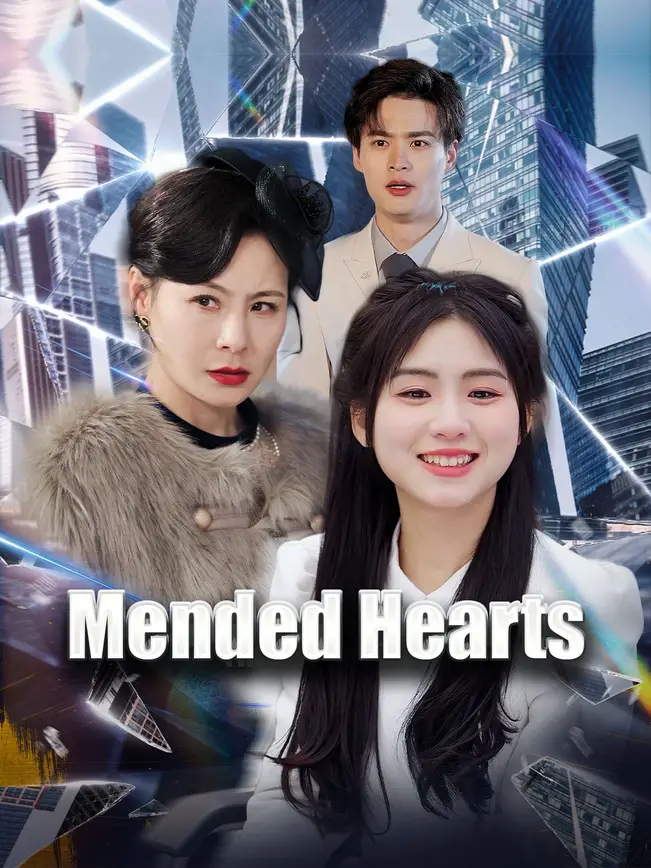
Mended Hearts Storyline
Mended Hearts More details
Genres:Modern Romance/Finding Relatives/Tragic Love
Language:English
Release date:2024-12-20 12:00:00
Runtime:100min
Mended Hearts: When Silence Speaks Louder Than Tears
The first five seconds of *Mended Hearts* are a masterclass in visual storytelling—no dialogue, no music swell, just two women caught in a collision of emotion so raw it feels dangerous to watch. The older woman—let’s call her Madame Lin, though the title never names her outright—holds the younger one, Li Xinyue, with the kind of grip that suggests both protection and restraint. Li Xinyue’s face, half-buried in Madame Lin’s fur-trimmed coat, is a study in suppressed panic: her mouth parted, her eyes darting sideways as if scanning for an exit, her fingers clutching the fabric like it’s the only thing keeping her from dissolving. This isn’t grief. It’s guilt. Or fear. Or the unbearable weight of a secret too heavy to carry alone. And Madame Lin? She doesn’t soothe. She *contains*. Her posture is upright, her chin lifted, her red lipstick immaculate—even as her own eyes glisten with something older than sorrow. She’s not comforting Li Xinyue. She’s anchoring her. Making sure she doesn’t flee. Because in *Mended Hearts*, running isn’t always cowardice. Sometimes, it’s the only way to survive until you’re ready to face what you’ve done. Then—cut to light. To stillness. To a bedroom where Zhou Yichen lies motionless under white sheets, his face slack, his breathing barely perceptible. Li Xinyue sits beside him, not crying, not praying, just *being*. Her white blouse is pristine, her hair neatly arranged, but her eyes betray her: they’re red-rimmed, exhausted, yet fiercely focused. She doesn’t look at the camera. She looks at *him*. As if her gaze alone could will him back. And then—she takes his hand. Not to check his pulse. Not to reassure herself. She places a single green leaf on his palm. Not a token. Not a metaphor. A *choice*. In that moment, *Mended Hearts* reveals its central motif: healing isn’t linear. It doesn’t begin with words. It begins with a gesture so small it could be missed—if you weren’t watching closely enough. The leaf stays there. Through close-ups of Li Xinyue’s face—her lips moving silently, her brow furrowing, her breath hitching once, then steadying. Through shots of Zhou Yichen’s hand, unmoving, the leaf resting like a tiny flag on conquered territory. Through the soft rustle of sheets as she shifts, careful not to disturb him. Every frame is saturated with golden-hour light, not to romanticize, but to *illuminate*—to show us the texture of waiting. Waiting isn’t passive in *Mended Hearts*. It’s active resistance against despair. Li Xinyue isn’t idle. She’s vigil-keeping. She’s stitching time back together, one minute at a time, with nothing but presence and a leaf that refuses to dry up. When Zhou Yichen finally stirs, it’s not dramatic. No gasp. No sudden sitting up. Just a slow blink, a faint furrow between his brows, and then—his fingers closing gently around the leaf. Li Xinyue doesn’t smile. Not yet. She watches, her expression unreadable, as if she’s waiting for the other shoe to drop. Because in this world, kindness is suspect. Love is conditional. And resurrection—especially emotional resurrection—comes with strings. But Zhou Yichen doesn’t ask questions. He doesn’t accuse. He simply turns his head toward her, his eyes still hazy, and lets his hand slide over hers. That’s when she exhales. Not relief. Recognition. *He’s still him.* The man who loved her before the fracture. The man who might love her after. Madame Lin reappears—not as an intruder, but as a witness. Dressed in lavender tweed, her fascinator tilted just so, she stands in the doorway, arms loose at her sides, watching the two of them like a curator observing a restored painting. Her expression is unreadable at first—then, slowly, a smile touches her lips. Not joyful. Not ironic. *Satisfied.* As if she’s been waiting for this exact moment since the day Li Xinyue walked into her life, trembling and guilty, clutching a suitcase and a lie. Madame Lin knows the truth about the pier in the photo on the nightstand. She knows why Zhou Yichen disappeared. She knows what Li Xinyue did to bring him back. And yet—she says nothing. Her silence is the loudest sound in the room. It speaks of forgiveness earned, not given. Of boundaries respected. Of a legacy being passed down: *This is how you love someone who’s broken. You don’t fix them. You sit with them in the wreckage until they remember how to stand.* What follows is a sequence so tender it borders on sacred. Zhou Yichen lifts his hand—not to push Li Xinyue away, but to cradle the back of her head. She leans in, resting her forehead against his shoulder, her body finally relaxing into his. He strokes her hair, his thumb brushing her temple, and for the first time, he speaks: *“You kept it.”* Not *the leaf*. Not *the promise*. *It.* The unspoken thing between them. The thing that survived the fall. Li Xinyue doesn’t answer. She closes her eyes, and a single tear escapes—not of sadness, but of release. The dam breaks, quietly. And Zhou Yichen holds her tighter, as if he’s afraid she’ll vanish if he loosens his grip. In *Mended Hearts*, intimacy isn’t defined by proximity. It’s defined by *permission*—the permission to be broken, to be silent, to be held without explanation. The final act of the clip is deceptively simple: Li Xinyue curls into Zhou Yichen’s side, her hand still clasping his, the leaf now tucked between their palms like a shared secret. Zhou Yichen’s eyes drift shut—not in exhaustion, but in surrender. To peace. To her. To the possibility that some wounds don’t scar—they transform. And Madame Lin, still standing in the doorway, turns away—not out of disapproval, but out of respect. She leaves them to it. To the slow, sacred work of rebuilding. Because in *Mended Hearts*, the most powerful acts of love are the ones no one sees. The leaf on the hand. The hand on the hair. The silence that says *I’m still here, even when you forget how to speak.* This is why *Mended Hearts* resonates beyond genre. It doesn’t traffic in grand gestures or explosive revelations. It finds drama in the space between breaths, in the weight of a held hand, in the courage it takes to stay when every instinct screams to leave. Li Xinyue isn’t a heroine because she saves Zhou Yichen. She’s a heroine because she chooses to believe in him—even when he’s gone. Even when the world tells her he’s lost. And Zhou Yichen? He’s not redeemed by her love. He’s *remembered* by it. *Mended Hearts* understands a truth many stories ignore: healing isn’t about returning to who you were. It’s about becoming someone new—someone who can hold both the brokenness and the beauty, side by side, without flinching. The leaf wilts by the end of the sequence. Its edges curl inward, brown at the tips. But it’s still green at the center. Still alive. Still *there*. And so are they. Not fixed. Not perfect. But mended. In the quietest, most human way possible.
Mended Hearts: The Leaf That Never Fell
In the opening frames of *Mended Hearts*, we’re thrust into a moment thick with unspoken tension—two women locked in an embrace that feels less like comfort and more like containment. One, adorned with a black netted fascinator and heart-shaped earrings, wears her composure like armor; the other, younger, dressed in a cream coat with soft fur trim, presses her face into the older woman’s shoulder as if trying to vanish. Her lips tremble—not from cold, but from the weight of something she can’t yet name. The camera lingers on their faces, catching the flicker of fear in the younger woman’s eyes, the practiced calm in the elder’s. This isn’t just a hug. It’s a transfer of burden. A silent plea. A surrender. And when they finally pull apart, the younger woman’s breath catches—not in relief, but in realization. She sees something in the older woman’s gaze that makes her flinch inwardly. That look says: *I know what you did. And I’m still here.* The scene shifts abruptly—not with fanfare, but with light. Sunlight, golden and forgiving, spills across white linen sheets. A man lies still, pale, his chest rising and falling with shallow rhythm. Beside him sits Li Xinyue, her long dark hair half-pinned back, her white blouse crisp but not stiff—like someone who’s chosen elegance over rigidity. Her hands rest gently on the bed, fingers interlaced, as if holding herself together. Then comes the detail that anchors the entire sequence: a single green leaf, pressed between two fingers, placed delicately on the man’s hand—Zhou Yichen’s hand. Not a flower. Not a ring. A leaf. Alive, fragile, persistent. It’s not symbolic in the cliché sense; it’s *evidence*. Evidence of a choice made in silence, of a promise whispered before words could form. In *Mended Hearts*, objects speak louder than monologues—and this leaf? It’s the first sentence of a love story written in absence. Li Xinyue doesn’t speak for nearly thirty seconds. She watches Zhou Yichen breathe. She studies the way his eyelids flutter, the slight twitch near his temple—the kind that means he’s dreaming, or remembering, or resisting waking. Her expression shifts subtly: concern, yes—but also resolve. There’s no desperation in her posture, only quiet determination. She doesn’t beg him to wake. She waits. As if time itself is bending to her patience. The room is minimal—white walls, a pendant lamp casting soft shadows, a small bouquet of orange and yellow blooms on the nightstand beside a framed photo of a pier stretching into fog. That photo matters. It’s not decorative. It’s a map. A memory. A place where things were lost—or found. When Zhou Yichen finally stirs, his fingers curl slightly around the leaf, and Li Xinyue exhales—not a sigh, but a release. A surrender to hope. She leans forward, just enough for her hair to brush the sheet, and whispers something too low for the mic to catch. But we see her lips move: *I’m still here.* Later, the older woman returns—this time in lavender tweed, a bow at her throat like a question mark, her fascinator now perched with deliberate precision. She stands at the foot of the bed, observing not with judgment, but with the weary wisdom of someone who has seen love break and mend more times than she cares to count. Her gaze moves from Zhou Yichen’s sleeping face to Li Xinyue’s bowed head, then back again. And in that glance, we understand: she knows about the leaf. She knows about the pier. She may even know why Zhou Yichen is lying here, wrapped in silence. Yet she says nothing. Instead, she smiles—a small, private thing, like she’s watching a play she helped write, but never expected to see performed so tenderly. That smile is the emotional pivot of *Mended Hearts*. It tells us this isn’t just about healing one broken heart. It’s about the generational transmission of grace—the way mothers, mentors, or even strangers become vessels for second chances. What follows is a sequence so intimate it feels voyeuristic, yet never exploitative. Zhou Yichen wakes—not fully, but enough. His eyes open slowly, clouded at first, then clearing as they land on Li Xinyue. He doesn’t speak. He lifts his hand—still holding the leaf—and places it in hers. Then, with the same hand, he reaches up, brushes a stray strand of hair from her temple, and pulls her gently toward him. She rests her head on his chest. He strokes her hair. No grand declarations. No tearful confessions. Just touch. Just presence. And in that simplicity, *Mended Hearts* reveals its true thesis: mending isn’t about erasing the crack. It’s about learning to hold the pieces so the light still gets through. The leaf remains on her finger as she sleeps beside him, now curled into his side, her breathing syncing with his. The camera pulls back, showing them bathed in morning light, the lavender-clad woman standing just outside the frame—her silhouette a quiet benediction. This is where *Mended Hearts* transcends melodrama. It refuses the easy catharsis of a shouted confrontation or a last-minute rescue. Instead, it trusts the audience to read the subtext in a held hand, the hesitation before a touch, the way a character’s shoulders relax when they finally stop fighting the inevitable. Li Xinyue’s arc isn’t about winning Zhou Yichen back—it’s about reclaiming her right to *stay*, even when the world assumes she’ll run. Zhou Yichen’s recovery isn’t measured in steps taken, but in moments of vulnerability he allows himself to feel. And the older woman? She’s the ghost in the machine—the unseen architect of this fragile peace. Her entrance isn’t disruptive; it’s *confirming*. She sees what’s been rebuilt, and she nods—not in approval, but in recognition. *Yes. This is how it’s supposed to be.* The final shot lingers on the leaf, now slightly wilted at the edges, still resting on Li Xinyue’s finger as she sleeps. It’s no longer perfect. But it’s still green. Still alive. Still *there*. That’s the quiet revolution of *Mended Hearts*: love doesn’t demand flawlessness. It asks only for continuity. For the courage to place a leaf in someone’s palm and trust them not to crush it. For the humility to accept that sometimes, healing looks less like a miracle and more like two people learning how to breathe in the same room again—without flinching. And when Zhou Yichen turns his head, just slightly, to watch Li Xinyue sleep, his expression isn’t gratitude. It’s awe. As if he’s seeing her for the first time—not as the girl who stayed, but as the woman who rebuilt him, one silent gesture at a time. That’s the real magic of *Mended Hearts*. Not that love conquers all. But that love, when tended with patience and truth, can grow back—even from the smallest, most unlikely seed.
Mended Hearts: When Laughter Cuts Deeper Than Steel
Let’s talk about the knife. Not the one Chen Kai holds—though it’s sharp, matte-black, utilitarian—but the one hidden in his laughter. In the opening frames of this Mended Hearts segment, Li Wei sits bound not by ropes, but by expectation. Her mouth is stuffed, her eyes closed, her body limp in the wheelchair, as if surrendering to the narrative everyone assumes she’s trapped in. But then Chen Kai enters, and everything fractures. He doesn’t storm in. He *glides*, leather coat whispering against the silence, his smile already in place before he even kneels. He removes the rag from her mouth with the delicacy of a surgeon, and the moment her lips part—dry, trembling, stained—he leans in, not to kiss, but to *watch*. To study. His grin widens, revealing teeth that gleam like polished bone, and he lets out a laugh that echoes off the bare walls. It’s not cruel. It’s *delighted*. As if he’s just witnessed the punchline to a joke only he understands. That laugh is the pivot point of the entire sequence. Because in Mended Hearts, danger isn’t signaled by raised weapons—it’s signaled by unrestrained joy. Chen Kai’s laughter isn’t nervous. It’s confident. Triumphant. He’s not threatening Li Wei; he’s *entertaining* her. Or perhaps, himself. The knife remains in his hand, yes—but it’s almost an afterthought, a prop he forgets to put down because the performance is too good. When he presses it lightly to her jaw, it’s not pressure—it’s punctuation. A comma in a sentence he’s composing aloud, though no words are spoken. Li Wei flinches, but not violently. Her reaction is measured: a slight intake of breath, a blink, a tilt of the head that reads less as submission and more as assessment. She’s not reacting to the blade. She’s reacting to the absurdity of the situation—and to the man wielding it with such glee. What’s fascinating is how the camera treats them. Wide shots emphasize the emptiness of the space—their isolation, the lack of witnesses. But the close-ups? They’re intimate. Too intimate. We see the sweat on Chen Kai’s temple when he laughs, the faint tremor in Li Wei’s lower lip when she tries to speak, the way his thumb brushes the edge of the knife as he talks, not to cut, but to *feel* its presence. His red polka-dot tie, crisp against the black of his suit, feels like a dare—a splash of whimsy in a world of gray. And that brooch? The silver crescent moon with the dangling pearl? It catches the light every time he moves, a tiny beacon in the gloom. It’s not decoration. It’s a signature. A declaration: *I am not what you think I am.* Then comes the phone. Not a burner. Not a flip phone. A modern smartphone, sleek and expensive, pulled from his inner pocket like a magician revealing his final trick. He taps the screen, smiles, lifts it to his ear—and suddenly, the knife is forgotten. He’s *on* now. Fully engaged in a conversation we cannot hear, but whose tone we *feel*: animated, conspiratorial, delighted. He nods, chuckles, glances at Li Wei with a wink—as if sharing an inside joke *about her*. And here’s the twist: Li Wei doesn’t look away. She watches him, her expression shifting from wary to intrigued to something colder—almost amused herself. Because she’s realizing something critical: Chen Kai isn’t in control. He’s *performing* control. The phone call isn’t external coordination; it’s self-reinforcement. He needs to hear his own voice, confirm his narrative, before he can continue the act. Mended Hearts excels at these layers. The surface story is captivity. The subtext is collaboration. The emotional truth? They’re both trapped—not by each other, but by a script they’ve inherited. Chen Kai plays the villain because it’s expected. Li Wei plays the victim because it’s safe. But in those fleeting moments when their eyes meet without the knife between them, something cracks open. A shared recognition. A mutual exhaustion with the charade. When he leans in again, whispering something that makes her eyebrows lift—not in fear, but in surprise—she doesn’t pull back. She leans *in*. Just a fraction. Enough to signal: *I’m listening. I’m still here.* The climax isn’t a fight. It’s a pause. Chen Kai stops laughing. His smile falters. For a heartbeat, his mask slips—and what’s underneath isn’t rage or lust, but vulnerability. A flicker of doubt. He glances at the phone, then back at her, and for the first time, he looks unsure. Li Wei sees it. And in that instant, she makes a choice. Not to fight. Not to flee. But to *speak*. Her lips move. No sound comes out—not yet—but her eyes lock onto his, steady, clear, unflinching. The wheelchair, the rag, the knife—they all fade into background noise. What remains is two people, finally seeing each other without the filters of role or expectation. Mended Hearts doesn’t heal wounds by stitching them shut. It heals them by revealing they were never really there to begin with. The real damage was the belief that she needed rescuing. That he needed to dominate. That love—or its absence—had to be performed with props and lighting. In this ruined room, with dust in the air and a knife still in his hand, Chen Kai and Li Wei stand on the precipice of something new: not romance, not revenge, but *recognition*. And sometimes, that’s the most dangerous thing of all. Because once you see someone clearly, you can’t unsee them. And once Li Wei speaks—really speaks—the story of Mended Hearts won’t be about captivity anymore. It’ll be about the moment the cage dissolved, and they both stepped out, blinking, into the light they’d forgotten existed.
Mended Hearts: The Knife, the Phone, and the Unspoken Truth
In a desolate, concrete-walled room—dust motes dancing in shafts of weak daylight filtering through high, grimy windows—a scene unfolds that feels less like a hostage scenario and more like a psychological theater piece staged by two actors who’ve rehearsed their roles too well. The woman, Li Wei, sits slumped in a wheelchair, her ivory qipao-style dress immaculate despite the grime of the floor beneath her wheels. Her long black hair frames a face caught between exhaustion and defiance, lips smeared with what looks like ash or dried blood, a rag stuffed into her mouth at the start—not as a gag, but almost as a prop, a visual metaphor for silencing. Then enters Chen Kai, leather coat gleaming under the sparse light, a silver brooch pinned to his lapel like a badge of ironic elegance. He kneels beside her, not with menace, but with theatrical intimacy, removing the rag with exaggerated care, as if performing a ritual rather than committing coercion. His smile is wide, teeth white, eyes alight—not with malice, but with something far more unsettling: amusement. He laughs. Not a chuckle. A full-throated, head-tilted-back laugh, the kind you hear in a bar after someone tells a joke no one else gets. And yet, he holds a knife. Not pressed to her throat—not yet—but resting against her jawline, its edge catching the light like a promise deferred. This is where Mended Hearts reveals its true texture: it’s not about violence. It’s about control disguised as affection, threat wrapped in charm. Chen Kai doesn’t speak much in these frames, but his expressions do all the talking. One moment he’s grinning, leaning in so close his breath stirs her hair; the next, his brow furrows, lips parting in mock concern, then twisting into a snarl that flashes his canines—like a dog showing teeth not to bite, but to remind you he *could*. Li Wei watches him, her eyes darting, pupils dilating—not just with fear, but with calculation. She blinks slowly, swallows hard, shifts her weight subtly in the chair. She’s not passive. She’s waiting. Waiting for the script to slip. Waiting for the mask to crack. When Chen Kai pulls out his phone—a sleek silver device, modern, incongruous against the decay around them—he doesn’t dial. He *performs* the call. He lifts it to his ear, tilts his head, mouths words silently, then grins again, as if confirming some delicious secret. The camera lingers on his fingers, still curled around the knife in his other hand. The juxtaposition is deliberate: technology and steel, connection and threat, all held in one man’s grip. What makes Mended Hearts so compelling here is how it subverts genre expectations. This isn’t a thriller where the victim screams and the villain monologues. This is a dance. A slow, tense, deeply uncomfortable waltz where every gesture carries double meaning. When Chen Kai leans in again, whispering something we can’t hear, Li Wei’s expression flickers—not terror, but recognition. A micro-expression of dawning realization, as if she’s just remembered something crucial. Her fingers tighten on the wheelchair armrest. Her posture straightens, just slightly. She’s not broken. She’s recalibrating. Meanwhile, Chen Kai’s demeanor shifts like quicksilver: from playful predator to earnest confidant to manic showman, all within ten seconds. His laughter returns, louder this time, almost hysterical, and the camera zooms in on his eyes—wide, bright, unblinking. There’s no madness there. Only focus. Precision. He knows exactly what he’s doing. And he’s enjoying it. The setting itself becomes a character. Cracked concrete, scattered debris, a discarded pipe lying like a forgotten weapon—all suggest abandonment, decay, a place where rules don’t apply. Yet Li Wei’s dress remains pristine, her hair neatly half-up, her makeup (though smudged) still present. She hasn’t surrendered her dignity; she’s holding onto it like a shield. That contrast—her refinement against the ruin—is the emotional core of Mended Hearts. It whispers: *She is not defined by this room. She is not defined by him.* Even when the knife hovers near her neck again, her chin lifts. Not in bravado, but in quiet refusal. Refusal to be reduced. Refusal to play the role he’s assigned her. And then—the phone rings. Or does it? The sound isn’t heard, only implied by Chen Kai’s sudden pause, his smile freezing mid-grin. He glances at the screen, then back at her, and for the first time, uncertainty flickers across his face. Just a tremor. But it’s enough. Li Wei sees it. Her breath catches. Her eyes narrow. In that split second, the power dynamic shifts—not dramatically, not with a bang, but with the quiet click of a lock turning. Mended Hearts thrives in these micro-moments: the hesitation before the strike, the glance that betrays intent, the silence that speaks louder than any scream. Chen Kai pockets the phone, tucks the knife away, and stands, smoothing his coat with a flourish. He’s still smiling, but now it’s tighter, edged with something new: impatience. Or perhaps, anticipation. He walks a few steps away, then turns, looking back at her—not with triumph, but with curiosity. As if he’s finally met someone who might actually change the ending. This sequence doesn’t resolve. It *suspends*. And that’s the genius of Mended Hearts. It doesn’t give us answers; it gives us questions that linger like smoke. Why is she in the wheelchair? Was she injured—or is it part of the act? Is Chen Kai truly dangerous, or is he playing a role for *her* benefit? The brooch on his lapel—a crescent moon with a teardrop pendant—feels symbolic. A reminder that even darkness can hold beauty, and even cruelty can wear elegance. Li Wei’s final look—upward, searching, lips parted—not toward escape, but toward understanding—suggests she’s piecing together a puzzle only she can solve. Mended Hearts isn’t about mending broken hearts. It’s about recognizing when the breakage was never real to begin with. The real wound was the assumption that she needed saving. She doesn’t. She’s been waiting for the right moment to speak. And when she does, the knife won’t matter anymore. The phone won’t ring. The room will fall silent—not because the threat ended, but because the game has changed. And Chen Kai, for all his flair and fury, might just be the first to realize: he’s no longer directing the scene. He’s watching it unfold. Just like us.
Mended Hearts: When Fur Meets Fury in a Factory of Forgotten Promises
There’s a particular kind of dread that settles in your chest when you realize the villain isn’t wearing black gloves or a mask—he’s wearing a brooch shaped like a crescent moon, pinned crookedly on a leather coat, and his tie has tiny white stars scattered across maroon silk. That’s Lin Zeyu in *Mended Hearts*, and oh, how he owns the screen. Not with brute force, but with volatility. Watch him in those first six seconds: leaning over Su Xiao, voice cracking like dry wood, eyes darting between her face and the edge of the frame—as if he’s expecting someone else to walk in, someone who might call his bluff. His movements are jerky, almost choreographed, like a puppet whose strings are being pulled by someone just out of shot. But here’s the twist: he *knows* he’s being watched. He *wants* to be watched. Every exaggerated gasp, every sudden tilt of the head—it’s performance art staged in a crumbling industrial tomb. The director doesn’t cut away to reaction shots. Instead, the camera stays tight on Lin Zeyu’s face, forcing us to sit with his instability, to feel the sweat bead at his temple, to notice how his left eyelid twitches when he lies. Su Xiao, seated in that wheeled office chair like a queen dethroned, doesn’t flinch when the knife grazes her jawline. Her neck is exposed, vulnerable, yet her posture remains regal—shoulders squared, spine straight, one hand resting lightly on the armrest as if she’s merely pausing during tea service. Her white qipao is immaculate, untouched by dust or fear, and that contrast is everything. In *Mended Hearts*, clothing isn’t costume; it’s armor. Her outfit says: I am not what you think I am. And when Lin Zeyu leans in, whispering something we can’t hear but can *feel*—a mix of accusation and longing—her lips part, not in fear, but in recognition. She knows him. Not as a kidnapper, but as someone who once shared her breakfast table, who laughed at her terrible jokes, who promised to protect her from the world. That’s the gut punch *Mended Hearts* delivers so quietly: the most violent moments aren’t the ones with blades—they’re the ones where memory cuts deeper. Then Madame Feng enters—not with fanfare, but with the quiet authority of someone who’s buried three husbands and still wears pearls to the funeral. Her fur coat isn’t opulence; it’s insulation against a world that’s stripped her bare. The way she adjusts her fascinator mid-stride, the slight hitch in her step as she approaches, the way her fingers brush the hem of her skirt before she kneels—that’s not hesitation. It’s ritual. She’s not pleading for Su Xiao’s life. She’s reenacting a vow she made years ago, perhaps to a different girl, in a different room, under different circumstances. And when she lifts her hands, palms up, it’s not surrender—it’s offering. An offering of herself, of truth, of consequence. The camera circles her slowly, capturing the way light catches the sequins on her blouse, the way her shadow stretches long across the concrete, merging with Lin Zeyu’s as he stares down at her. In that overlap, *Mended Hearts* whispers its central question: Can guilt be worn like jewelry? Can remorse be tailored into a coat? What follows is a sequence so tightly edited it feels like breathing underwater. Lin Zeyu’s expression cycles through five emotions in ten frames: shock, amusement, doubt, fury, and finally—something softer, almost tender—as he looks at Su Xiao not as a hostage, but as a mirror. He sees his own reflection in her eyes: the boy who swore he’d never hurt her, the man who broke that promise before breakfast. The knife, once a symbol of control, now feels heavy in his hand—too heavy. He shifts his grip, fingers slipping, and for a heartbeat, you think he’ll drop it. But he doesn’t. He raises it instead—not toward her, but toward the ceiling, as if challenging the heavens themselves. And then, in a move that redefines the entire scene, he *laughs*. Not a cruel laugh. Not a nervous one. A laugh of disbelief, of exhaustion, of sudden, staggering clarity. He’s realized something we’ve suspected since frame one: he never wanted to hurt her. He wanted her to *see* him. To see the mess, the fear, the love buried under layers of shame. That laugh is the first thread pulled in the unraveling of his facade—and in *Mended Hearts*, unraveling is how healing begins. Madame Feng rises without haste. Her knees leave the dirt, but her dignity remains intact. She doesn’t speak. She doesn’t need to. Her presence alone recalibrates the room’s gravity. Lin Zeyu lowers the knife. Su Xiao exhales—just once—and the sound is louder than any gunshot. The camera pulls back, revealing the full scope of the space: broken windows, rusted beams, a single green plant pushing through a crack in the floor. Life persists. Even here. Even now. *Mended Hearts* doesn’t resolve the conflict with dialogue or deus ex machina. It resolves it with silence, with touch, with the quiet understanding that some wounds don’t scar—they transform. Lin Zeyu will likely face consequences. Su Xiao will carry this day in her bones. Madame Feng will return to her world of fur and pearls, forever altered. But none of them are the same person they were when the video began. And that, dear viewer, is why *Mended Hearts* lingers long after the screen fades to black. It doesn’t give answers. It gives aftermath. And in a world obsessed with closure, aftermath is the rarest, most honest gift of all.

Tragic Love


Finding Relatives

Modern Romance
 Download