




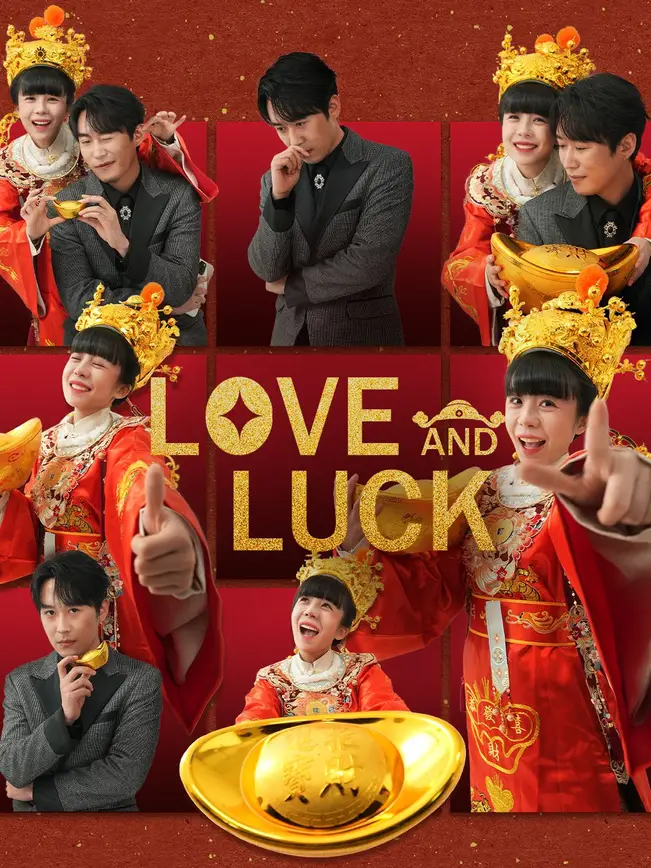
Love and Luck Storyline
Love and Luck More details
Love and Luck: When Deities Clock In Late
There’s a particular kind of modern dread that surfaces when you’re dressed as a deity, seated at a desk cluttered with fiscal documents, and the divine appointment system shows ‘Late Arrival’ in glowing neon font. That’s the exact emotional precipice where *Love and Luck* begins—not with fanfare, but with fog, a vintage monitor, and Su NianNian’s exasperated sigh. She isn’t lounging on clouds or riding a carp; she’s trapped in a white-walled studio, surrounded by symbolic props that feel less like sacred artifacts and more like IKEA purchases labeled ‘For Ritual Use Only’. The orange pom-poms on her crown bob with each frustrated headshake; the embroidered koi on her robe seem to swim upward in protest. Her performance is masterful precisely because it’s *understated*: no booming voice, no lightning bolts—just a young woman trying to uphold cosmic responsibility while her tech keeps buffering. When she raises a finger to her lips, shushing an unseen entity, it reads less like divine command and more like a junior analyst reminding her boss to mute himself before the client call. That’s the genius of *Love and Luck*: it demystifies divinity by making it *relatable*, even mundane. Su NianNian isn’t failing at being a god—she’s succeeding at being human *while* playing one. Meanwhile, Lin Zhi operates in a parallel reality of polished minimalism. His apartment is a temple of restraint: neutral tones, geometric furniture, a single white horse statue standing sentinel beside a cardboard box overflowing with snacks—the same snacks that later appear on Su NianNian’s monitor. The visual echo is deliberate, a cinematic wink suggesting that their worlds are already entangled, even before the plot confirms it. Lin Zhi’s ritual is methodical, almost clinical: he cleans his hands with deliberate slowness, as if preparing for surgery; he selects incense sticks with the care of a sommelier choosing vintage wine; he places the censer on a dark wood table with the precision of a watchmaker aligning gears. There’s no chanting, no bells—just silence, breath, and the soft crackle of flame. His attire reinforces this duality: the white blazer signals modernity, the patterned scarf hints at heritage, the pocket square folded into a perfect triangle speaks of control. Yet his eyes, when he finally looks up, betray vulnerability. He’s not performing piety; he’s *hoping*. Hoping that the universe notices his effort. Hoping that the snacks he bought aren’t just junk food, but offerings with intent. In *Love and Luck*, belief isn’t shouted—it’s whispered into the grain of rice in the censer, pressed into the crease of a suit sleeve, typed into a chat window that may or may not be monitored by higher powers. The turning point arrives not with a bang, but with a pixelated face on a CRT screen. Su NianNian’s expression shifts from irritation to intrigue to something softer—curiosity, perhaps, or the first flicker of recognition. Lin Zhi, on the other side, watches her react, his own posture relaxing infinitesimally. They’re communicating without syntax, through micro-expressions and spatial awareness: she tilts her head left, he mirrors it right; she taps the desk twice, he nods once. It’s a language older than words, built on rhythm and reciprocity. The camera lingers on details that ground the surreal: the dust motes dancing in the studio light, the slight wobble of the golden ingot as she shifts in her chair, the way her sleeve catches on the edge of the keyboard. These aren’t flaws—they’re proof of presence. *Love and Luck* thrives in these imperfections, using them to argue that authenticity resides not in perfection, but in the willingness to show up, even when you’re underdressed for the occasion (spiritually speaking). The transition from studio to garden is handled with elegant disorientation. One moment, Su NianNian is framed by white walls and artificial mist; the next, she steps through a brick archway into sunlight, vines curling around the doorframe like living embroidery. The shift isn’t magical realism—it’s *emotional* realism. She’s no longer performing for the camera; she’s moving toward someone who sees her not as Caishen, but as Su NianNian. Lin Zhi meets her not with ceremony, but with a smile that starts in his shoulders and travels upward, lighting his face from within. Their embrace is brief but charged: her hand on his arm, his fingers brushing the edge of her sleeve, the golden ingot held between them like a shared secret. The ingot isn’t a trophy; it’s a covenant. In Chinese cosmology, the ingot symbolizes not just wealth, but *accumulated virtue*—the idea that prosperity flows to those who act with integrity. By presenting it together, they acknowledge that luck isn’t random; it’s earned through alignment, through showing up, through choosing connection over isolation. The final pose—arm linked, smiles genuine, background softly blurred—isn’t staged for Instagram; it’s the natural conclusion of two people who’ve navigated the absurdity of modern devotion and found, against all odds, a harmony that feels both ancient and urgently new. *Love and Luck* doesn’t promise riches; it promises resonance. And in a world drowning in noise, that might be the rarest currency of all. Su NianNian and Lin Zhi don’t need miracles. They’ve already created one—between a monitor and a censer, between a crown and a blazer, between lateness and love.
Love and Luck: The Crowned Clerk’s Digital Summoning
In a world where tradition collides with the hum of outdated CRT monitors, *Love and Luck* emerges not as a mere romantic comedy but as a surreal allegory of modern spiritual anxiety—where divine punctuality is measured in milliseconds and blessings are delivered via pixelated video call. The opening scene sets the tone with mist swirling around a wooden chair like incense smoke, yet the desk holds a Samsung SyncMaster 763m monitor, a relic from the early 2000s, its beige casing whispering of corporate drudgery. Seated before it is Su NianNian, dressed in full Caishen (God of Wealth) regalia—vibrant red silk embroidered with golden koi and phoenixes, a towering gold crown studded with pom-poms and mythical beasts, her expression oscillating between bureaucratic impatience and childlike bewilderment. She taps her fingers on the keyboard, not typing, but *waiting*. A holographic notification flickers above her head: ‘Caishen 5927 Su NianNian — Late Arrival’. It’s absurd, yes—but also painfully familiar. How many of us have stared at a Zoom screen, waiting for the ‘important person’ to join, while our own costume of professionalism feels increasingly theatrical? Su NianNian isn’t just late; she’s *overdue*, and the universe has sent a digital reminder. Her gestures—pointing at the screen, puffing her cheeks, glancing left and right as if checking for witnesses—reveal a character caught between divine duty and mortal embarrassment. She’s not a deity descending from heaven; she’s a gig-economy god, contracted by fate, clocking in with a login and a sigh. The camera then tightens on her face, revealing the delicate craftsmanship of her attire: the white fur collar, the layered necklaces bearing coin motifs, the subtle shimmer of sequins catching studio light. Yet her eyes betray fatigue—not of age, but of repetition. This isn’t her first summoning. She’s seen the same office setup before: the yellow ingot-shaped ornament perched precariously atop the monitor, the miniature treasure chest beside a pen holder, the dried berries and decorative branches evoking Lunar New Year without ever quite committing to authenticity. Everything is *almost* sacred, *almost* ceremonial—yet grounded in the banality of paperwork. A document lies open on the desk, partially obscured, bearing the characters ‘有限公司’—‘Co., Ltd.’—a quiet indictment of how even divinity must file incorporation papers. When the monitor suddenly flashes with a cascade of snack bags—Lay’s, Doritos, colorful packets tumbling in chaotic abundance—it’s less a miracle and more a glitch in the cosmic supply chain. Su NianNian’s reaction is priceless: wide-eyed disbelief, then reluctant acceptance, as if she’s been handed a bonus she didn’t earn but won’t refuse. That moment encapsulates *Love and Luck*’s central tension: the gap between expectation and delivery, between ritual and reality. Cut to the second narrative thread: Lin Zhi, impeccably dressed in a cream double-breasted blazer over a patterned scarf and black shirt, moving through a minimalist luxury apartment. His world is clean, curated, silent—except for the faint rustle of rice grains as he carefully inserts a red-tipped incense stick into a brass censer filled with uncooked white rice. The gesture is precise, reverent, almost surgical. He doesn’t bow dramatically; he *adjusts his cuff*, then lights the stick with a small red lighter, his focus absolute. This isn’t superstition—it’s intentionality. Lin Zhi isn’t praying to an abstract force; he’s negotiating with causality itself. Behind him, a large red banner hangs on the wall: ‘Caishen Dao’—‘The God of Wealth Arrives’—flanked by vertical couplets promising prosperity and auspicious fortune. But the irony is thick: the banner is printed, laminated, mass-produced, while his ritual is handmade, intimate, personal. He places offerings—a small golden pagoda, a ceramic horse, a box of snacks identical to those on Su NianNian’s screen—on a low table, arranging them with the care of a curator. When he finally looks up, directly into the camera, his expression shifts from solemnity to mild confusion, then dawning realization. He’s not speaking to the audience; he’s speaking to *her*. And she’s watching him—through the monitor. The intercutting becomes the film’s heartbeat. Su NianNian leans forward, mouth slightly open, as Lin Zhi appears on her screen—not live, but recorded, or perhaps transmitted across dimensions. Their dialogue is never heard, yet their expressions tell everything: her hopeful tilt of the head, his hesitant nod, the way she touches her chin, then points emphatically at the screen, as if issuing a divine directive. In one sequence, she mimes handing him something—perhaps a blessing, perhaps a receipt—and he mirrors the motion, palms up, receiving air. It’s choreographed telepathy, a dance of mutual recognition across technological and metaphysical divides. The editing refuses to clarify whether this is magic, VR, or shared delusion—because in *Love and Luck*, the distinction doesn’t matter. What matters is the *desire* to connect, to align luck with love, to make the irrational feel rational through repetition and ritual. The climax arrives not with thunder, but with a soft knock. Su NianNian rises, her robes swishing, and walks toward a grand arched doorway adorned with red couplets and a ‘Fu’ character—blessing—stuck to the glass. She opens the door. Lin Zhi stands there, no longer in the apartment, but in a sun-dappled garden path, greenery framing him like a stage set. He smiles—not the polite smile of earlier scenes, but one that reaches his eyes, crinkling the corners, unguarded. She steps out, holding a massive golden ingot, its surface engraved with dragons and the character ‘Cai’—wealth. Their reunion is tender, wordless, physical: she loops her arm through his, rests her head against his shoulder, and he responds by clasping her hand over the ingot, as if sealing a contract written in gold and trust. The final shot lingers on their joined hands, the ingot gleaming between them, the background softly blurred—nature, architecture, time all dissolving into this single point of contact. *Love and Luck* isn’t about getting rich; it’s about being *seen* in your ridiculous, ornate, earnest attempt to invite grace into a world that runs on Wi-Fi and spreadsheets. Su NianNian and Lin Zhi don’t conquer fate—they collaborate with it, one incense stick, one keystroke, one shared glance at a time. And in that collaboration, they find something rarer than gold: synchronicity. The kind that makes you believe, just for a moment, that maybe the universe *does* have a sense of humor—and a very specific dress code.
Love and Luck: When the Hoodie Speaks Louder Than Words
There’s a particular kind of pain that doesn’t scream—it settles. Like dust on a forgotten shelf. Like the faint gray stain on Mei Ling’s hoodie in *Love and Luck*, visible only when the light hits just right. That stain isn’t accidental. It’s narrative. It tells us she’s been on the ground before. Not once. Not twice. Often enough that she knows how to rise without fanfare, how to stand without demanding attention. And yet—when Chen Wei finally reaches for her, it’s not her resilience that breaks the scene open. It’s her surrender. Not weakness. Surrender as trust. As permission. As the quietest revolution. Let’s talk about the bridge. Not the structure, but the metaphor. Elevated, exposed, functional—yet emotionally liminal. People cross it daily without thinking. But in *Love and Luck*, it becomes a threshold. Lin Xiao arrives already positioned—leaning against the railing, one foot slightly ahead, as if she owns the pavement. Her white coat gleams under the overcast sky, a visual contrast to Mei Ling’s muted gray. But color isn’t morality here. Lin Xiao’s pearl necklace catches the light like a challenge. Her earrings swing with every sharp turn of her head. She’s performing grief, or betrayal, or outrage—hard to tell, because her emotions are calibrated for effect. She points at Chen Wei. Not accusatorily, at first. Almost… disappointed. As if he’s failed a test she didn’t know she’d set. And Chen Wei? He doesn’t deny. Doesn’t explain. He just watches her, his expression a study in restraint. His coat is unbuttoned, revealing the black hoodie beneath—a detail that matters. He’s dressed for comfort, not confrontation. Which means he didn’t expect this. Or maybe he did, and chose to come anyway. The real turning point isn’t when the enforcers arrive—it’s when Mei Ling lifts her head. Not to glare. Not to plead. Just to look. Her eyes meet Chen Wei’s, and something shifts in his posture. His shoulders drop half an inch. His breath steadies. That’s when you realize: he’s been waiting for her to decide. Not him. *Her*. Because in *Love and Luck*, agency isn’t handed out. It’s reclaimed. Piece by piece. Mei Ling’s walk toward him is slow, deliberate—each step a refusal to be erased. The camera tracks her from behind, emphasizing how small she seems against the vastness of the city, the height of the overpass, the severity of Lin Xiao’s stance. But small doesn’t mean insignificant. In fact, her size becomes her power. She doesn’t tower over anyone. She occupies space quietly, insistently. And when she stops before Chen Wei, the air changes. Lin Xiao’s voice cuts off mid-sentence. The enforcers hesitate. Even the wind seems to pause. Then—the touch. Chen Wei’s hand on her elbow. Not possessive. Not corrective. Just… there. Anchoring. And Mei Ling doesn’t pull away. She leans. Not heavily, but with intention. Her forehead brushes his chest. His arms close around her—not tightly, but firmly, like he’s afraid she might vanish if he loosens his grip even slightly. The hug lasts longer than necessary. Longer than polite. Long enough for the audience to feel the weight of it. Her face, half-hidden, shows no tears—not because she’s numb, but because she’s conserving emotion. She’s storing it. For later. For when she’s safe. Chen Wei’s whisper is lost to the wind, but his lips press near her ear, and her eyelids flutter—not in relief, but in recognition. She knows that voice. She knows that touch. This isn’t new. It’s return. What’s brilliant about *Love and Luck* is how it subverts the ‘damsel’ trope without fanfare. Mei Ling isn’t rescued. She’s *chosen*. And Chen Wei doesn’t save her—he *sees* her. Even when she’s on the ground, even when she’s silent, even when the world treats her as background noise, he registers her. His gaze lingers. His hesitation isn’t doubt—it’s respect. He won’t speak for her. He won’t fight *her* battle. He’ll stand beside her, and if she reaches for him, he’ll hold her. That’s the love in *Love and Luck*: not grand gestures, but micro-decisions. The choice to turn toward instead of away. To touch instead of retreat. To believe in someone’s worth, even when they’re covered in dust and doubt. Lin Xiao’s exit is telling. She doesn’t storm off. She walks—back straight, chin high—but her pace is slower than before. She glances once over her shoulder. Not at Chen Wei. At Mei Ling. And in that glance, we see the crack: not jealousy, not anger, but confusion. Because she expected a collapse. A breakdown. A plea. What she got was quiet strength. And that unsettles her more than any argument could. The enforcers follow, silent, professional—but their body language has shifted. Less certainty. More assessment. They’re recalibrating. Because Mei Ling didn’t win by shouting. She won by existing, fully, in the space Chen Wei made for her. The final shot lingers on their embrace—not from afar, but close, intimate, almost intrusive. We see the texture of her hoodie, the frayed cuff, the way his thumb strokes her back in slow circles. We see her fingers curl slightly against his side, not clutching, but holding on—like she’s memorizing the shape of him. *Love and Luck* understands that trauma doesn’t vanish with a hug. But safety? Safety can begin there. In the space between two heartbeats, synchronized despite the chaos around them. This isn’t romance as escape. It’s romance as resistance. Mei Ling’s gray hoodie becomes a banner. Chen Wei’s beige coat, a shield. And the bridge? It’s no longer just concrete and steel. It’s where love, against all odds, chooses to take root. Not loudly. Not perfectly. But stubbornly. And that’s why *Love and Luck* sticks with you long after the screen fades—the realization that sometimes, the most radical act is simply letting yourself be held, while the world watches, and wonders how such quiet courage is possible.
Love and Luck: The Bridge Where Lies Shattered
The opening shot of *Love and Luck* captures a moment suspended between cruelty and compassion—a paved walkway beneath a concrete overpass, the city skyline blurred by haze, as if the world itself is holding its breath. At the center stands Lin Xiao, draped in a white fur-trimmed coat that screams wealth but feels hollow against the chill of the scene. Her black dress underneath is elegant, severe—like her posture, like her voice when she speaks. She grips a hairbrush like a weapon, not for grooming, but for accusation. Beside her, Chen Wei wears a beige coat over a black hoodie, his expression unreadable at first, then slowly cracking under pressure. His hands stay still, but his eyes flicker—between Lin Xiao’s rage, the kneeling figure on the ground, and something deeper, something unspoken. That figure is Mei Ling, small in a gray hoodie stained with dirt, knees pressed into the tiles, head bowed, hair half-tied, bangs shielding her face like armor. She doesn’t cry out. She doesn’t beg. She just sits there, absorbing the storm. What makes this sequence so gripping isn’t the shouting—it’s the silence that follows each outburst. Lin Xiao’s tirade isn’t random; it’s rehearsed, precise. Every gesture—the way she flings her arm toward Chen Wei, the way she steps forward only to halt mid-stride—suggests performance. She wants witnesses. And they arrive: two men in dark suits, sunglasses even in daylight, moving in like shadows given form. Their entrance shifts the power dynamic instantly. They don’t speak. They simply position themselves behind Lin Xiao, one placing a hand lightly on her shoulder—not comforting, but anchoring. It’s a subtle reminder: she’s not alone. She’s backed. Chen Wei notices. His jaw tightens. He doesn’t flinch, but his fingers twitch at his side. He knows what’s coming. Then comes the pivot. Not from Lin Xiao, not from the enforcers—but from Mei Ling. She rises. Slowly. Deliberately. No stumble, no hesitation. Her hoodie sleeves hang loose, her pants slightly smudged, but her stance is steady. She walks—not away, not toward Lin Xiao, but straight to Chen Wei. The camera lingers on her back as she moves, the faint red smudge on her sleeve catching light like a wound. Chen Wei watches her approach, his expression shifting from guarded neutrality to something raw, almost startled. When she stops before him, he doesn’t reach out immediately. He waits. And in that pause, *Love and Luck* reveals its true tension: it’s not about who’s right or wrong. It’s about who dares to choose. He touches her arm. Gently. A question, not a command. She turns her head—just enough to let him see her eyes. Red-rimmed, yes, but clear. Not broken. Not begging. Just… waiting. Then she leans in. Not into his chest, not for safety—but into his space, as if claiming it. And he folds around her. The hug isn’t theatrical. It’s quiet. His arms wrap low, firm, one hand resting just above her hip, the other cradling the back of her neck. She buries her face against his collarbone, her breath uneven, but her body doesn’t shake. She holds herself together. Meanwhile, Lin Xiao freezes. Her mouth opens, then closes. The hairbrush dangles uselessly at her side. The enforcers shift, uncertain. For the first time, she looks unsure—not angry, not dominant, but exposed. Because love, in *Love and Luck*, isn’t declared in speeches. It’s enacted in proximity. In touch. In choosing someone *despite* the spectacle. The bridge becomes a stage, yes—but not for drama. For reckoning. Chen Wei doesn’t defend Mei Ling with words. He defends her with presence. With silence. With the weight of his body shielding hers from the wind, from the stares, from the judgment raining down from Lin Xiao’s polished heels. And Mei Ling? She doesn’t need to justify herself. Her dignity isn’t in her clothes or her posture—it’s in the way she lets herself be held without shrinking. That’s the core of *Love and Luck*: truth doesn’t always shout. Sometimes it whispers against a collarbone, while the world watches, stunned, as the script flips in real time. The city looms behind them, indifferent. Cars rush overhead. But here, on this narrow path, time slows. Chen Wei murmurs something—inaudible, but his lips move close to her temple. She nods once. A tiny motion. Enough. The enforcers step back. Lin Xiao turns away, not in defeat, but in recalibration. She’ll return. She always does. But for now, the bridge belongs to two people who chose each other in the middle of a storm. *Love and Luck* doesn’t promise happy endings. It promises moments—raw, fragile, fiercely human—where luck isn’t random. It’s chosen. Again and again. And in those choices, we see ourselves: not as heroes or villains, but as people standing on bridges, deciding who we’ll hold onto when the world tries to pull us apart. That’s why *Love and Luck* lingers. Not because of the conflict—but because of the quiet courage in the embrace after.
Love and Luck: When Fortune Wears Red and Glasses
Let’s talk about the elephant—or rather, the bearded, crown-wearing, ingot-hoisting deity—in the room: Cai Shen’s cameo in *Love and Luck* isn’t just a gimmick. It’s a narrative detonator. The scene unfolds on an ordinary urban overpass—tiled walkway, blue railings, distant skyscrapers blurred by haze—where Li Wei and Xiao Man are locked in that delicate pre-conversation silence couples know too well: the kind where every breath feels like a decision. She’s wearing a grey hoodie, slightly rumpled, hair half-tied, eyes downcast. He’s in a cream coat, sleeves pushed up just enough to reveal a black zip-up underneath—a detail that screams ‘I tried, but not too hard.’ They’re not arguing. They’re not reconciling. They’re *waiting*. Waiting for the right words. Waiting for the world to stop spinning long enough to let them speak. And then—*poof*—reality glitches. Not with thunder or lightning, but with golden mist and the soft crunch of embroidered silk on concrete. Cai Shen enters stage left, not with fanfare, but with the quiet confidence of a man who’s done this a thousand times before and is mildly annoyed that no one’s offering him tea. His costume is textbook mythological cosplay—vibrant red robe stitched with golden dragons, a crown heavy with pom-poms and faux pearls, the kind of headpiece that says ‘I am important, please do not question my authority.’ But Zhang Hao’s performance elevates it beyond parody. His eyes, magnified behind thick black frames, hold a weary kindness. His beard, meticulously groomed, sways slightly as he speaks—not in booming proclamations, but in measured, almost conversational tones. He doesn’t address them as ‘mortals’ or ‘believers.’ He addresses them as *people*. And that’s where the tension crackles. Xiao Man, initially startled, doesn’t recoil. She tilts her head, studies him, and for a beat, her expression is pure anthropological interest—as if she’s encountered a rare species of street performer and is deciding whether to tip or report him. Then, something shifts. Her gaze drops to the ingot. Not with greed. With recognition. The ingot isn’t just gold; it’s a mirror. It reflects the city skyline, the bridge, their own distorted faces—reminding them that fortune isn’t a thing you receive, but a lens through which you reinterpret what you already have. Li Wei, meanwhile, stands slightly behind her, his posture protective but not possessive. He doesn’t interrupt. He doesn’t scoff. He watches Cai Shen with the quiet intensity of someone who’s seen enough strange things to know that strangeness often carries truth. When Xiao Man finally speaks—her voice soft, hesitant, yet clear—she doesn’t ask for riches. She asks, ‘Is it real?’ Not ‘Can I have it?’ but ‘Is this *true*?’ That question is the pivot of the entire sequence. Cai Shen pauses. He blinks. He adjusts his grip on the ingot, and for the first time, his expression wavers—not with doubt, but with something deeper: empathy. He knows the weight of that question. He’s heard it whispered in temples, shouted in stock exchanges, murmured in hospital rooms. *Love and Luck*, at its core, isn’t about manifesting wealth. It’s about surviving uncertainty. And in that moment, Cai Shen becomes less a god and more a witness—a fellow traveler who’s also stood on the edge of belief, wondering if the next step will be solid ground or thin air. The visual language here is masterful. The camera alternates between tight close-ups—Xiao Man’s trembling lips, Li Wei’s furrowed brow, Cai Shen’s knuckles white around the ingot—and wide shots that dwarf them all beneath the looming bridge. The architecture becomes a character: cold, geometric, indifferent. Yet within that indifference, intimacy blooms. When Xiao Man finally smiles—not at Cai Shen, but at Li Wei—it’s the first genuine warmth in the scene. Her hands, previously clenched or clasped, now relax. She reaches out, not for gold, but for his sleeve. A tiny gesture. A monumental shift. And Li Wei, in response, doesn’t pull away. He lets her touch him. He lets her anchor herself. That’s the real blessing Cai Shen delivers: not money, but permission—to hope, to trust, to believe that love, when paired with luck, doesn’t need a golden ingot to shine. The final frames show them walking away, side by side, the overpass stretching ahead. The city hums. The wind stirs Xiao Man’s hair. And somewhere, offscreen, Cai Shen sighs, adjusts his crown, and vanishes into the afternoon light—leaving behind not treasure, but transformation. Because in *Love and Luck*, the greatest fortune isn’t found in a mythical hoard. It’s found in the courage to stand together, even when the world feels like it’s built on shifting concrete. And that, friends, is why we keep watching.
Love and Luck: The Golden Intruder on the Overpass
There’s something quietly unsettling about a love story that begins not with a glance across a coffee shop, but with a sudden burst of golden smoke and a man in imperial red robes holding a giant ingot. That’s exactly how *Love and Luck* opens its latest episode—on a sun-drenched overpass where the city hums in the background like a distant lullaby, indifferent to the emotional tremors unfolding beneath the concrete arch. Li Wei and Xiao Man stand close, wrapped in a quiet intimacy that feels both tender and fragile—Li Wei’s beige coat draped protectively around Xiao Man’s shoulders, her grey hoodie slightly stained, as if she’s been through more than just a morning walk. Their posture suggests comfort, yes—but also hesitation. They’re not speaking. Not yet. And then, like a glitch in reality, the air shimmers. A figure emerges—not from behind a pillar or a passing bus, but seemingly *from* the light itself. Enter Cai Shen, the God of Wealth, played with deadpan sincerity by actor Zhang Hao: thick black beard, round glasses perched precariously on his nose, ornate crown bobbing with each step, and that absurdly oversized golden ingot cradled like a sacred relic. His entrance isn’t grandiose; it’s almost bureaucratic. He doesn’t bow. He doesn’t chant. He simply walks forward, eyes fixed, mouth slightly open—as if mid-sentence, mid-blessing, mid-awkward interruption. What follows is less a divine blessing and more a psychological ambush. Xiao Man’s expression shifts like weather: first confusion, then wary curiosity, then a flicker of hope so brief it might be imagined. Her hands, initially tucked into her hoodie pockets, slowly rise—not in fear, but in instinctive reverence. She clasps them together, palms pressed, fingers interlaced, the universal gesture of supplication. Yet her eyes never leave Cai Shen’s face. There’s no awe, only assessment. Is this real? Is this a prank? Is this… opportunity? Meanwhile, Li Wei remains stoic, though his jaw tightens ever so slightly when Cai Shen speaks—his voice low, rhythmic, almost incantatory, though the subtitles (if we had them) would likely reveal nothing more profound than ‘May fortune find you where you least expect it.’ The irony is thick: here they are, two people who’ve clearly shared hardship—the stain on Xiao Man’s hoodie, the way Li Wei’s coat hangs slightly too large, the subtle wear on their shoes—all standing before a deity of abundance, as if wealth were a door that could be knocked on and opened with proper etiquette. The brilliance of *Love and Luck* lies not in spectacle, but in subtext. Cai Shen doesn’t grant wishes. He *observes*. He holds the ingot aloft, not to bestow, but to provoke. Each time he lifts it, golden particles drift like pollen in sunlight—beautiful, transient, meaningless unless caught. Xiao Man watches those particles rise, her lips parting in silent wonder, then closing again in resolve. She doesn’t ask for money. She doesn’t beg for luck. Instead, she turns to Li Wei—not with desperation, but with quiet urgency—and points upward, toward the sky, toward the bridge’s steel skeleton, toward something only she seems to see. That gesture is the heart of the scene: it’s not about receiving fortune, but about *recognizing* it already present—in his hand on her shoulder, in the way he leans just slightly toward her when she speaks, in the shared silence that feels heavier than any spoken vow. *Love and Luck*, after all, isn’t about choosing between romance and prosperity. It’s about realizing they’re the same currency, minted in moments like this: suspended between disbelief and belief, between the mundane and the miraculous. Later, when Cai Shen vanishes—not with a bang, but with a soft fade into the glare of the afternoon sun—Xiao Man doesn’t rush to check her pockets or scan the pavement for dropped coins. She looks at Li Wei, really looks, and smiles—not the wide, performative grin of someone who’s won, but the slow, dawning smile of someone who’s finally understood the rules of the game. Li Wei, for his part, doesn’t smile back immediately. He studies her face, as if memorizing the exact shade of relief in her eyes, the way her shoulders drop just a fraction. He knows what she’s thinking. He’s thinking it too. Because *Love and Luck* has always been less about external blessings and more about internal alignment. The overpass isn’t just a location; it’s a threshold. Below it, traffic rushes—cars, buses, lives in motion, indifferent. Above it, the sky stretches, pale and forgiving. And between them, two people, standing still, choosing to believe—not in gods or gold, but in each other. The final shot lingers on Xiao Man’s hands, now unclasped, resting lightly at her sides. No prayer. No plea. Just presence. And in that presence, the most valuable ingot of all: the certainty that whatever comes next, they’ll face it not as supplicants, but as partners. That, dear viewers, is the real magic of *Love and Luck*—not the glitter, but the gravity.
Love and Luck: When the Bin Speaks Louder Than Words
Let’s talk about the bin. Not metaphorically. Literally. The stainless-steel, dual-compartment public recycling unit positioned like a silent judge on the wooden pier—this is where *Love and Luck* pivots. Not in boardrooms, not in luxury sedans, not even in the quiet intensity of two men staring at a skyline they’ve both helped shape and resent. No. The truth spills out beside that bin, in the dust and discarded wrappers, in the desperate reach of a girl named Xiao Man whose hoodie smells faintly of rain and instant noodles. She’s not a plot device. She’s a pressure valve. And when she leans into that bin, her hair falling forward like a veil, the entire narrative holds its breath. Because what she’s searching for isn’t physical. It’s proof. Proof that something was left behind. Proof that she wasn’t imagining the conversation, the promise, the slip of a phone number tucked into a napkin that vanished two days ago. The bin is her oracle. And it’s lying to her. Meanwhile, Lin Zeyu rides past in a black Mercedes, tinted windows reflecting the city’s indifference. He sees her. We know he sees her because the camera lingers on his profile—jaw tight, eyes narrowed just enough to register detail without engagement. He doesn’t slow down. Doesn’t gesture. Doesn’t think about stopping. And yet—his finger taps once, twice, against the armrest. A rhythm. A habit. A betrayal of his own stillness. That tap is louder than any dialogue in the scene. It’s the sound of a man realizing he’s been recognized, not by sight, but by *vibe*. Xiao Man’s desperation radiates like heat haze. It’s detectable. Even from thirty feet away, through reinforced glass. Chen Wei, seated beside him, notices the tap. He doesn’t comment. He just exhales, slow and measured, like he’s deflating a balloon he didn’t know he was holding. That’s their dynamic in microcosm: Chen Wei names the unspoken; Lin Zeyu embodies it. In *Love and Luck*, communication isn’t verbal—it’s kinetic. A shift in posture. A delayed blink. A hand hovering over a door handle. These are the sentences they speak. Then Li Tao enters, all floral chaos and misplaced confidence. His shirt—a riot of red roses and teal leaves—is a direct insult to the film’s otherwise restrained palette. He doesn’t walk; he *arrives*. And when he spots Xiao Man wrestling with the bin, he doesn’t offer help. He offers judgment. ‘You’re gonna get germs on your sleeves,’ he says, voice dripping with faux concern. She ignores him. So he escalates: ‘That thing’s been touched by pigeons and regret. Let me handle it.’ She finally looks up. Not angry. Tired. ‘It’s not yours to handle,’ she replies, flat. And that’s when it clicks—for us, for Li Tao, maybe even for Lin Zeyu, still watching from the car. This isn’t about trash. It’s about agency. Xiao Man isn’t digging for garbage. She’s digging for dignity. For the right to believe, just for a moment, that her effort meant something. Li Tao, surprisingly, gets it. His smirk fades. He crouches beside her, not to take over, but to *witness*. ‘Show me where you looked,’ he says. She points. He checks. Finds nothing. Nods. ‘Okay. Then it’s not here.’ Not ‘You’re wrong.’ Not ‘Give up.’ Just: ‘It’s not here.’ That’s the kindness *Love and Luck* traffics in—not grand gestures, but precise acknowledgments. The kind that leave room for the person to choose their next move. The group that forms around the bin—Xiao Man, Li Tao, and two bystanders who drift over out of curiosity (one in denim, one in a dark jacket)—becomes a micro-society. They don’t introduce themselves. They don’t exchange numbers. They just stand, arms crossed or hands in pockets, orbiting the bin like it’s a campfire. The denim guy asks, ‘Did you lose something important?’ Xiao Man hesitates. Then: ‘Something I thought was mine.’ Li Tao snorts. ‘Most things we think are ours turn out to be loans.’ The dark-jacketed man nods slowly, like he’s heard that before. And in that exchange, *Love and Luck* reveals its thesis: ownership is fragile. Memory is unreliable. But presence—that’s negotiable. You can choose to stay. You can choose to look. You can choose to hand someone a green bag when they’re too exhausted to carry it themselves. What’s brilliant about this sequence is how it subverts expectation. We’re conditioned to believe the powerful man in the car is the protagonist. But Lin Zeyu is passive here. Reactive. Xiao Man is the engine. Her actions drive the scene, force the others to respond, make Chen Wei question his own detachment. When she finally straightens up, wiping her hands on her pants, her expression isn’t defeated—it’s resolved. She turns to leave. Li Tao steps in front of her. Not blocking. Offering. ‘Where to?’ She blinks. ‘Home.’ ‘Which way is home?’ She gestures vaguely toward the river. He smiles, small and genuine. ‘Then I’ll walk part of it. My car’s parked that way.’ He doesn’t wait for permission. He just falls into step beside her. The denim guy and dark-jacketed man exchange a look—half-amused, half-impressed—and wander off, leaving the pier quieter than before. The bin stands empty. The green bag is gone. The city looms, unchanged. But here’s the twist *Love and Luck* hides in plain sight: Lin Zeyu doesn’t drive away. He parks. Gets out. Walks toward the spot where Xiao Man stood. Not to confront her. Not to retrieve anything. He just stands where she stood, looks at the bin, then at the river, then at his own hands. And for the first time, he smiles. Not happily. Not sadly. Just… humanly. A crack in the facade so small it could be mistaken for a trick of the light. Chen Wei appears beside him, silent. Lin Zeyu doesn’t speak. He just nods toward the direction Xiao Man disappeared. Chen Wei follows his gaze. ‘You’re not going after her,’ he says, statement not question. Lin Zeyu shrugs. ‘I’m just checking the view.’ And that’s the luck part—not fate intervening, but choice emerging from stillness. Love isn’t declared here. It’s implied. In the space between letting go and reaching out. In the decision to stand where someone else once stood, and wonder what they saw. The bin didn’t give Xiao Man what she wanted. But it gave her something better: witnesses. And in *Love and Luck*, witnesses are the closest thing to salvation we get. The final frame isn’t a kiss or a hug. It’s Lin Zeyu’s reflection in the bin’s polished surface—superimposed over Xiao Man’s earlier pose. Two people, separated by distance and class and circumstance, sharing the same angle of light. That’s not coincidence. That’s design. That’s the quiet magic of a show that understands: sometimes, the most profound connections begin not with ‘Hello,’ but with a shared silence beside a public trash can.
Love and Luck: The Window and the Bin
There’s something quietly devastating about a man standing still in front of a panoramic window—back turned, hands in pockets, black shirt crisp as a freshly pressed contract. That’s how we meet Lin Zeyu in the opening frames of *Love and Luck*, not with fanfare, but with silence. The city sprawls beneath him like a chessboard he’s already lost, high-rise towers fading into haze, rivers winding like forgotten promises. He doesn’t move for three full seconds. Not a blink. Not a shift of weight. Just presence—weighted, deliberate, almost ritualistic. The camera lingers, not because it’s dramatic, but because it *needs* to. We’re being asked to sit with him, to feel the gravity of what he’s not saying. His collar pin—a silver gear encircling a black stone—catches the light once, then vanishes again. It’s not jewelry; it’s armor. A tiny declaration that he’s still functional, still calibrated, even if his soul’s internal clock has skipped a beat. Cut to Chen Wei, entering the frame like a question mark given form. Black turtleneck, tailored coat, thick-framed glasses that don’t hide his eyes—they sharpen them. He speaks, though we don’t hear the words yet. His mouth moves with precision, like someone used to delivering verdicts. His posture is upright, but there’s a slight tilt in his shoulders, a micro-imbalance that suggests he’s holding something back. When he glances toward Lin Zeyu, it’s not curiosity—it’s assessment. Like he’s reading a report he already knows by heart. The two men stand side by side later, seen through a doorway, their reflections shimmering on the polished floor. They don’t touch. They don’t turn to each other. Yet the space between them hums with unspoken history. This isn’t just a meeting; it’s a reckoning dressed in monochrome. In *Love and Luck*, silence isn’t absence—it’s accumulation. Every pause is a ledger entry. Every glance, a footnote. Then—whiplash. The scene fractures. We’re outside now, under daylight that feels too bright, too honest. A young woman—Xiao Man—bends over a public recycling bin, her gray hoodie stained at the hem, hair half-tied, half-falling across her face like a curtain she hasn’t bothered to draw. She’s digging. Not casually. Desperately. Her fingers scrape the edge of the bin, searching for something that shouldn’t be there. A plastic bottle? A receipt? A piece of paper with a name on it? The camera zooms in—not on her face, but on her knuckles, white against the stainless steel. Behind her, cars glide past, indifferent. One black sedan slows. Inside, Lin Zeyu watches. Not with pity. Not with recognition. With something colder: calculation. He sees her, but he doesn’t *see* her. To him, she’s motion blur with a pulse. And yet—he doesn’t look away. That’s the first crack in his composure. The second comes when Xiao Man finally pulls out a crumpled green bag, shakes it open, and finds… nothing. Or maybe everything. Her shoulders sag, but she doesn’t cry. She just stands, breath uneven, staring at the bag like it betrayed her. That’s when the floral-shirted man—Li Tao—steps in. Loud. Unapologetic. His shirt screams roses and chaos, a visual rebellion against the muted tones of the world around him. He doesn’t ask what she’s doing. He *accuses*. His voice is theatrical, exaggerated, but his eyes flicker with something real—annoyance, yes, but also concern disguised as irritation. He grabs her arm, not roughly, but firmly, like he’s trying to wake her up. Xiao Man flinches, then stiffens. She doesn’t pull away. She lets him hold her, just for a second, before shrugging free and turning her back—not in anger, but in exhaustion. That moment is the heart of *Love and Luck*: not the boardroom tension, not the skyline contemplation, but this messy, sunlit collision of strangers who might, just might, become witnesses to each other’s unraveling. What makes *Love and Luck* so unnervingly compelling is how it refuses catharsis. There’s no grand confession in the elevator. No tearful reunion on the bridge. Just Xiao Man walking away, Li Tao muttering to his friend, and Lin Zeyu still in the car, watching her disappear behind a passing bus. The film doesn’t tell us whether the green bag held a key, a photo, or just trash. It doesn’t matter. What matters is that she believed it mattered. And that Lin Zeyu, for the first time in the entire sequence, looked uncertain. His hand hovers near the door handle—not opening it, not closing it. Suspended. That’s where *Love and Luck* lives: in the hesitation. In the space between action and consequence. In the way Chen Wei later glances at Lin Zeyu’s profile and says, very softly, ‘You’re thinking about her.’ Not ‘Who is she?’ Not ‘Why did you watch?’ But ‘You’re thinking.’ As if thought itself is evidence of vulnerability. As if noticing is the first step toward falling. The cinematography reinforces this. Wide shots emphasize isolation—the vastness of the city, the emptiness of the lounge, the wooden planks of the pier stretching into nowhere. Close-ups are reserved for hands, eyes, the texture of fabric. When Xiao Man wipes her sleeve across her nose, we see the frayed threads. When Lin Zeyu adjusts his cuff, we see the faint tremor in his wrist. These aren’t flourishes; they’re diagnostics. The film treats emotion like a symptom to be observed, not a force to be dramatized. Even the music—minimal, ambient, almost absent—is a choice. It forces us to listen to the wind, the traffic, the rustle of the green bag as Xiao Man drops it beside the bin, then picks it up again, unable to let go. That bag becomes a motif: hope wrapped in plastic, carried too long, too heavy. Li Tao tries to take it from her twice. She resists both times. On the third attempt, she hands it over—but only after making him promise he’ll check inside *properly*. He rolls his eyes, but he does it. And when he finds nothing, he doesn’t mock her. He just sighs, shoves the bag into his own pocket, and says, ‘Next time, bring a flashlight.’ It’s stupid. It’s kind. It’s exactly the kind of line that lingers long after the credits roll. *Love and Luck* doesn’t believe in destiny. It believes in proximity. In the accidental alignment of paths that forces people to reckon with their own ghosts. Chen Wei isn’t Lin Zeyu’s conscience—he’s his mirror. Xiao Man isn’t a damsel—she’s a detonator. Li Tao isn’t comic relief—he’s the only one willing to speak in full sentences. Their interactions are stilted, awkward, littered with missteps. But that’s the point. Real connection isn’t smooth. It’s fumbling in a public bin, it’s catching someone’s eye in a rearview mirror, it’s saying the wrong thing at the right time. The final shot of the episode isn’t Lin Zeyu walking away. It’s Xiao Man, alone again, staring at her reflection in the bin’s metal surface. Her face is smudged. Her hoodie is dirty. But her eyes—her eyes are clear. Not hopeful. Not broken. Just awake. And somewhere, miles away, Lin Zeyu opens the car door. Not to follow her. Not to call her name. But to step onto the pavement, finally, and breathe air that isn’t filtered through glass. That’s the luck part. Not finding what you lost. But realizing you were never really looking for it.
Love and Luck: When the Bottle Breaks, Who Picks Up the Pieces?
There’s a particular kind of tension that only a hospital corridor can generate—the kind where fluorescent lights buzz like anxious insects, where the scent of antiseptic masks deeper anxieties, and where every footstep echoes with the weight of decisions not yet made. In this space, Lin Xiao sits propped against white sheets, her blue-and-white striped pajamas a visual metaphor for the duality she embodies: outward calm, inner turbulence. Her eyes track Dr. Chen as he departs, his back rigid, his pace unhurried but final. He doesn’t glance back. He doesn’t offer a reassuring word. He simply vanishes behind the curtain, leaving Lin Xiao suspended in the aftermath of a diagnosis—or perhaps, a confession—that we’re never told, but feel in the way her fingers twist the blanket, in the slight tremor of her lower lip. This is the first act of Love and Luck: the moment truth arrives not with fanfare, but with the quiet click of a door closing. Then Li Zhen enters. Not like a savior, but like a ghost returning to a place he swore he’d never revisit. His beige coat is stylish but practical, his black hoodie peeking out like a secret he hasn’t fully buried. He stops short of the bed, as if crossing that threshold would make it real—make *them* real again. Lin Xiao’s reaction is electric. Her face lights up—not with blind joy, but with the desperate, fragile hope of someone who’s been waiting for a sign. She reaches for his sleeve, not demanding, not pleading, just *touching*, as if to confirm he’s flesh and blood, not memory. For three seconds, the air hums with possibility. Then Li Zhen looks down at her hand, then at her face, and something shifts. His expression doesn’t change much—just a subtle tightening around the eyes, a fractional retreat of his shoulders. He doesn’t pull away. He doesn’t stay. He simply… pauses. And in that pause, Lin Xiao’s hope curdles into something else: realization. Understanding. Grief, already familiar, settles back into her bones. She releases his sleeve. Her smile fades, not into sadness, but into something sharper—resignation laced with quiet fury. ‘I knew you’d come,’ she says, voice low, ‘but I didn’t think you’d leave again so soon.’ The line isn’t in the subtitles, but it’s written in the way her knuckles whiten as she grips the sheet. This is where Love and Luck reveals its central paradox: love doesn’t guarantee return. Luck doesn’t favor the faithful. Sometimes, the bravest thing you can do is show up—and the hardest thing is staying when the cost is your own peace. The transition to the riverside walkway is jarring, intentional. One moment, sterile white walls; the next, open sky, distant skyscrapers blurred by haze, the rhythmic clatter of traffic overhead. Here, Mei Ling kneels beside a green sack, sorting recyclables with methodical precision. Her hoodie is stained, her sneakers scuffed, her hair pulled into a loose ponytail that keeps slipping. She doesn’t look up when Lin Xiao approaches—not because she’s ignoring her, but because she already knows who’s coming. There’s no surprise in her posture, only a deep, weary familiarity. Lin Xiao stands over her, not towering, but present—a figure of contrast: luxury coat, diamond earrings, a necklace that catches the light like a challenge. Yet her voice, when she speaks, isn’t condescending. It’s tired. Raw. ‘You always did hate waste,’ she says, nodding at the bottle Mei Ling is about to toss. Mei Ling glances up, and for the first time, we see the resemblance—not just in features, but in the set of the jaw, the tilt of the chin. Sisters? Former friends? Former selves? The ambiguity is the point. Love and Luck thrives in the gray zones, where labels fail and humanity persists. What follows is not confrontation, but revelation. Lin Xiao doesn’t accuse. She doesn’t offer money. Instead, she picks up a shattered wine bottle lying near Mei Ling’s foot—dark liquid still pooling in the base—and holds it up, turning it slowly in the sunlight. ‘Remember this?’ she asks. Mei Ling’s breath hitches. Of course she does. The bottle is a relic, a symbol of a night that ended in shouting, in broken glass, in promises made and immediately shattered. Lin Xiao doesn’t throw it. Doesn’t crush it further. She simply lets it slip from her fingers. It hits the pavement with a sharp, clean crack. Shards fly. Mei Ling flinches—not from the sound, but from the echo it stirs in her chest. And then Lin Xiao does something unexpected: she kneels. Not fully, but enough to meet Mei Ling at eye level. ‘I used to think luck was about getting what you wanted,’ she says, voice steady now, ‘but it’s not. It’s about who shows up when you’re covered in glass.’ That line—simple, devastating—is the thesis of the entire piece. Love and Luck isn’t about fate or fortune. It’s about agency in the aftermath. Mei Ling, after a long silence, nods. Not agreement. Acknowledgment. She stands, brushes dirt from her knees, and without a word, offers Lin Xiao the green sack. Lin Xiao takes it. Not to carry it for her, but to hold it beside her, as if saying: I’m not here to fix you. I’m here to stand with you while you fix yourself. The camera pulls back, showing them side by side against the city skyline—two women, two versions of survival, bound not by blood or romance, but by the shared knowledge that broken things can still be useful. A bottle may shatter, but its fragments can cut, or reflect light, or be melted down and reborn. So can people. Back in the hospital, Lin Xiao lies back, staring at the ceiling. The IV drip ticks softly. She thinks of Li Zhen’s retreating back. She thinks of Mei Ling’s quiet strength. She thinks of the bottle, now scattered across the pavement, catching the sun in fractured glints. And for the first time since we met her, she closes her eyes—not in defeat, but in decision. Love and Luck doesn’t promise happy endings. It promises continuity. It whispers that even when the people you love walk away, even when the world feels indifferent, you are still here. Still breathing. Still capable of reaching out, of picking up the pieces, of choosing kindness when bitterness would be easier. Lin Xiao, Mei Ling, Li Zhen—they’re not perfect. They’re not even always likable. But they’re real. And in a world obsessed with curated perfection, that realism is the rarest kind of luck. The kind that doesn’t arrive with fanfare, but with a quiet knock on the door, a shared silence on a bridge, a hand extended not to lift you up, but to say: I’m still here. And maybe, in the end, that’s all the love—and all the luck—we truly need.
Love and Luck: The Hospital Bed That Never Lies
In the sterile glow of Room 27, where IV poles hang like silent sentinels and blue curtains divide privacy from exposure, a quiet emotional earthquake unfolds—not with sirens or shouting, but with glances, clenched hands, and the slow unraveling of a smile that never quite reaches the eyes. This is not just a hospital scene; it’s a stage where love, luck, and the unbearable weight of unspoken truths converge. The woman—let’s call her Lin Xiao—sits upright in bed, wrapped in a striped pajama top that feels less like comfort and more like armor. Her hair falls in soft waves, framing a face that shifts between hope, confusion, and something sharper: betrayal. She watches Dr. Chen leave, his white coat flapping slightly as he walks away without turning back. His ID badge reads ‘Chen Wei’, and though his expression remains professionally neutral, the way he avoids eye contact speaks volumes. He doesn’t say goodbye. He doesn’t offer reassurance. He simply exits—leaving Lin Xiao suspended in the aftermath of a conversation we never hear, but feel in every fiber of her posture. Then enters Li Zhen. Not with fanfare, not with flowers, but with a beige overcoat that looks expensive yet worn at the cuffs, as if he’s been walking for hours before arriving. His entrance is deliberate, almost hesitant—he pauses just beyond the foot of the bed, as if measuring the distance between them. Lin Xiao’s face transforms instantly: her lips part, her eyes widen, and for a fleeting second, she smiles—not the polite, patient smile she gave the doctor, but one that trembles with relief, with memory, with something dangerously close to joy. She reaches out, not for his hand, but for the sleeve of his coat, fingers brushing the fabric like she’s confirming he’s real. That small gesture—so intimate, so loaded—is where Love and Luck begins its true test. Is this reunion? A rescue? Or merely the prelude to another kind of disappointment? What follows is a masterclass in nonverbal storytelling. Li Zhen stands stiffly, hands clasped in front of him, gaze fixed somewhere just past her shoulder. He doesn’t sit. He doesn’t lean in. He remains a statue of restraint, while Lin Xiao’s emotions surge like tide against stone. Her voice, when it finally comes, is soft but urgent—‘You came.’ Not ‘Why now?’ Not ‘Where were you?’ Just: You came. As if that alone should be enough. But it isn’t. Because seconds later, her expression hardens. Her fingers tighten on the blanket. She asks something—again, we don’t hear the words—but his reaction tells us everything: he blinks once, slowly, then turns away. Not dramatically. Not angrily. Just… away. And in that turn, the fragile hope shatters. Lin Xiao doesn’t cry. She doesn’t scream. She exhales, long and low, and sinks back into the pillows as if gravity has doubled. The camera lingers on her face—not in close-up, but from across the room, emphasizing how alone she is, even with someone standing right there. This is the heart of Love and Luck: love isn’t guaranteed by presence. Luck isn’t measured in timing. Sometimes, showing up is the easiest part. Staying? That’s where the real reckoning begins. The scene cuts abruptly—not to black, but to daylight, to a riverside walkway under a concrete overpass, where the city looms hazy in the background like a dream half-remembered. Here, we meet a different woman: Mei Ling, younger, dressed in a faded gray hoodie with a coffee stain near the hem, her hair tied up messily, bangs framing tired eyes. She crouches beside a green trash bag, sorting through bottles and wrappers with quiet diligence. There’s no desperation in her movements—only routine, resignation, perhaps even dignity. She doesn’t look up when footsteps approach. She doesn’t flinch when a shadow falls across her work. But then—Lin Xiao appears. Not in pajamas now, but in a pristine white coat lined with faux fur, pearls gleaming at her throat, red lipstick perfectly applied. The contrast is jarring, almost cruel. Lin Xiao doesn’t speak at first. She watches. Studies. Then, with a sigh that sounds more weary than angry, she says something—again, unheard, but the effect is immediate. Mei Ling freezes. Her shoulders tense. She lifts her head, and for the first time, we see recognition flicker in her eyes. Not fear. Not shame. Just… understanding. As if she’s been waiting for this moment, dreading it, preparing for it. What happens next defies expectation. Lin Xiao doesn’t berate. Doesn’t lecture. Instead, she bends down—not all the way, but enough—and picks up a broken glass bottle lying near Mei Ling’s foot. She holds it up, examining the jagged edge, the dark liquid still clinging inside. Then, without warning, she smashes it against the concrete railing. Shards scatter. Mei Ling flinches, but doesn’t move. Lin Xiao stares at the broken pieces, then at Mei Ling, and says, quietly, ‘You think I don’t know what it’s like to pick up the pieces?’ The line lands like a stone in still water. Because now we understand: this isn’t about charity. It’s about kinship. About shared ruin. Lin Xiao isn’t here to judge Mei Ling—she’s here to remind her that survival isn’t linear, that falling doesn’t erase who you were, and that sometimes, the most radical act of love is refusing to let someone believe they’re alone in their brokenness. The final shot lingers on Mei Ling’s face as Lin Xiao walks away—not triumphantly, but with the quiet certainty of someone who’s made peace with her own contradictions. The wind catches Lin Xiao’s coat, lifting the fur collar like a banner. Behind her, Mei Ling slowly rises, dusts off her knees, and picks up her bag—not with renewed vigor, but with a new kind of resolve. The city hums in the distance. The river flows. And somewhere, in Room 27, an empty bed waits. Love and Luck isn’t about happy endings. It’s about the courage to show up, again and again, even when the odds are stacked against you. Even when the person you love walks away. Even when you’re the one left holding the broken bottle, wondering if the liquid inside was worth spilling. In this world, luck isn’t random—it’s earned in the quiet moments when you choose empathy over judgment, when you extend a hand not to lift someone up, but to say: I see you. I’ve been there too. And maybe, just maybe, that’s enough to keep going. Lin Xiao, Li Zhen, Mei Ling—they’re not heroes or villains. They’re humans, tangled in the messy arithmetic of affection and accident. And in their silence, their gestures, their broken bottles and unspoken apologies, Love and Luck finds its truth: that the most enduring stories aren’t written in grand declarations, but in the spaces between breaths, where hope and hurt share the same oxygen.

Rebirth




Revenge


Underdog Rise



 Download

Ep Review