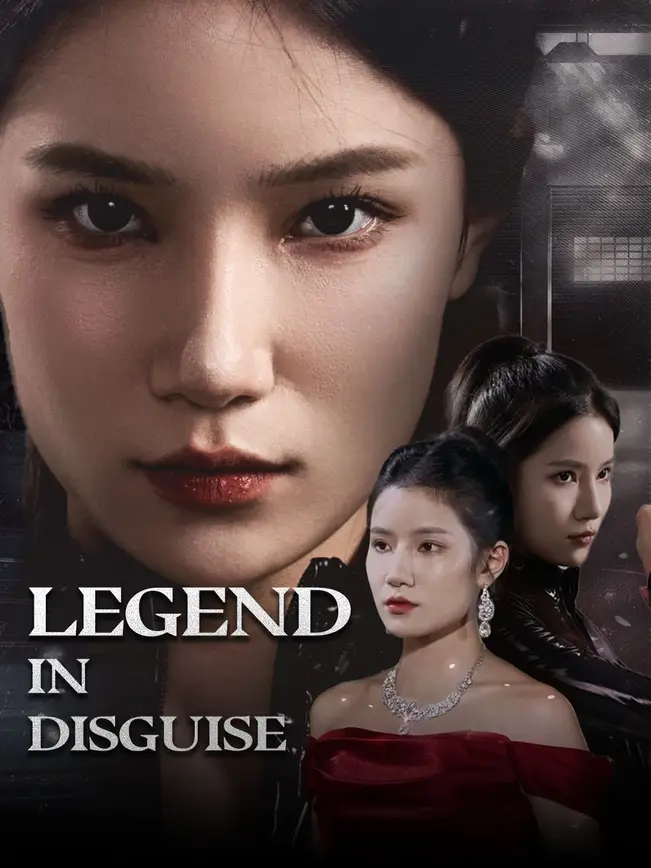
Legend in Disguise Storyline
Legend in Disguise More details
Genres:Revenge/Finding Relatives/Wish-Fulfillment
Language:English
Release date:2024-12-20 12:00:00
Runtime:84min
Legend in Disguise: When the Fan Speaks Louder Than Guns
Let’s talk about the fan. Not the object itself—the delicate yellow paper, the dark bamboo ribs, the calligraphy that seems to shift when you blink—but what it *does*. In a room where men wear suits like armor and women drape themselves in satin like shields, the fan is the only weapon that doesn’t need to be drawn. It’s already unsheathed. And in Legend in Disguise, it’s wielded by the woman who walks through smoke like she owns the air: Madame Su, the elder in white, whose hair is coiled high with a single black pin that looks less like an accessory and more like a dagger she forgot to hide. At 00:15, she emerges from the haze not as a guest, but as an arbiter. Her entrance isn’t announced; it’s *felt*. The chatter dies. Glasses stop clinking. Even Feng Wei pauses mid-gesture. That’s power—not shouted, but *exhaled*. Because Legend in Disguise operates on a different frequency. This isn’t a story about who has the most money or the biggest estate. It’s about who controls the narrative. And right now, Madame Su holds the pen. When she fans herself at 00:20, it’s not to cool down. It’s to *frame* the moment. The camera lingers on the fan’s surface: characters swirl in elegant script, but one dominates—‘Zhu’, the surname of Zhu Li, the woman in ivory who stands like a statue carved from refusal. Zhu Li doesn’t look at the fan. She looks *through* it. Her expression is unreadable, but her left hand—hidden behind her back—clenches. A micro-tremor. That’s the crack in the marble. The first sign she’s not as composed as she pretends. Now contrast that with Feng Wei. He’s all motion, all sound. His jacket sleeves flare with every gesture, those wave patterns undulating like the sea before a storm. He points, he smirks, he leans into Yuan Hao at 01:12 like a predator sharing a secret with its cub. But watch his eyes. They never leave Madame Su. Not once. He’s not challenging her; he’s *waiting* for her next move. Because he knows—deep in his bones—that in this game, the loudest voice loses. The quietest wins. And Madame Su? She’s quieter than silence. She doesn’t raise her voice at 00:17 when she speaks; she lets the syllables hang in the air like incense, heavy and deliberate. The subtitle (if we had one) would read: *‘You think the past is buried. But graves have doors.’* Then there’s Lin Jian—the man in the dark tunic, whose hands are always clasped, always *contained*. He’s the perfect foil to Feng Wei’s flamboyance. Where Feng Wei wears his history on his sleeves, Lin Jian locks his behind a collar buttoned to the throat. His anxiety isn’t visible until 00:39, when his knuckles whiten and his breath hitches—not from fear, but from *recognition*. He sees the fan. He knows what’s written on it. And he knows Mei Xue saw it too. Which is why, when she turns away at 00:56, he doesn’t reach for her. He *bows* his head. A surrender. A confession. A plea. All in one tilt of the chin. Mei Xue doesn’t look back. She can’t. Because if she does, she’ll see the truth: Lin Jian didn’t fail her. He protected her by letting her leave. The real danger wasn’t the shouting. It was the silence after. This is where Legend in Disguise transcends genre. It’s not a revenge drama. It’s a *memory drama*. Every character is haunted not by ghosts, but by *documents*: ledgers, letters, fan inscriptions, the kind of evidence that doesn’t burn easily. The banquet hall isn’t a venue—it’s a courtroom with no judge, only witnesses who’ve already decided the verdict. The red tablecloths? They’re not festive. They’re *evidence markers*. The floral arrangements behind Zhu Li and Lin Jian? They’re not decorations. They’re *witnesses*, frozen in porcelain and wire, their petals arranged in the shape of a broken seal. And Yuan Hao—the young man in the tailored black suit—stands apart not because he’s innocent, but because he’s *unfinished*. His posture is rigid, his gaze fixed forward, but his fingers twitch at his sides. He’s been trained to stand still, to listen, to absorb. But Feng Wei’s hand on his shoulder at 01:14 changes everything. It’s not blessing. It’s branding. Feng Wei’s thumb presses just above the collarbone, where the pulse races. Yuan Hao’s breath catches. For the first time, he looks *left*—not at Zhu Li, not at Madame Su, but at the empty chair beside the throne-like seat. The chair reserved for the one who *should* have been here. The one who vanished in ’98. That’s when Yuan Hao understands: he’s not the successor. He’s the placeholder. The decoy. The fan will open again. And when it does, his name will be written in the margin—not as heir, but as footnote. What’s brilliant about Legend in Disguise is how it uses costume as confession. Zhu Li’s pearls aren’t jewelry; they’re *ledgers*. Each bead a year of silence. Feng Wei’s mala isn’t prayer beads—it’s a countdown. The largest pendant, carved like a serpent’s eye, swings with every step he takes, catching light like a warning beacon. Madame Su’s white tunic? It’s not purity. It’s *erasure*. The color of documents burned and rewritten. Even Lin Jian’s tunic—those four front buttons—are spaced like prison bars. He’s been locked in this role for decades. The climax isn’t a fight. It’s a turn. At 00:57, Mei Xue walks away. Not running. Not storming. *Walking*. Her heels click like a metronome counting down to detonation. And Lin Jian? He doesn’t follow. He watches her go, then slowly, deliberately, unbuttons the top button of his tunic. Just one. A tiny rebellion. A signal. To whom? To Feng Wei? To Madame Su? To the ghost in the empty chair? We don’t know. And that’s the point. Legend in Disguise refuses closure. It offers only resonance. The fan remains closed in Madame Su’s hand at 01:26, but her eyes—sharp, ageless, terrifyingly calm—tell us it will open again. Soon. And when it does, the room won’t just hold its breath. It will forget how to breathe at all.
Legend in Disguise: The Fan That Unveiled a Dynasty
In the opulent, dimly lit banquet hall—where gilded carvings whisper of old money and red silk drapes conceal more than just windows—the air hums with tension thicker than the incense smoke that briefly swallows the frame at 00:14. This is not a wedding. Not quite. It’s something far more volatile: a social reckoning disguised as celebration, where every gesture is a chess move and every glance a coded threat. At the center of it all stands Zhu Li, the woman in white—not bridal, but *strategic*, her pearl necklace gleaming like a weapon she hasn’t yet drawn. Her dress is minimalist, almost ascetic, yet the cut reveals shoulders poised for confrontation. She doesn’t flinch when a hand (blurred, aggressive) sweeps past her face at 00:00; instead, her lips part in a half-smile that says, *I’ve seen worse*. That’s the first clue: this isn’t her debut. This is her return. Then enters Feng Wei—long hair pulled back with a silver clasp, goatee trimmed sharp as a blade, ears adorned with spiral earrings that catch the light like surveillance devices. His black jacket, fastened with ornate toggle buttons, is traditional in silhouette but subversive in detail: the sleeves are embroidered with crashing waves in gold and indigo, a motif that screams *unpredictable tide*. He wears a beaded mala around his neck, not as devotion, but as punctuation—each bead a silent count of how many lies he’s heard tonight. When he points at 00:06, it’s not accusation; it’s *invitation*. He wants someone to speak up. He *needs* them to crack. And crack they do. Watch Lin Jian, the man in the Mao-style suit—dark, rigid, hands clasped like he’s praying for mercy he won’t receive. His eyes dart, his jaw tightens, and when Zhu Li’s companion in crimson—a woman named Mei Xue, whose satin dress hugs her like armor—finally turns away at 00:57, Lin Jian doesn’t stop her. He *lets* her go. That’s the betrayal no one saw coming. He knew she’d flee. He *allowed* it. Because what follows is the real performance: the fan. Not just any fan—the yellow paper fan held by the older woman in white, her hair pinned with a single jade stick, her expression shifting from serene to searing in three frames (00:15–00:17). She doesn’t shout. She *fans*. Slowly. Deliberately. The characters on the fan—‘Zhu’, ‘Lin’, ‘Feng’—are not decoration. They’re names. Accusations. A genealogical ledger written in ink and silence. When she opens it fully at 00:25, the camera lingers on the calligraphy: *‘The debt was settled in ’98. Why reopen the ledger now?’* No one speaks those words aloud. But everyone hears them. This is Legend in Disguise at its most potent: a world where power isn’t seized, but *reclaimed* through ritual. The young man in the black three-piece suit—Yuan Hao, standing stiff as a statue at 00:26—isn’t passive. He’s calculating. His tie pin is shaped like a phoenix feather, a symbol of rebirth, but his posture suggests he’s still learning how to wear it. When Feng Wei places a hand on his shoulder at 01:11, it’s not mentorship—it’s *transfer*. A passing of the torch wrapped in silk and sarcasm. Feng Wei leans in, mouth near Yuan Hao’s ear, and though we don’t hear the words, Yuan Hao’s pupils dilate. He blinks once. Then again. And in that second, he stops being the heir apparent and becomes the heir *designate*. The difference is everything. Meanwhile, Mei Xue’s exit isn’t retreat—it’s repositioning. She walks toward the back of the hall, not fleeing, but *advancing* into the shadows where the real negotiations happen. Her red dress catches the light like blood on snow, and when she glances back at 00:58, her expression isn’t fear. It’s resolve. She knows Lin Jian won’t follow. He’s too busy watching Feng Wei’s next move. And Feng Wei? He smiles at 01:04—not kindly, but like a man who’s just confirmed the trap is sprung. The fan, now closed, rests in the older woman’s hand like a verdict. The banquet tables remain set, untouched. No one eats. No one drinks. This feast is purely symbolic: a communion of grudges, served cold. What makes Legend in Disguise so unnerving is how little it explains. We never learn why the fan bears those names. We don’t know what happened in ’98. But we *feel* the weight of it—in Lin Jian’s trembling fingers, in Zhu Li’s unbroken eye contact, in the way Feng Wei’s sleeve ripples when he gestures, as if the waves stitched into the fabric are rising inside him. The setting isn’t just backdrop; it’s complicit. Those floral centerpieces? They’re not flowers. They’re *crown motifs*, echoing the throne-like chair behind Zhu Li at 00:01—a chair no one sits in, because the throne is now contested, not occupied. The lighting favors chiaroscuro: faces half-lit, secrets half-revealed. Even the smoke at 00:14 isn’t atmospheric filler; it’s the visual metaphor for truth—dense, transient, impossible to grasp without stepping into it. And then there’s the silence between lines. When Zhu Li speaks at 00:01, her voice is calm, but her throat moves like she’s swallowing glass. When Feng Wei laughs at 01:20, it’s low, guttural, and Yuan Hao doesn’t smile back. He *notes* it. That’s the genius of Legend in Disguise: it treats dialogue as the least important element. What matters is the space *between* words—the hesitation before Lin Jian speaks at 00:37, the way Mei Xue’s necklace shifts when she turns, the exact moment Feng Wei’s ring catches the light as he points again at 00:34. That ring? It’s not jewelry. It’s a seal. A family crest. And he’s about to press it into the tablecloth. This isn’t melodrama. It’s *micro-politics* dressed in silk and sorrow. Every character is playing multiple roles: host/guest, victim/perpetrator, ally/ambusher. Zhu Li isn’t just a woman in white—she’s the archive, the living record of debts unpaid. Feng Wei isn’t just the loud one—he’s the archivist of chaos, the man who knows which thread to pull to unravel the whole tapestry. And Lin Jian? He’s the tragic figure who thought obedience would protect him. It won’t. Because in Legend in Disguise, loyalty is the first casualty. The fan will open again. Soon. And when it does, someone will kneel. Or vanish. There’s no third option.
Legend in Disguise: When Pearls Meet Smoke and Silence Speaks Louder
Let’s talk about the woman in cream. Not because she’s the prettiest—or though she is—but because Xiao Lin is the quiet epicenter of a storm no one saw coming. She stands in the middle of a banquet hall that screams opulence: red damask drapes, gold-leafed pillars, floral arrangements so elaborate they look like sculptures commissioned by emperors. Yet her outfit is understated—ivory silk, square neckline, cropped bolero jacket, pearls strung with a delicate silver charm shaped like a bell. Not a wedding bell. A warning bell. And she wears it like armor. At first, she seems passive. A spectator. But watch her eyes. When Li Wei enters—his navy jacket slightly oversized, his collar crisp, his walk measured—her gaze locks onto him not with judgment, but with the intensity of someone recognizing a missing piece. She doesn’t smile. Doesn’t frown. Just *sees*. And in Legend in Disguise, seeing is the most dangerous act of all. Because once you see clearly, you can’t unsee. You can’t pretend the hierarchy is natural. You can’t ignore the way Li Wei’s knuckles whiten when Zhou Yan laughs too loudly, or how he subtly positions himself between Xiao Lin and the crowd whenever someone leans in too close. Zhou Yan, for his part, is all surface. Tailored three-piece suit, patterned tie, lapel pin shaped like a stylized phoenix—because of course it is. He moves like he owns the air, hands in pockets, chin lifted, speaking in clipped phrases designed to impress, not connect. He addresses Li Wei once, casually, as ‘brother,’ and the word hangs like spoiled milk. Li Wei doesn’t correct him. Doesn’t react. Just blinks, slow and deliberate, and says, ‘I’m honored you’d consider me family.’ The room freezes. Xiao Lin’s fingers twitch at her side. Zhou Yan’s smile tightens, just a fraction. That’s the first crack. Not in the floor, not in the chandelier—but in the illusion of control. Then Professor Chen arrives. Not through the main doors, but from the service corridor, wreathed in dry ice fog that curls around his ankles like spectral serpents. He doesn’t announce himself. He doesn’t need to. The music dips. A waiter drops a glass—shatters silently, as if the sound has been edited out of reality. Chen walks with the calm of a man who has already won every argument he’ll ever have. His glasses reflect the ambient light, obscuring his eyes, making him unreadable—and therefore, infinitely threatening. He stops ten feet from Li Wei, tilts his head, and says only two words: ‘You’re late.’ Not angry. Not accusatory. Just factual. And yet, Li Wei’s breath catches. Because those words aren’t about time. They’re about timing. About readiness. About whether he’s finally prepared to stop hiding in plain sight. That’s the core tension of Legend in Disguise: identity isn’t worn like clothing—it’s earned through moments like this, where silence becomes a language, and a single phrase can unravel years of performance. Xiao Lin watches it all unfold, her expression shifting like light through water. First, confusion. Then dawning realization. Then—something else. Not joy. Not relief. *Recognition.* She knows now why Li Wei always lingered near the kitchen door during past events, why he memorized guest names before they arrived, why he never accepted tips. He wasn’t staff. He was *waiting*. And she? She wasn’t just a bride-to-be (though the rumors said she was engaged to Zhou Yan). She was a strategist, a listener, a woman who collected silences the way others collect vintage wine. Her pearls aren’t jewelry—they’re talismans. Each bead a vow she made to herself: *I will not be spoken for. I will not be arranged. I will wait until the right voice rises.* The turning point comes not with a shout, but with a gesture. Professor Chen removes his right hand from his pocket—not to draw a weapon, but to offer a small, folded slip of paper to Li Wei. No words. Just the paper, held out like an olive branch forged in steel. Li Wei hesitates. For three full seconds, the camera holds on his face—the sweat at his temple, the pulse in his neck, the way his thumb brushes the edge of the paper as if testing its weight. Then he takes it. Unfolds it. Reads it. And his entire posture changes. Shoulders drop. Chin lifts. Eyes widen—not with shock, but with confirmation. He looks at Xiao Lin. She gives the faintest nod. Not permission. Acknowledgment. That’s when Da Feng appears, stepping out of the residual smoke like a character summoned by narrative necessity. His style is chaos incarnate: asymmetrical jacket, mismatched earrings, a necklace that looks like it belongs in a temple shrine, not a gala. He doesn’t address anyone directly. Instead, he raises one finger, points to the ceiling, and murmurs, ‘The roof remembers every lie told beneath it.’ Then he vanishes back into the mist, leaving behind only the echo of his words and the sudden awareness that *someone* has been watching. Always. The aftermath is quieter than the storm. Zhou Yan excuses himself abruptly, muttering about a ‘call,’ but no one believes him. His entourage follows, glancing back with unease. Li Wei folds the paper again, tucks it into his inner pocket, and turns to Xiao Lin. This time, he speaks—not loudly, but clearly, each word placed like a stone in a still pond: ‘I’m not who they think I am. But I’m also not who I pretended to be.’ She smiles. Not the polite smile of a hostess. The real one. The one that says, *I’ve been waiting for you to say that.* Legend in Disguise doesn’t end with a kiss or a contract signed. It ends with them walking side by side toward the exit, not arm-in-arm, but in sync—step, breath, silence. The guests part like reeds in a current. No one stops them. No one dares. Because in that moment, Li Wei and Xiao Lin aren’t just two people leaving a party. They’re symbols. Proof that disguise isn’t deception—it’s delay. A necessary camouflage while the self gathers strength. And when the time is right, the mask doesn’t come off. It dissolves. Like smoke. Like expectation. Like the old world, making way for the new. The final frame: a close-up of Xiao Lin’s pearl necklace, the bell charm catching the last light as the doors swing shut behind them. Fade to black. No credits. Just the faint sound of distant drums—steady, ancient, alive. That’s Legend in Disguise in a nutshell: not a story about becoming powerful, but about remembering you already were. And sometimes, the loudest truths are whispered in the space between breaths.
Legend in Disguise: The Man in Blue and the Smoke That Changed Everything
In a grand banquet hall draped in crimson velvet and gilded woodwork, where crystal chandeliers cast soft halos over round tables set with porcelain and silver, a quiet storm begins to brew—not with thunder, but with a man in a navy-blue Mao-style jacket. His name is Li Wei, though no one calls him that aloud yet; he’s still just ‘the delivery guy’ in the eyes of most guests, including the elegantly poised Xiao Lin, who stands near the central dais in a cream-colored dress, her pearl necklace catching the light like a silent accusation. She watches him not with disdain, but with something more dangerous: curiosity. And that’s where Legend in Disguise truly starts—not with fanfare, but with a glance held too long. Li Wei moves through the room with the careful rhythm of someone used to being invisible. His hands are clean, his posture upright, his voice low when he speaks—yet every word carries weight, as if each syllable has been rehearsed in solitude for years. He gestures once, sharply, toward the far end of the hall, and the camera lingers on his fingers: calloused, precise, betraying a life of labor, not leisure. Behind him, a woman in a shimmering grey gown sips champagne, her smile polite but hollow. She doesn’t see what we see: the way Li Wei’s jaw tightens when a young man in a tailored black suit—Zhou Yan, heir to the Zhou textile empire—steps forward with a smirk and a pocket square folded into an X. That X isn’t just decoration; it’s a signature, a brand, a declaration of privilege. And Li Wei? He doesn’t flinch. He simply tilts his head, as if listening to a frequency only he can hear. Then comes the smoke. Not from fire, not from accident—but from intention. A figure emerges from the mist, glasses perched low on his nose, black Mandarin-collared suit immaculate, a red-and-gold brooch pinned over his heart like a wound turned into art. This is Professor Chen, former university dean, now rumored to be a consultant for high-stakes private negotiations. He walks slowly, deliberately, hands in pockets, smoke curling around his ankles like loyal hounds. His entrance isn’t loud, but the room *holds its breath*. Even Zhou Yan shifts his stance, his smirk faltering for half a second. Xiao Lin’s lips part—not in surprise, but recognition. She knows this man. Or rather, she knows *of* him. Rumors swirl about Professor Chen: that he once mediated a dispute between two rival triad families using only metaphors from classical poetry; that he never raises his voice, yet people have fainted after hearing him speak three sentences. In Legend in Disguise, he doesn’t need a spotlight—he *is* the spotlight. What follows is not dialogue, but choreography. Li Wei turns to face Professor Chen, and for the first time, his expression cracks—not into fear, but into something rawer: grief, maybe, or resolve. His hands unclench. He bows—not deeply, not subserviently, but with the dignity of a man who has carried too much and finally decides to set it down. The camera cuts to Xiao Lin, whose eyes glisten, not with tears, but with the sudden clarity of someone who’s just solved a puzzle they didn’t know they were holding. She glances at Zhou Yan, who now looks less like a prince and more like a boy caught cheating on a test. There’s no shouting, no slap, no dramatic music swell—just silence, thick as the smoke still drifting across the floorboards. Then, another figure rises from the haze: a man with a goatee, ear cuffs, and a black jacket fastened with ornate silver toggles, layered over a white tee and a long beaded necklace ending in a carved jade pendant. His name is Da Feng, and he’s not supposed to be here. Not officially. He’s known in certain circles as a ‘cultural liaison’—a euphemism for someone who bridges worlds that shouldn’t touch: old money and street wisdom, tradition and rebellion. He points upward, not at anyone, but at the ceiling, where a hidden projector flickers to life, casting shifting patterns onto the walls—ancient calligraphy, fragmented maps, a single line of verse: *‘The river does not argue with the stone; it simply flows around it—until the stone erodes.’* That line hangs in the air longer than any speech ever could. Li Wei exhales. Xiao Lin smiles—not the practiced smile of a socialite, but the real one, the kind that reaches the eyes and crinkles the corners, born of relief, of hope, of understanding. Zhou Yan takes a step back, then another, his confidence visibly fraying at the edges. Professor Chen nods once, almost imperceptibly, and the smoke begins to thin. This is the genius of Legend in Disguise: it refuses the easy catharsis. There’s no villain defeated, no confession extracted, no grand reveal that ties everything with a bow. Instead, it offers something rarer—a moment of suspended truth, where power isn’t seized, but *reallocated* through presence alone. Li Wei doesn’t win by shouting louder; he wins by standing still long enough for others to realize he was never the one who needed to move. Xiao Lin doesn’t choose between men; she chooses herself, and in doing so, redefines what ‘choice’ even means in a world built on inherited roles. And Professor Chen? He doesn’t solve the conflict—he *holds space* for it to resolve itself, like a gardener who knows some seeds need darkness before they split open. The final shot lingers on Li Wei’s hands, now relaxed at his sides, fingers slightly curled as if still holding something unseen. Behind him, the banquet tables remain set, untouched, waiting. The guests murmur, but no one leaves. Because in that room, for those few minutes, time didn’t pass—it *paused*, and in that pause, Legend in Disguise revealed its truest form: not as a story about rising from nothing, but about remembering who you were before the world told you otherwise. The smoke clears. The lights dim. And somewhere, off-camera, a single drumbeat echoes—soft, steady, inevitable. That’s when you know: this isn’t the end. It’s just the first act.
Legend in Disguise: When Silence Screams Louder Than Accusations
The banquet hall in Legend in Disguise isn’t just a location—it’s a pressure chamber. Red velvet, gilded railings, tables arranged like chessboards: every element feels staged, deliberate, *loaded*. And yet, the most explosive moments occur without a single raised voice. That’s the genius of this sequence: the drama isn’t in what’s said, but in what’s withheld, what’s swallowed, what’s *performed*. We’re not watching a confrontation. We’re watching a ritual of revelation, where body language is the liturgy and eye contact is the scripture. Start with Uncle Feng—the man in the dark Mao jacket, his face slick with sweat despite the cool air. His gestures are theatrical, almost desperate: palms open, fingers jabbing, brow furrowed like he’s trying to carve truth out of thin air. He’s not angry. He’s *terrified*. Terrified that the carefully constructed world he’s upheld is crumbling beneath him. Notice how he keeps glancing toward the stairs, as if expecting reinforcements—or perhaps, absolution. His companion, the man in navy blue (let’s call him Brother Lei), stands rigid beside him, hands clasped behind his back, jaw clenched. He doesn’t speak either. But his eyes—sharp, assessing—track Chen Wei like a hawk watching prey. He’s not loyal to Uncle Feng. He’s loyal to the *order*. And right now, Chen Wei is threatening to dismantle it. Then there’s Chen Wei himself. Dressed in black, crisp, expensive, with that distinctive gold ‘X’ pin—symbolism we’re meant to decode. Is it a brand? A faction? A personal sigil? The show never tells us. It doesn’t have to. What matters is how he *wears* it: not proudly, but *lightly*, as if it’s a burden he’s learned to carry without letting it weigh him down. His posture is relaxed, but his shoulders are slightly hunched—not in submission, but in preparation. Like a boxer waiting for the bell. When Yun Fei places her hand in his, he doesn’t squeeze it. He doesn’t even look at it. He just *holds* it, steady, as if anchoring himself to something real in a sea of illusion. That’s the core of Legend in Disguise: authenticity isn’t found in declarations, but in the quiet consistency of touch. Now, the women. Oh, the women. Lin Xiao in red—her dress is a weapon she’s chosen not to wield. She stands slightly behind Brother Lei, her posture neutral, her expression unreadable. But watch her feet. In one shot, she shifts her weight from heel to toe, just once—a tiny motion, but it betrays her restlessness. She’s not passive. She’s *waiting*. Waiting for the right moment to speak, to act, to reclaim what was taken. Her necklace, that Y-shaped pendant, catches the light whenever she turns her head—like a beacon no one’s supposed to see. And Mei Ling, in rose-gold sequins, arms crossed, lips pressed thin. She’s the only one who dares to smirk when Uncle Feng raises his voice. Not mockery. *Amusement*. As if she’s heard this speech before—and knows exactly how it ends. Her earrings, long and dangling, sway with every subtle tilt of her head, drawing attention to her eyes, which never leave Chen Wei’s face. She’s not judging him. She’s *measuring* him. Yun Fei, in ivory, is the enigma. Her dress is pure, her demeanor serene—but her hands tell a different story. When Chen Wei leads her forward, her fingers curl inward, just slightly, as if gripping something invisible. Later, when Uncle Feng points, she doesn’t recoil. She *steps* forward—not toward him, but *beside* Chen Wei, aligning herself with him physically, even as her expression remains distant. That’s the paradox of Legend in Disguise: loyalty isn’t declared. It’s demonstrated through proximity. And yet—there’s a crack in her composure. In a close-up, her lower lip trembles, just for a frame. Not enough to be noticed by the others. Enough for us to know she’s not as unshaken as she appears. The editing is surgical. Cuts between characters are timed to the rhythm of breath, not dialogue. When Chen Wei speaks (again, we don’t hear his words—only see his mouth form syllables), the camera cuts to Lin Xiao’s pupils dilating. To Mei Ling’s nostrils flaring. To Yun Fei’s throat bobbing as she swallows. These aren’t reactions. They’re *translations*. The film trusts us to interpret the emotional dialect spoken in micro-movements. What’s fascinating is how the environment mirrors the internal states. The red curtains behind Uncle Feng pulse with intensity, like a heartbeat. The floral arrangements on the tables—white blossoms with red centers—echo the duality of the characters: outward purity, inner fire. Even the lighting shifts subtly: warmer when Yun Fei and Chen Wei walk together, cooler when the accusations fly. It’s not just mood lighting. It’s psychological mapping. And then—the clincher. At the climax, Uncle Feng points directly at Chen Wei, his finger trembling, voice cracking (though we hear no sound). The camera holds on Chen Wei’s face. He doesn’t blink. Doesn’t flinch. Just tilts his head, ever so slightly, and *smiles*. Not a smile of triumph. Not of guilt. A smile of *recognition*. As if to say: *Yes. I know what you’re accusing me of. And you’re right. But you’re also wrong.* That smile is the thesis of Legend in Disguise: truth is never singular. It’s layered, contradictory, worn like a second skin. The final shot—Yun Fei and Chen Wei walking away, hands still joined, backs to the camera—isn’t an ending. It’s a question. Will they reach the door? Will someone stop them? Will the women follow? The film doesn’t answer. It leaves us in the aftermath, staring at the empty space where the confrontation just unfolded, wondering who really won. Because in Legend in Disguise, victory isn’t measured in words spoken, but in silences endured. And the loudest scream in the room? It’s the one no one lets out.

Wish-Fulfillment




Finding Relatives





Revenge


 Download