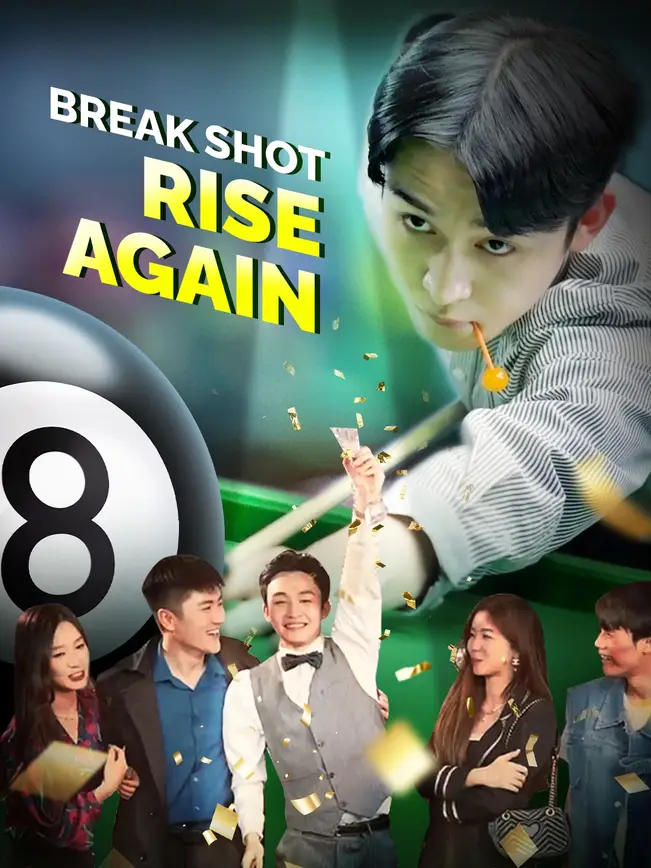
Break Shot: Rise Again Storyline
Break Shot: Rise Again More details
Genres:Underdog Rise/Karma Payback/Return of the King
Language:English
Release date:2024-12-20 12:00:00
Runtime:84min
Break Shot: Rise Again — Where Cues Speak Louder Than Words
Let’s talk about the language of hands. Not spoken. Not signed. *Performed*. In Break Shot: Rise Again, dialogue is sparse—almost nonexistent—but the body speaks in fluent, urgent dialects. Li Wei’s right hand, for instance: raised, fingers splayed, thumb brushing his temple—this isn’t hesitation. It’s calibration. Like a pianist adjusting wrist angle before the first note. He does it three times in the first minute. Each time, the camera tightens, as if the gesture itself is a countdown. Meanwhile, Chen Hao watches from the beige sofa, cue resting vertically between his knees, one leg crossed over the other, socked ankle exposed—a detail that feels deliberate, almost vulnerable amid his otherwise polished armor. His smile never wavers, but his eyes do. They narrow, just slightly, when Li Wei’s hand drops. Not in disapproval. In recognition. He knows what’s coming. And he’s ready to be wrong. Then there’s Zhang Ye—the man in the glittering black jacket—who enters not with fanfare, but with a glare so sharp it could slice through the ambient green LED lighting. He doesn’t sit. He *occupies*. His posture is all edges: shoulders squared, chin lifted, hands planted on his thighs like he’s bracing for impact. When Li Wei walks past him, Zhang Ye doesn’t turn. Doesn’t blink. Just exhales through his nose—a sound barely audible over the low hum of the venue’s HVAC system, yet somehow louder than any shout. That’s the texture of this world: sound design as psychology. The clack of balls is distant. The rustle of fabric is intimate. The click of a phone unlocking? That’s the gunshot. And oh—the phone call. When Zhang Ye answers, his voice doesn’t rise. It *drops*. Lower register. Tighter vowels. His jaw locks. His free hand curls into a fist, then relaxes, then clenches again—like a metronome set to panic. He doesn’t pace. He *vibrates*. The couch beneath him seems to absorb the tremor. Chen Hao glances over, eyebrow arched, but says nothing. That silence is heavier than any line of dialogue. Because in Break Shot: Rise Again, what’s unsaid isn’t missing—it’s *loaded*. Every withheld word is a bullet in the chamber. Now shift focus to the periphery: the group behind the red rope. Liu Yang, the bespectacled one, keeps adjusting his vest—not out of nervousness, but out of habit. A tic. A grounding mechanism. He’s not just watching; he’s *rehearsing*. His mouth moves silently, mimicking cues, calculating angles, whispering probabilities to himself. Beside him, Wang Jie stands like a statue, but his pupils dilate every time Li Wei shifts weight. He’s not impressed. He’s *investigating*. And then there’s the woman in the floral blouse—Xiao Mei—who doesn’t speak until the very end. Her entrance is timed like a musical cue: the moment Zhang Ye’s rage peaks, she steps forward, sign aloft, voice clear and warm, cutting through the tension like sunlight through smoke. “I Love You, Master.” Not romantic. Not subservient. *Affirmative*. A declaration of faith in the craft, in the ritual, in the man who dares to stand still while the world spins. The pool table, meanwhile, is a stage with no curtain. Green felt. Wooden rails. Balls arranged like chess pieces mid-game. When Li Wei finally approaches, the camera circles him—not in a flashy 360, but in a slow, reverent orbit, as if honoring a priest approaching the altar. He picks up the orange chalk. Not with flourish. With reverence. Tucks it between his teeth. Leans down. The cue tip hovers. The white ball gleams under the overhead spotlights. And in that suspended second—before contact—the entire room holds its breath. Even Zhou Lin, the announcer, stops moving. His microphone dangles. His eyes widen. Not in shock. In *wonder*. Because here’s the truth Break Shot: Rise Again reveals without stating: mastery isn’t about perfection. It’s about presence. Li Wei doesn’t need to sink the eight-ball cleanly. He just needs to *exist* in the moment with such absolute certainty that everyone else forgets to doubt. Zhang Ye’s outburst? It’s not jealousy. It’s terror—the terror of realizing you’ve been reading the script wrong your whole life. Chen Hao’s smile? It’s not smugness. It’s relief. He gambled on Li Wei, and the gamble paid off in silence, not sound. The final shot—Li Wei standing upright, cue in hand, smiling at the crowd—isn’t victory. It’s surrender. Surrender to the weight of expectation, to the absurd beauty of human fragility masked as elegance. The women behind Xiao Mei exchange glances. One nods. The other bites her lip. They’re not fans. They’re students. And the lesson isn’t about angles or spin. It’s about how to hold yourself when the world is watching, waiting, *needing* you to be more than human. Break Shot: Rise Again doesn’t end with a clatter of balls. It ends with a sigh. A shared, collective release. The red rope stays in place. The lights stay green. The game continues—but something has shifted. The rules haven’t changed. The players have. Li Wei walks away from the table, not triumphant, but *transformed*. Chen Hao rises, offers a nod—not congratulations, but acknowledgment. Zhang Ye is still on the phone, but his voice is quieter now. He’s listening. Really listening. And in the background, Zhou Lin lowers the mic, smiles faintly, and whispers to no one in particular: “He didn’t even break the rack. He broke the silence.” That’s the magic of this sequence. It turns a sport into a sacrament. A cue stick into a staff. A green table into an altar. And in doing so, Break Shot: Rise Again reminds us: the most powerful shots aren’t the ones that move the balls. They’re the ones that move *us*—long after the final echo fades.
Break Shot: Rise Again — The Cue That Shattered Composure
In the sleek, neon-drenched interior of what appears to be a high-end billiards lounge—part social hub, part performance stage—the tension isn’t just in the air; it’s *charged*, like the static before a lightning strike. Break Shot: Rise Again doesn’t open with a cue ball rolling across green felt. It opens with a man—let’s call him Li Wei—wearing a pinstriped vest, black bowtie, and an expression caught between concentration and quiet despair. His fingers twitch near his temple, as if trying to recalibrate his own nervous system. He holds a cue stick like it’s both weapon and crutch. This isn’t just a game. It’s a ritual. And everyone in the room knows it. The camera lingers on his face—not for dramatic effect, but because his micro-expressions are the script. A blink too long. A lip pressed thin. A flicker of doubt that vanishes the moment he lifts his hand, palm up, as if testing the weight of fate itself. Behind him, blurred but unmistakable, sits Chen Hao—smiling, arms crossed, holding his own cue like a scepter. Chen Hao is not just watching; he’s *curating* the spectacle. His grin isn’t friendly. It’s anticipatory. Like a ringmaster waiting for the acrobat to step onto the wire. When Li Wei gestures again—this time more deliberately, almost theatrical—it’s clear: this isn’t about angles or spin. It’s about control. Who controls the narrative? Who gets to look calm while the world tilts? Then there’s the announcer—Zhou Lin—perched against a glittering wall of mirrored tiles, microphone in hand, eyes wide, mouth slightly agape. His role is ambiguous: commentator? Provocateur? Witness? He doesn’t narrate the shot. He *reacts* to the silence before it. His eyebrows climb higher with each passing second, as if the audience’s collective breath is a physical force pressing against his ribs. When he finally speaks—though we don’t hear the words—the cadence of his jaw tells us everything: this is no ordinary match. This is a reckoning disguised as recreation. And then—the crowd. Not spectators. *Participants*. A group of young men in double-breasted vests, some with glasses, some with silver chains peeking from collars, stand behind a red velvet rope like they’re guarding sacred ground. One of them—Liu Yang—leans forward, gesturing emphatically, as if arguing strategy with the universe. Another, Wang Jie, stands rigid, hands clasped, lips parted—not in awe, but in calculation. They aren’t cheering. They’re *decoding*. Every gesture from Li Wei is parsed, every pause analyzed. When a woman in a floral blouse (we’ll call her Xiao Mei) steps forward, flanked by two others—one in denim, one in black blazer—the energy shifts. She doesn’t hold a cue. She holds a sign: “I Love You, Master.” Not irony. Not parody. Sincerity, delivered with the gravity of a coronation. The crowd erupts—not with noise, but with synchronized fist pumps, grins, and a shared exhale. For a moment, the pressure valve releases. But only for a moment. Because back on the couch, the third man—Zhang Ye—has gone silent. Dressed in a shimmering black suit, patterned tie, cropped trousers, he looks less like a player and more like a man who just received bad news via text. He pulls out his phone. Then he answers. His face tightens. His knuckles whiten around the device. And then—he *snaps*. Not metaphorically. Literally. He rises, mid-call, and slams his fist into the armrest, then kicks the cushion, then spins toward Li Wei with a snarl that could curdle milk. The contrast is jarring: Li Wei, still serene, still smiling faintly, still holding his cue like nothing has happened. Zhang Ye’s rage is raw, unfiltered, almost childish in its intensity. Yet it feels earned. Because in Break Shot: Rise Again, power isn’t held in hands—it’s held in silences, in glances, in the space between a breath and a strike. What makes this sequence so compelling is how it refuses to explain. There’s no voiceover. No flashback. No exposition dump. We’re dropped into the middle of a storm and expected to read the wind. Is Li Wei the underdog? The prodigy? The fraud? Chen Hao’s smirk suggests he knows something we don’t. Xiao Mei’s sign implies devotion—but to whom? To the skill? To the myth? To the man who *looks* like he’s about to break the world with one clean stroke? Even the pool table itself becomes a character: the green felt, the scattered balls—red, yellow, black, white—arranged like constellations waiting for interpretation. When Li Wei finally leans over the table, cue in hand, orange chalk tucked between his teeth like a talisman, the camera zooms in on his eyes. Not focused on the ball. On the *reflection* in the ball—the distorted image of the crowd, the lights, Zhang Ye’s furious silhouette. He’s not aiming at the object. He’s aiming at the echo. Break Shot: Rise Again understands that the most devastating shots aren’t the ones that sink the eight-ball. They’re the ones that shatter the illusion of control. Li Wei’s final smile—soft, knowing, almost apologetic—is the real climax. Because he didn’t need to take the shot. He already won. The crowd cheered. Zhang Ye raged. Chen Hao nodded, satisfied. And Zhou Lin, still gripping the mic, finally exhales—and whispers something we can’t hear, but feel in our bones. That’s the genius of this scene: it turns billiards into ballet, tension into theology, and a simple cue stick into a symbol of everything we pretend we can manage—until the moment we can’t. The real break wasn’t on the table. It was in the silence after the cue touched the white ball. And no one saw it coming—except maybe Li Wei. He was already smiling.
Break Shot: Rise Again — When the Table Becomes a Stage
There’s a scene in Break Shot: Rise Again that lingers long after the credits roll—not because of the shot itself, but because of what happens *after*. Li Wei has just sunk the final red ball. The scoreboard reads 9–8. The crowd erupts. But instead of stepping back, he walks forward. Not toward the trophy. Not toward his cheering friends. Toward the edge of the table, where a single cue rests, abandoned. He picks it up. Not to celebrate. To inspect. His fingers trace the wood grain, the tip, the joint. He tilts it slightly, catching the light from the neon green arch above. And for a beat—just one—he closes his eyes. Not in prayer. In memory. That’s the heart of Break Shot: Rise Again: the table isn’t just furniture. It’s a confessional. A battlefield. A mirror. Every character in this world relates to it differently. Chen Yu watches from the sidelines, her hands clasped, her breath held—not because she cares about the score, but because she remembers the last time Li Wei played, and how he walked away without speaking for three days. Xiao Feng, meanwhile, treats the table like a concert stage, waving his sign like a banner at a rally. He doesn’t see the tension in Li Wei’s shoulders. He only sees the hero. Then there’s Zhang Hao—the antagonist who never needed to be evil, only arrogant. His entrance is cinematic: black sequined jacket, floral silk tie, a smirk that says ‘I’ve already won.’ He doesn’t play pool. He *performs* it. He adjusts his cufflinks mid-shot. He winks at the camera (yes, literally—the fourth wall cracks here, intentionally). But when Li Wei begins his comeback, Zhang Hao’s performance falters. His hands shake. His laugh becomes strained. By the time the score hits 7–8, he’s no longer looking at the table. He’s looking at the audience. Trying to gauge their loyalty. That’s when you realize: Zhang Hao isn’t afraid of losing. He’s afraid of being irrelevant. The turning point isn’t the 8–8 tie. It’s the moment Li Wei removes the straw. Not dramatically. Not for effect. He simply spits it out, catches it mid-air with his thumb and forefinger, and tucks it into his vest pocket. A tiny gesture. A massive shift. From that second on, his movements change. Faster. Sharper. Less guarded. He’s not playing *against* Zhang Hao anymore. He’s playing *through* him. The final sequence—where he lines up the black ball with the white, the yellow, and the brown in a perfect diagonal—isn’t just skill. It’s storytelling. Each ball represents a hurdle: doubt, pressure, expectation. And he clears them all in one stroke. What’s remarkable is how the film uses sound—or rather, *silence*. During the critical shots, the ambient noise fades. No crowd murmur. No music swell. Just the soft *click* of balls colliding, the whisper of cloth, the faint creak of Li Wei’s knee bending. It’s hypnotic. You lean in. You hold your breath. And when the black ball drops, the silence holds for half a second longer than expected. That’s when the explosion happens. Not just cheers—but screams, clapping, someone dropping their phone, Xiao Feng jumping onto the table (and nearly knocking over the scoreboard). Break Shot: Rise Again understands that victory isn’t linear. After the win, Li Wei doesn’t immediately accept the trophy. He hesitates. Looks at Zhang Hao, who’s now being escorted out by security, his face a mask of shock and shame. Li Wei opens his mouth—once, twice—as if to say something. But he doesn’t. Instead, he raises the cue stick, not in triumph, but in salute. A silent acknowledgment. A truce forged in chalk dust and sweat. Later, during the celebration, the camera circles the group: Li Wei, Xiao Feng, Chen Yu, and two others hugging, laughing, pointing at the trophy like it’s a shared joke. But zoom in on Li Wei’s hands. They’re still trembling. Not from exertion. From release. The straw is still in his pocket. He hasn’t thrown it away. He might need it again. Because in Break Shot: Rise Again, the game never really ends. It just resets. The balls get racked. The lights dim. The crowd returns. And somewhere, in the shadows, Zhang Hao watches—waiting for his next turn. This isn’t sports drama. It’s psychological theater disguised as pool. Every cue strike is a confession. Every missed shot is a regret. And that final image—the REC overlay flickering, the crew visible in the reflection of the glass wall—reminds us: we’re all players in someone else’s story. Even the audience. Especially the audience. Break Shot: Rise Again doesn’t ask you to pick a side. It asks you to remember the last time you held your breath, waiting for the ball to drop… and whether you were rooting for the player, or for yourself.
Break Shot: Rise Again — The Straw That Split the Cue
Let’s talk about the quiet storm that is Li Wei in Break Shot: Rise Again — a man who doesn’t speak much, but whose silence speaks volumes. From the very first frame, he stands there, cue in hand, an orange straw dangling from his lips like a relic of childhood defiance. He’s not just playing pool; he’s conducting a ritual. His pinstriped vest, crisp white shirt, and bowtie aren’t costume pieces—they’re armor. Every flick of his wrist, every subtle shift in posture, tells you this isn’t casual play. This is war waged on green felt. The camera lingers on his eyes—not wide with excitement, but narrowed, calculating, almost predatory. When he leans over the table, the straw still lodged between his teeth, it’s not a gimmick. It’s a psychological anchor. He’s forcing himself to stay grounded, to breathe slowly, to *not* rush. In a world where everyone else reacts—gasping, cheering, clutching signs that read ‘I Love You, Master’—Li Wei remains still. Even when the scoreboard flips from 2–8 to 9–8, his expression barely changes. That’s the genius of the performance: restraint as rebellion. Watch how the crowd behaves around him. There’s Xiao Feng, the loud, expressive fan in the denim vest, practically vibrating with anticipation. Then there’s Chen Yu, the woman in the floral blouse, whose laughter turns into gasps, then tears of joy. They’re not just spectators—they’re emotional conduits, amplifying what Li Wei refuses to express. And yet, when the final shot drops—the black ball sinking cleanly into the corner pocket—Li Wei doesn’t raise his arms. He exhales. The straw falls. For the first time, he looks up. Not at the crowd. Not at the trophy. At the man across the room: Zhang Hao, the rival in the shimmering black suit, who’s been watching with a smirk that slowly curdles into disbelief. That moment—when Zhang Hao is dragged away by two men in blue shirts—isn’t just comic relief. It’s narrative punctuation. Zhang Hao wasn’t just losing a game; he was losing control. His entire persona—flashy tie, glittering jacket, smug posture—was built on dominance. And Li Wei dismantled it with a single break shot. The irony? The cue stick never touched Zhang Hao. But the impact was physical, visceral. Later, when Zhang Hao sits slumped on the couch, mouth agape, eyes darting like a cornered animal, you realize: this wasn’t about pool. It was about dignity. About proving that precision beats pretense. That silence can shatter louder than any shout. Break Shot: Rise Again doesn’t rely on flashy trick shots or CGI-enhanced physics. It trusts its characters. Li Wei’s victory isn’t celebrated with fireworks—it’s marked by a slow-motion pile-up of fans tackling him onto the sofa, laughing, crying, pulling at his sleeves like he’s a deity who walked off the felt. The overhead shot of that chaotic embrace—bodies tangled, shoes flying, one man holding a trophy like a sacred relic—is pure cinematic poetry. It’s messy. It’s human. It’s real. And then, the twist: the camera pulls back, revealing the REC overlay. We’re not watching a live event. We’re watching a *filmed* event. A staged triumph. Which makes everything more fascinating. Because now we question: Was Li Wei ever truly silent? Or was that all part of the act? Did he *choose* the straw? Did he rehearse that exact moment of stillness before the final shot? The show blurs reality and performance so seamlessly that you start wondering if the audience’s cheers were scripted too. That’s the brilliance of Break Shot: Rise Again—it doesn’t just tell a story about pool. It asks you to question what’s authentic in a world where even victory can be edited. The trophy Li Wei holds at the end isn’t heavy. It’s glass, delicate, almost transparent. Like his composure. Like the line between confidence and arrogance. When Xiao Feng grabs his shoulder and whispers something—probably ‘You did it, brother’—Li Wei finally smiles. Not the tight-lipped grin he wore during the match, but a full, unguarded beam. Teeth showing. Eyes crinkling. For three seconds, he’s just a kid again, the straw forgotten, the weight lifted. And that’s when you understand: Break Shot: Rise Again isn’t about winning. It’s about remembering who you are when no one’s watching. Even if ‘no one’ is a camera rolling at 30 fps.
When the Scoreboard Lies
8–8? Nah. The real tension was in the blue-vested rival’s twitching eye and the crowd’s gasps. This isn’t about points—it’s about who *owns* the room when the cue strikes. Break Shot: Rise Again nails the silent drama between claps. 🎤💥
The Straw That Broke the Cue
Jiang’s orange straw isn’t just a prop—it’s his quiet rebellion. Every shot, every smirk, every time he leans in with that absurd focus… you feel the weight of expectation cracking. Break Shot: Rise Again turns pool into poetry. 🎯✨
Scoreboard Lies, Emotions Don’t
2–8 looks like a rout—but in Break Shot: Rise Again, scores are just noise. The real game happens in side-eye glances, trembling hands, and that turquoise-vested underdog’s grin. When the cue strikes, it’s not balls colliding—it’s egos shattering. Pure cinematic tension in 60 seconds. 🎤💥
The Lollipop Gambit
Break Shot: Rise Again turns pool into psychological warfare—every stroke a silent dare. The pinstriped player’s lollipop? Not a prop, but a weapon of calm defiance. While the crowd gasps, he blinks like he’s already won. That final smirk? Chef’s kiss. 🎯✨
When Snooker Meets Soap Opera
Break Shot: Rise Again turns a green felt table into a stage for emotional whiplash. One man calculates angles; another screams into his phone like it betrayed him. The contrast—elegant vests vs. chaotic energy—is deliciously absurd. Also, why is the guy in blue smiling like he knows something we don’t? 😏
The Cue That Broke the Ice
In Break Shot: Rise Again, the tension isn’t just in the pocket—it’s in the silence between shots. Our protagonist’s smirk vs. the rival’s phone rage? Chef’s kiss. The crowd’s gasps, the sign ‘I love you, Master’, and that orange chalk bite—pure cinematic dopamine. 🎯✨

Underdog Rise


.jpg~tplv-vod-rs:651:868.webp)


Return of the King

Karma Payback
.jpg~tplv-vod-rs:651:868.webp)

 Download