




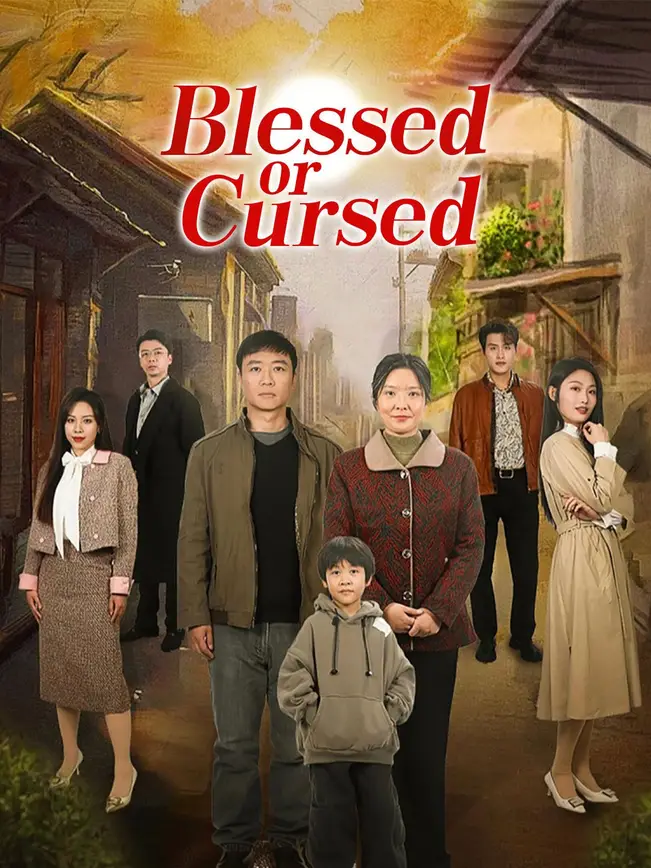
Blessed or Cursed Storyline
Blessed or Cursed More details
Genres:Plot Twist/Karma Payback/Underdog Rise
Language:English
Release date:2025-02-20 16:00:00
Runtime:113min
Blessed or Cursed: When the Batons Fall in a House of Red Knots
There’s a particular kind of dread that settles in your chest when you realize the tension isn’t building—it’s already peaked, and you’ve been standing in the epicenter the whole time. That’s the feeling this hallway scene evokes: not suspense, but inevitability. The characters aren’t waiting for something to happen. They’re waiting for the *next* thing to happen, because the first thing—the intrusion, the silence, the unspoken accusation—has already occurred offscreen. What we witness is the aftermath, the cleanup, the reckoning. And it’s devastating precisely because it feels so ordinary. Let’s talk about space. The hallway is narrow, claustrophobic, lined with doors that lead nowhere important—just bedrooms, storage, maybe a bathroom. There’s a shelf with jars and bottles, a faded painting of the character ‘Fu’ (blessing) hanging crookedly above a sofa. These aren’t set pieces. They’re artifacts of a life lived quietly, modestly, *honestly*. And then the men in black arrive. Their suits are immaculate. Their shoes are polished to a mirror shine. They don’t belong here. Not because they’re outsiders—but because they represent a different logic, a different economy of power. In this house, value is measured in loyalty, in shared meals, in the way Zhang Mei mends Li Wei’s coat without being asked. In their world, value is measured in compliance, in silence, in the weight of a baton held just so. Lin Tao—the man with the gold-rimmed glasses and the paisley tie—is the most fascinating figure in the ensemble. He’s not the aggressor. He’s not the victim. He’s the translator. He speaks the language of both worlds, and that makes him dangerous. In the opening shots, he stands slightly apart from the others, his gaze steady, his posture neutral. He’s observing, yes—but he’s also *assessing*. When Mr. Chen speaks, Lin Tao’s eyes flick to Li Wei, then to Zhang Mei, then back to Mr. Chen. He’s mapping the emotional terrain, calculating the cost of each possible response. And when the violence begins—not sudden, but *unfolding*, like a slow-motion collapse—he doesn’t flinch. He kneels. Not out of fear, but out of protocol. He understands the script. He’s played this role before, perhaps not as the one on the floor, but as the one holding the baton. His pain is not physical. It’s cognitive dissonance made flesh. Zhang Mei, meanwhile, is the emotional anchor of the scene. Her coat—red and black, woven with zigzag patterns—is a visual metaphor: beauty and danger intertwined. She doesn’t scream when Li Wei falls. She doesn’t rush to him. She watches. And in that watching, she becomes the audience’s proxy. We see what she sees: the arrogance in Mr. Chen’s posture, the resignation in Li Wei’s eyes, the chilling efficiency of the enforcer’s grip. Her face doesn’t contort with rage. It tightens with grief—not for what’s happening now, but for what *led* here. She knows the debts. She knows the promises broken. She knows that the red knots on the wall weren’t hung for decoration. They were hung as warnings. And no one listened. The child, Xiao Yu, is the silent witness who will carry this memory into adulthood. He doesn’t hide his face. He doesn’t look away. He studies the mechanics of power: how a man can be brought low without a single punch thrown; how a word can be more damaging than a strike; how the most terrifying threat isn’t the baton—it’s the *choice* not to use it. When the woman in pink covers his eyes, he doesn’t resist. He lets her. But his fingers curl inward, gripping the fabric of her sleeve. He’s not scared. He’s processing. And later, when the adults are too busy drowning in their own shame to notice, he bends down and retrieves the broken piece of rubber. Not as a trophy. As data. As proof that even the strongest tools can fracture under pressure. Mr. Chen is the linchpin. His glasses are thin, elegant, the kind that suggest intellect, not intimidation. Yet his voice—when he finally speaks—is low, resonant, devoid of inflection. He doesn’t yell. He *states*. And in doing so, he strips the room of its noise, leaving only the echo of his words. His anger isn’t hot. It’s cold, precise, surgical. He doesn’t need to raise the baton to assert dominance. He only needs to hold it. The threat is implicit. The consequence is assumed. And that’s what makes him so terrifying: he doesn’t want to hurt anyone. He just wants the equation to balance. And if someone has to break for that to happen… well, that’s not cruelty. That’s arithmetic. The climax isn’t the falling. It’s the standing up. After the baton is dropped—yes, *dropped*, not thrown, not smashed, but released, as if it had become too heavy to hold—Mr. Chen turns to Zhang Mei. Not with hostility. With something worse: recognition. He sees her. Truly sees her. And for the first time, his composure cracks. His shoulders slump, just slightly. His hand drifts toward his pocket, then stops. He wants to say something. He *needs* to say something. But the words won’t come. Because what is there to say? That he’s sorry? That he had no choice? That the system demands sacrifice? None of those phrases fit in this hallway, surrounded by the remnants of a celebration that never happened. And then—the final shot. Not of the broken men, not of the departing enforcers, but of the red knot, swaying gently in a draft no one can feel. It’s still there. Still bright. Still hopeful. And that’s the true horror of the scene: the world keeps pretending. The decorations stay up. The banners remain unfurled. Life goes on, even when the foundation has crumbled. Blessed or Cursed? The question isn’t about fate. It’s about complicity. Who tied the knot? Who let it fray? Who will be the one to cut it—and at what cost? This isn’t just a scene from a short film. It’s a mirror. And if you look closely, you’ll see your own hallway reflected in it. The same doors. The same shelves. The same red knots, hanging stubbornly, defiantly, against the weight of truth. Blessed or Cursed—we keep choosing, again and again, until the day the baton falls. And when it does, we’ll all be kneeling. Some by force. Others by habit. And a few, like Xiao Yu, will be collecting the pieces, waiting for the day they understand what they mean.
Blessed or Cursed: The Red Knot That Tied a Family’s Fate
In the narrow, dimly lit hallway of what appears to be a modest rural home—its walls adorned with red Chinese knots and a banner reading ‘Cheng Shi Xiang Xin’ (Wishing All Your Wishes Come True)—a quiet domestic gathering spirals into chaos with the precision of a staged tragedy. At first glance, it’s just another family reunion: elders in woolen coats, younger men in tailored suits, a woman in a gray overcoat standing stiffly like a statue caught between two currents. But beneath the surface, every gesture, every pause, every flicker of the eye tells a story far more complex than mere kinship. This isn’t just a scene—it’s a pressure cooker waiting for the lid to blow. Let’s begin with Li Wei, the man in the brown leather jacket, whose expressive face shifts from mild confusion to raw terror within seconds. His posture is open at first—hands relaxed, shoulders loose—as if he’s still trying to process why three men in black suits have entered his home uninvited. He doesn’t recognize them as threats yet; he sees them as anomalies, perhaps even guests mistaken for someone else. But when the man in the black coat—the one with silver-streaked hair and wire-rimmed glasses, who we’ll call Mr. Chen—steps forward with that calm, almost serene demeanor, Li Wei’s body betrays him. His breath hitches. His pupils dilate. He takes half a step back, then stops himself, as if ashamed of his instinctive retreat. That hesitation is fatal. In the world of this short film, hesitation is not weakness—it’s invitation. Meanwhile, Zhang Mei, the woman in the green-and-red plaid coat, clutches her husband’s arm like a lifeline. Her knuckles are white. Her eyes dart between Li Wei, Mr. Chen, and the silent enforcer behind him—the younger man in the black suit with the pin on his lapel, who never speaks but watches everything like a hawk scanning for prey. She knows something is wrong long before anyone moves. She knows because she’s seen this before. Not this exact scenario, perhaps, but the rhythm of it: the way authority enters a space not with noise, but with silence; the way power doesn’t announce itself—it simply *occupies*. The turning point arrives not with a shout, but with a hand reaching out. Mr. Chen extends his palm—not toward Li Wei, but toward the younger man beside him. A subtle signal. And then, the baton appears. Not a weapon of war, but a tool of control: black, rubber-gripped, cold to the touch. It’s handed over with reverence, as if it were a ceremonial staff. The camera lingers on the transfer—fingers brushing, weight shifting—before cutting to Zhang Mei’s face. Her lips part. She exhales once, sharply, like she’s been punched in the gut. She doesn’t scream. She doesn’t cry yet. She just *watches*, as if memorizing every detail for later testimony—or for revenge. What follows is not a brawl. It’s a choreographed dismantling. Li Wei is shoved—not violently, but efficiently—onto the floor. His knees hit first, then his palms, then his cheek. The man in the black suit kneels behind him, one hand pressing down on his shoulder blade, the other resting lightly on the nape of his neck. It’s not restraint. It’s domination. And Li Wei, for all his earlier bravado, doesn’t fight back. He *accepts*. His eyes close. His jaw unclenches. He lets the humiliation settle into his bones. Why? Because he understands the rules now. This isn’t about justice. It’s about hierarchy. And he’s at the bottom. Then comes the second fall. The man in the gray suit—the one with the patterned tie and gold-rimmed glasses, whom we’ll call Lin Tao—drops to his knees beside Li Wei. Not in solidarity. Not in protest. In surrender. His mouth opens, but no sound comes out. His eyes widen, not with fear, but with dawning realization: *This was always going to happen.* He knew it. He just didn’t believe it would happen *here*, in front of his mother, in front of the child hiding behind the woman in the pink coat. That child—let’s call him Xiao Yu—is the only one who doesn’t look away. He stares at the baton on the floor, then at Mr. Chen’s face, then back at the baton. His expression isn’t horror. It’s calculation. He’s learning. And that’s the most terrifying thing of all. Mr. Chen doesn’t raise the baton. Not yet. He holds it loosely at his side, like a cane. He speaks—not loudly, but with such clarity that every syllable cuts through the silence like glass. His words are never heard in full, but his tone says everything: *You knew this day would come. You just hoped it wouldn’t be today.* He turns to Zhang Mei, and for the first time, his mask slips. Just a fraction. A twitch at the corner of his mouth. Is it pity? Regret? Or merely the satisfaction of seeing a truth finally acknowledged? Zhang Mei steps forward. Not toward her husband. Not toward the men in black. Toward Mr. Chen. She doesn’t beg. She doesn’t plead. She simply stands before him, her chin lifted, her hands clasped in front of her like she’s about to recite a prayer. And then she says something—soft, deliberate—that makes Mr. Chen pause. The camera zooms in on his eyes. They narrow. He tilts his head. For a heartbeat, the entire room holds its breath. Even the clock on the wall seems to stop ticking. That moment—those few seconds—is where the real story lives. Not in the violence, not in the shouting, but in the silence after the storm. Because what Zhang Mei says isn’t recorded. It’s implied. It’s in the way Mr. Chen lowers the baton. In the way he glances at the red knot behind him—the symbol of good fortune, of unity, of hope—and then looks away, as if ashamed of its presence. Blessed or Cursed? The question isn’t rhetorical. It’s existential. Every family has its knots—some bind, some strangle. Some are tied with love, others with debt, with shame, with secrets buried so deep they’ve fossilized. Later, when the men in black leave—quietly, without fanfare—the hallway feels emptier than before. The red decorations still hang. The banner still reads ‘Wishing All Your Wishes Come True.’ But no one believes it anymore. Li Wei sits on the floor, rubbing his shoulder. Lin Tao helps him up, but their hands don’t linger. Zhang Mei walks to the window, her back to the room, her fingers tracing the edge of the curtain. Xiao Yu stays beside the woman in pink, his eyes fixed on the spot where the baton lay. He picks up a small piece of rubber from the floor—a fragment that broke off during the struggle—and pockets it. This is not a story about crime. It’s not about corruption or revenge. It’s about the quiet erosion of dignity, the slow collapse of trust, and the unbearable weight of knowing you’re not the hero of your own life. Mr. Chen isn’t a villain. He’s a functionary of consequence. Li Wei isn’t a victim. He’s a man who made choices and is now paying the interest. Zhang Mei isn’t a martyr. She’s a strategist, recalibrating in real time. And Xiao Yu? He’s the future. And the future is already holding evidence in his pocket. Blessed or Cursed—this short film forces us to ask: When the red knots unravel, do we mourn the loss of tradition? Or celebrate the freedom to retie them ourselves? The answer, like the baton on the floor, lies waiting. Unspoken. Unclaimed. Ready to be picked up by whoever dares.
Blessed or Cursed: When Kneeling Reveals More Than Words
There’s a moment, barely three seconds long, that defines the entire emotional arc of this short film: the three men drop to their knees. Not in prayer. Not in supplication to a deity. But before the women. Specifically, before *Mei*, the woman in the pale silk jacket with floral embroidery, and *Yun*, the woman in the houndstooth coat whose smile never quite settles. The camera doesn’t cut away. It holds. Wide angle. Floor-level. We see the polished tile reflect their bent forms, the red lanterns hanging like judgmental witnesses, the clock ticking silently above them. And in that stillness, everything unravels. Let’s unpack the choreography of that kneeling. The man in the navy suit—let’s call him *Jian*, for his sharp lines and controlled demeanor—goes down first, smoothly, deliberately, as if rehearsed. His hands rest on his thighs, palms up, a gesture of openness. But his eyes? They flick toward *Mei*, then to the boy standing nearby, then back to *Mei*. He’s not asking for forgiveness. He’s confirming alignment. The second man, *Lei*, in the tan jacket, follows, but his descent is less fluid. His knee hits the tile with a soft thud, his shoulders hunching slightly, his breath catching. He’s not used to this. Or he’s resisting it. His wife, *Yun*, stands beside him, her hand resting lightly on his shoulder—not comforting, but anchoring, as if to prevent him from rising too soon. And the third man, *Wei*, in the brown cardigan? He kneels last, and only partially. One knee touches ground; the other remains bent, foot flat. His posture is upright, almost defiant. He smiles, yes, but it’s the smile of a man who knows he holds the real power in the room. He doesn’t need to lower himself fully. The ritual is for the others. For the optics. For the boy, who watches, wide-eyed, clutching the red amulet like a shield. This isn’t just about filial piety or wedding customs. It’s about power renegotiation. In Chinese tradition, kneeling before elders or in-laws signifies respect, but here, the elders aren’t present. The women are the arbiters. *Mei* stands tall, hands folded, her expression serene—but her fingers are interlaced so tightly the knuckles have whitened. She’s not passive. She’s presiding. And *Yun*? Her stance is rigid, her jaw set, her gaze fixed on *Wei*’s half-kneeling form. She sees the loophole. She knows the game. When *Mei* finally gestures for them to rise, it’s not with a wave, but with a slow, deliberate lift of her chin—a queen granting amnesty. The men stand, brushing dust from their knees, their faces flushed, their smiles returning too quickly, too brightly. The tension doesn’t dissipate. It condenses. Earlier, the boy’s amulet ceremony felt tender, intimate. *Mei* adjusting his hair, her fingers gentle, her voice presumably soft—though we hear nothing, the intimacy is palpable. The red pouch, with its green snake and golden coin, is presented not as a trinket, but as a covenant. The boy’s initial hesitation, his careful examination of the pendant, his eventual smile—it reads as acceptance. But watch his eyes when *Yun* approaches him later, her hand reaching out to cup his cheek. His smile widens, yes, but his pupils dilate. He leans in, but his shoulders stay tense. He’s performing gratitude. He’s learned the script. And when *Jian* and *Ling* (the woman in black) flank him for the group photo, their hands resting on his shoulders, he doesn’t flinch—but he doesn’t relax either. He’s a vessel. A symbol. The family’s public face. The brilliance of this film lies in its refusal to explain. We’re never told why *Yun* looks so wary, why *Wei* resists full submission, why the boy carries that specific amulet. Is the snake a reference to the Year of the Snake? A family zodiac sign? Or something darker—a warning, a legacy of betrayal? The text on the boy’s sweatshirt—‘be’, ‘they’, ‘have’—feels like fragments of a larger sentence, perhaps ‘be what they have made you’. It’s not random. It’s thematic. He is being shaped, molded, blessed and cursed in equal measure by the expectations hovering around him like incense smoke. Consider the spatial dynamics. The living room is arranged like a stage: the sofa against the wall, the TV as backdrop, the doorway as exit/entrance. Every movement is choreographed for visibility. When *Mei* rises from her seat to greet *Yun*, she does so with a slight bow—not deep, but sufficient. *Yun* reciprocates, but her bow is shallower, her eyes never leaving *Mei*’s face. Their handshake is brief, fingers brushing, no lingering contact. Then *Mei* turns, and for a split second, her expression shifts: a flicker of pity? Regret? It’s gone before the camera can settle. That micro-expression is more revealing than any dialogue could be. She knows *Yun* is trapped too. Trapped by love, by duty, by the very traditions they’re enacting. And the ending—the group clapping, the red title card flashing ‘福娘’ (Fu Niang, roughly ‘Blessing Mother’ or ‘Fortune Bride’)—it’s not closure. It’s punctuation. The applause is loud, synchronized, joyful. But listen closely (if sound were present): the claps are uneven. *Jian* claps fast, sharp, like a metronome. *Lei* claps slower, heavier, as if each clap costs him something. *Wei* claps last, his hands meeting with a soft, almost reluctant sound. And the boy? He claps too, but his hands move mechanically, his eyes fixed on the amulet, as if checking whether it’s still there, still working. Blessed or Cursed isn’t a binary. It’s a spectrum. *Mei* is blessed with authority, cursed with the burden of maintaining peace. *Yun* is blessed with inclusion, cursed with perpetual vigilance. *Lei* is blessed with a family, cursed with irrelevance in the ritual. *Jian* is blessed with status, cursed with performance. And the boy? He is blessed with protection, cursed with inheritance—the weight of stories he didn’t ask to carry. The film’s genius is in its restraint. No shouting matches. No dramatic reveals. Just hands clasping, knees bending, smiles that don’t reach the eyes. In a culture where face matters more than truth, the most violent acts are the quietest: a withheld glance, a half-kneel, a pendant pressed too firmly into a child’s palm. Blessed or Cursed isn’t about good versus evil. It’s about love that demands sacrifice, tradition that suffocates individuality, and blessings that come with strings so fine they’re invisible—until they cut. The red lanterns glow. The ‘福’ scroll hangs proud. And somewhere, in the silence between claps, the boy wonders if the snake on his amulet is guarding him… or waiting to strike. That’s the real curse: not the absence of blessing, but the terror of what the blessing demands in return. Blessed or Cursed? The answer isn’t in the ritual. It’s in the tremor of a hand, the hesitation before a smile, the way a mother’s love can feel like a cage—and still be true.
Blessed or Cursed: The Red Amulet and the Fractured Family
The opening frames of this short film—let’s call it ‘Fu Niang’ for now, given the final title card—immediately establish a domestic ritual steeped in tradition and tension. A young boy, perhaps eight or nine, stands with his back to the camera, wearing a lavender sweatshirt emblazoned with fragmented English text: ‘be’, ‘they’, ‘have’. It’s an odd juxtaposition—modern Western typography on a child caught in a deeply Chinese ceremonial moment. His hair is neatly trimmed, his posture obedient but not entirely relaxed. Around him, three adults form a semi-circle: a woman in a light-blue silk jacket embroidered with peonies and phoenixes, her sleeves tied with delicate white cords and jade buttons; a younger woman in a black blazer over a cream turtleneck, smiling with practiced warmth; and a man in a brown cable-knit cardigan, spectacles perched low on his nose, observing with quiet intensity. The woman in silk reaches out—not to hug, but to adjust the boy’s hair, then gently lifts a red pouch pendant, embroidered with a green snake coiled around a golden coin, and slips it over his head. The boy’s eyes widen slightly as the cord settles against his chest. He looks down, fingers tracing the pouch’s texture, then lifts his gaze—first at the woman who placed it, then toward the camera, offering a smile that’s both genuine and guarded. That smile is the first crack in the veneer of harmony. What follows is a masterclass in nonverbal storytelling. The camera lingers on micro-expressions: the older woman’s lips parting just enough to reveal a flash of teeth, her eyes crinkling—but not quite reaching the corners, suggesting effort rather than ease. The younger woman in black watches the exchange with serene composure, yet her fingers twitch near her waist, betraying a flicker of anticipation. Meanwhile, the man in the cardigan shifts his weight, his hands clasped behind his back like a schoolteacher waiting for a student to speak. The setting reinforces the duality: traditional wooden furniture, red lanterns strung beside the door, a framed scroll above the TV bearing the character ‘福’ (fu—blessing, fortune), yet the floor is polished tile, the walls stark white, the lighting clinical. This isn’t a rustic village home—it’s a modern apartment retrofitted for ceremony, a space where tradition is performed, not lived. Then enters the second couple: a man in a tan jacket and a woman in a houndstooth coat layered over a black-and-white diamond-patterned sweater. Their entrance is marked by physical proximity—the man’s arm draped casually over her shoulder—but her expression tells another story. Her eyes dart, her mouth tightens, her shoulders stiffen. When she speaks later—though we hear no audio, her lip movements suggest rapid, clipped syllables—her brow furrows, her chin lifts, and she glances repeatedly at the woman in silk. There’s history here. Not rivalry, exactly, but something more insidious: conditional acceptance. She isn’t angry; she’s calculating. And the man beside her? He smiles too broadly, too often, his laughter arriving a half-beat after the others’. He’s playing the role of the affable uncle, but his eyes remain fixed on the boy, assessing, weighing. Is he the biological father? The stepfather? The uncle who’s been entrusted with the child’s upbringing? The ambiguity is deliberate—and devastating. The turning point arrives when the three men—tan jacket, brown cardigan, and a third man in a navy suit with a paisley tie—kneel before the women. Not all of them. Only the men. The boy remains standing, clutching his red amulet, watching. The kneeling is not subservience; it’s performance. Their postures are rigid, their gazes upward, mouths open mid-speech, likely reciting blessings or vows. But look closer: the man in the suit places one hand over his heart, a gesture of sincerity—or theatricality. The man in the tan jacket leans forward slightly, his knees pressing into the tile, his expression earnest, almost pleading. And the man in the cardigan? He doesn’t kneel fully. He lowers himself, yes, but his torso stays upright, his hands resting on his thighs, his smile never wavering. He’s participating, but not surrendering. The woman in silk stands above them, hands clasped, head tilted, her expression unreadable—until she laughs. Not a giggle, not a chuckle, but a full-throated, resonant laugh that echoes in the room. It’s the sound of relief, of triumph, of something long negotiated finally settled. And in that moment, the boy flinches—just slightly—as if the sound startled him, or reminded him of something he’d tried to forget. Later, the group gathers for a formal photo. Everyone is arranged with geometric precision: the boy in front, the two couples flanking him, the older pair centered, the younger woman in black positioned slightly behind, as if holding the frame together. They clap. They beam. The camera pulls back, revealing the full tableau: red decorations framing the scene, the ‘福’ scroll glowing behind them, the clock on the wall reading 10:10—a time associated with symmetry, balance, perfection. But the truth lies in the margins. The woman in houndstooth keeps her hands clasped too tightly, knuckles white. The man in the tan jacket’s smile doesn’t reach his eyes, which remain fixed on the boy’s pendant. And the boy? He holds the red pouch with both hands, fingers digging into the fabric, his gaze drifting past the camera, toward the door, toward the world outside this carefully constructed harmony. This is where ‘Blessed or Cursed’ earns its title. The red amulet—‘平安守护’ (peace and protection)—is meant to shield the child from harm. Yet its presence feels less like a talisman and more like a contract. Who gifted it? The woman in silk? Was it passed down? Or was it purchased specifically for this occasion—a symbolic transfer of responsibility, or ownership? The snake motif is particularly loaded: in Chinese folklore, the snake can represent wisdom, transformation, but also deception and hidden danger. Is the boy being protected… or marked? The film never answers outright. Instead, it invites us to sit with the discomfort. The blessing is visible, tangible, celebrated. The curse is silent, structural, embedded in the way the women exchange glances, the way the men kneel just so, the way the boy clutches that pouch like it’s the only thing keeping him grounded. Consider the names—if we dare to assign them based on visual cues. Let’s call the woman in silk *Mei*, for her elegance and quiet authority. The younger woman in black, sharp and composed, could be *Ling*. The man in the cardigan, steady and observant, *Wei*. The anxious woman in houndstooth, whose tension radiates like heat, *Yun*. And the boy? No name is given, which is itself a narrative choice. He is ‘the child’, the fulcrum upon which this entire emotional architecture balances. When Mei places the amulet on him, it’s not just a gift—it’s a declaration. When Yun watches, her face a mask of polite endurance, she’s not rejecting the gesture; she’s recalibrating her position within the hierarchy. The blessing is collective. The curse is personal. The final shot—before the red title card—shows the group clapping, smiling, frozen in unity. But the camera lingers a beat too long on Ling’s hands. Her nails are painted a deep crimson, matching the amulet. She rubs her thumb over her index finger, a nervous tic, as if trying to erase something. And in that small motion, the entire film’s thesis crystallizes: tradition offers rituals to soothe uncertainty, but it cannot dissolve the fractures beneath. We are all, in some way, wearing our own red pouches—symbols of protection that may also bind us to roles we didn’t choose. Blessed or Cursed? The answer isn’t in the pendant. It’s in the silence after the applause fades, in the way the boy looks away, already dreaming of a different kind of safety. Blessed or Cursed isn’t a question of fate. It’s a question of agency—and who gets to decide.
Blessed or Cursed: When Silence Speaks Louder Than Ties
There’s a particular kind of dread that settles in your chest when you realize the person speaking isn’t lying—they’re just omitting the parts that would make the truth unbearable. That’s the atmosphere thickening in the hallway of Apartment 302, where Zhou Tao, impeccably dressed in charcoal wool and a tie that whispers ‘I’ve read Machiavelli twice,’ delivers his lines with the cadence of a diplomat negotiating peace while secretly drafting the terms of surrender. His hands move like conductors guiding an orchestra of unease—palms up, fingers splayed, then gently folded again, as if folding away inconvenient truths. He smiles often. Too often. Each smile is a stitch in the fabric of denial, holding together a narrative that’s already fraying at the edges. And yet, no one interrupts him. Not Li Wei, not Wang Jian, not even Chen Lian, whose eyes remain fixed on the floor tiles as if they might offer escape. That’s the genius of this scene: the loudest voice isn’t the one speaking. It’s the silence that follows. Li Wei’s entrance is cinematic in its restraint. She doesn’t burst in. She *arrives*. Her gray coat flows like liquid steel, its double-breasted structure mirroring her psychological armor—layered, functional, designed to deflect. Underneath, the cream turtleneck and black-trimmed vest suggest order, discipline, a life curated with intention. She wears no rings. No bracelets. Just that single pendant—a circle with a tiny keyhole etched into its surface. Symbolism? Perhaps. Or maybe it’s just jewelry. But in a story where access is power, keys matter. And right now, Li Wei seems to be holding the only one that fits the lock no one will name. The contrast between indoor and outdoor lighting is deliberate. Outside, the world is soft-focus, muted greens and pale concrete—neutral, indifferent. Inside, the fluorescent glow is clinical, exposing every crease in Chen Lian’s coat, every bead of sweat on Zhou Tao’s temple when he turns slightly too fast at 00:10. The red decorations aren’t festive here; they’re forensic evidence. The Chinese knot above the door isn’t just decoration—it’s a visual echo of the tangled relationships below. Every loop, every twist, mirrors the conversations that have already happened offscreen, the compromises made in hushed tones, the promises broken with polite nods. Wang Jian stands like a statue carved from regret. His posture is correct, his expression composed, but his eyes—behind those thin-framed glasses—betray a man who knows he’s complicit. He doesn’t defend Zhou Tao. He doesn’t comfort Chen Lian. He simply *witnesses*, and in doing so, becomes an accomplice. His silence isn’t neutrality; it’s consent. When Li Wei turns to face him at 00:50, the camera lingers just long enough to capture the micro-shift in his stance: a half-inch backward, a blink held a fraction too long. He’s not afraid of her. He’s afraid of what she might say next. Because if she names it—if she calls out the arrangement, the pressure, the quiet coercion—he’ll have to choose. And he’s spent years avoiding choice. Chen Lian, meanwhile, is the emotional earthquake no one sees coming. Her coat—bold red and black waves—looks like a storm front rolling in. She says little, but her body speaks volumes: the way her fingers twist the hem of her sleeve, the slight tremor in her chin when Zhou Tao mentions ‘the child’s future,’ the way she pulls the boy closer at 00:28, as if shielding him from words that shouldn’t exist. She’s not weak. She’s trapped. Trapped by love, by duty, by the unspoken rule that mothers don’t disrupt harmony—even when the harmony is built on sand. Her grief isn’t loud. It’s in the way she exhales slowly, as if trying to keep her ribs from collapsing inward. Blessed or Cursed applies to her most acutely: blessed with a child who needs her, cursed with a situation she cannot fix without breaking something else. What elevates this beyond typical family drama is the absence of melodrama. No shouting matches. No thrown objects. Just people standing in a hallway, breathing the same air, refusing to acknowledge the elephant wearing a suit and quoting Confucius. The tension isn’t manufactured—it’s excavated, piece by careful piece, from the subtext buried beneath every ‘I understand’ and ‘Let’s be reasonable.’ When Li Wei finally speaks at 00:30, her voice doesn’t rise. It *drops*, becoming quieter, more precise, like a scalpel finding the exact nerve. ‘You keep saying ‘we,’ but I don’t see me in that sentence.’ That line isn’t confrontation. It’s revelation. And the room reacts not with outrage, but with a collective intake of breath—the sound of foundations shifting. Zhou Tao’s reaction is masterful. At 00:38, he pauses. Not because he’s lost for words, but because he’s recalibrating. His smile doesn’t vanish; it *adapts*, tightening at the corners, becoming less invitation, more warning. He leans forward slightly, hands still clasped, but now his thumbs press into his palms—a subtle sign of internal pressure. He’s used to controlling narratives, but Li Wei isn’t playing by his rules. She’s rewriting the grammar of the conversation. And that terrifies him more than anger ever could. The child remains the silent witness. At 00:41, he looks up—not at Li Wei, not at Zhou Tao, but at Chen Lian’s face. He sees her fear. He feels her tension. And in that moment, he understands something adults spend lifetimes denying: that love and obligation are not the same thing. That protection sometimes means letting go. His presence isn’t symbolic filler; he’s the moral compass of the scene, the reason all these adults are pretending they’re acting in good faith. Because if he grows up believing that silence equals peace, then the cycle continues. Blessed or Cursed—his future hangs in the balance, decided not by laws or contracts, but by the courage of one woman willing to speak when no one else will. The final shot—Chen Lian’s face, bathed in the warm, deceptive glow of the lanterns, with the words ‘Wei Wan Dai Xu’ (To Be Continued) fading in—doesn’t resolve anything. It deepens the wound. Because we know what comes next isn’t dialogue. It’s decision. And decisions, once made, cannot be unraveled. Li Wei has crossed the threshold. Zhou Tao has overplayed his hand. Wang Jian will have to pick a side. And Chen Lian? She’ll hold the child tighter, whispering promises she’s not sure she can keep. That’s the true curse of this world: not the lies, but the love that makes us tolerate them. Blessed or Cursed isn’t a question for the characters alone. It’s for us, watching, wondering which side of the door we’d stand on—and whether we’d have the guts to knock, or just wait for someone else to open it.
Blessed or Cursed: The Door That Split a Family
The opening shot of the video—Li Wei walking forward in her charcoal-gray overcoat, flanked by two silent men in black suits—immediately establishes a tone of controlled tension. Her posture is upright, her gaze fixed ahead, but her lips are slightly parted, as if she’s rehearsing words she hasn’t yet spoken. This isn’t a woman arriving for tea; this is Li Wei stepping into a battlefield disguised as a family gathering. Behind her, the blurred figure of Zhang Ming, her former fiancé turned rival, lingers just out of focus—a visual metaphor for how he still haunts her present. The camera doesn’t linger on him, yet his presence is felt in every frame where Li Wei hesitates, where her breath catches just before she speaks. She wears minimal jewelry: a delicate gold pendant shaped like a key, its symbolism too obvious to ignore. Is it a reminder of promises made? Or a token of something she’s locked away? When she enters the apartment hallway, the red banner overhead reads ‘Xin Xiang Shi Cheng’—‘Wishes Come True’—a phrase dripping with irony. The festive decorations—Chinese knots, paper-cut ‘Fu’ characters, lanterns strung like warnings—contrast sharply with the rigid silence of the group assembled near the door. Among them stands Chen Lian, Li Wei’s mother-in-law-to-be (or perhaps ex-mother-in-law), clutching a small child in a patterned coat, her expression unreadable but her knuckles white. Beside her, Wang Jian, the older man in the black overcoat and mauve turtleneck, watches Li Wei with the calm of someone who has already decided her fate. His glasses catch the light, obscuring his eyes—not quite hiding them, just making them harder to read. He doesn’t move when she approaches. He doesn’t need to. His stillness is accusation enough. Then there’s Zhou Tao—the man in the three-piece suit and ornate paisley tie, the one who keeps smiling too wide, too often. His gestures are theatrical: hands clasped, then opened, then raised in mock surrender. He speaks in clipped, polished sentences, each word carefully calibrated to sound reasonable while delivering knives. When he says, ‘We all just want what’s best for everyone,’ his eyes flick toward Chen Lian, then back to Li Wei, and the subtext screams louder than any shout. Zhou Tao isn’t mediating; he’s conducting. And the orchestra? A room full of people holding their breath, waiting for the first wrong note. Li Wei’s reactions are where the real storytelling happens. At first, she listens—head tilted, brow smooth, as if absorbing data rather than emotion. But then, at 00:14, her face shifts. A micro-expression: lips parting, nostrils flaring, eyes narrowing just enough to betray disbelief. It’s not anger yet—it’s the moment realization dawns that the script she thought she knew has been rewritten without her consent. She doesn’t raise her voice. She doesn’t storm out. She simply *stops*—her body halting mid-step, her coat sleeves hanging heavy at her sides. That pause is more devastating than any scream. It tells us she’s recalculating everything: her past, her choices, the people she trusted. And when she finally speaks at 00:30, her voice is low, steady, almost quiet—but the weight behind it could crack concrete. ‘You’re not asking me what I want,’ she says. Not a question. A statement. A verdict. What makes this scene so gripping is how deeply it roots conflict in physical space. The doorway isn’t just an entrance—it’s a threshold between two worlds: the outside world where Li Wei operates with autonomy, and the inside world where tradition, obligation, and unspoken hierarchies dictate behavior. Every time she steps forward, the camera pushes in, tightening the frame until her shoulders nearly touch the walls. The hallway feels narrower with each cut. Even the lighting shifts subtly: cooler tones outside, warmer but harsher inside, casting long shadows across faces that refuse to show vulnerability. Chen Lian’s coat—red and black zigzags, like warning tape—is visually jarring against the muted grays and blacks of the others. She’s the emotional fulcrum, the one whose pain is most visible, yet she says almost nothing. Her silence is louder than Zhou Tao’s speeches. And then there’s the child. Small, silent, clinging to Chen Lian’s leg. He doesn’t look at Li Wei. He looks at the floor. Yet his presence changes the stakes. This isn’t just about broken engagements or financial disputes—it’s about legacy, about who gets to shape the next generation’s understanding of love, loyalty, and consequence. When Li Wei glances down at him at 00:28, her expression softens for half a second—just long enough to reveal the fracture in her armor. That flicker of tenderness is dangerous. In a room full of strategists, empathy is the weakest link. Zhou Tao senses it. At 00:42, he raises a hand—not aggressively, but with the practiced grace of someone used to commanding attention. His mouth moves, but we don’t hear the words. We see Li Wei’s jaw tighten. We see Wang Jian’s fingers twitch at his side. We see Chen Lian’s breath hitch. The power here isn’t in volume; it’s in timing, in the space between words, in the way a single raised eyebrow can rewrite an entire conversation. Blessed or Cursed isn’t just a title—it’s the central question haunting every character. Is Li Wei blessed with clarity, or cursed with truth? Is Zhou Tao blessed with influence, or cursed with the need to control? Is Chen Lian blessed with maternal instinct, or cursed with helplessness? The final wide shot at 00:47 seals the mood: Li Wei stands at the center, surrounded but isolated, the red banner looming above like a judgment. No one moves toward her. No one steps back. They’re frozen in the aftermath of something unsaid, something unresolved. The camera holds. And then—cut to black. The last image isn’t resolution. It’s suspension. The kind of ending that leaves you staring at the screen, replaying every glance, every hesitation, wondering who lied, who sacrificed, and who will pay when the door finally closes. Because in this world, some thresholds, once crossed, can never be uncrossed. And Li Wei? She’s already halfway through. Blessed or Cursed—she’ll find out soon enough. The real tragedy isn’t that she walked in. It’s that she expected to walk out unchanged.
Blessed or Cursed: When the Suit Speaks Louder Than the Heart
Let’s talk about Chen Hao—not the man, but the *suit*. Black wool, impeccably tailored, three-button vest, tie knotted with surgical precision. In a room where coats are worn thin at the elbows and collars show faint stains of yesterday’s soup, his outfit isn’t just out of place—it’s an accusation. He doesn’t need to say ‘I’ve made it’ because his clothes scream it, loud and clear, drowning out the quieter truths whispered by Li Meihua’s threadbare red coat or Zhang Wei’s worn-out jacket. This is the central tension of the scene: appearance versus inheritance, ambition versus obligation, modernity versus memory. And Chen Hao, bless him—or curse him—is the walking embodiment of that clash. The first time he opens his mouth, you notice how his lips move without trembling. No hesitation. No stumble. He’s rehearsed this speech. Maybe not word-for-word, but in tone, in rhythm, in the way he tilts his head slightly when making a point, as if inviting agreement rather than demanding it. That’s the danger of people like Chen Hao: they don’t shout. They *persuade*. And persuasion, when wielded by someone who’s never had to beg for a seat at the table, can feel like erasure to those who’ve been sitting on the floor for years. Li Meihua watches him with the patience of someone who’s seen this movie before. Her eyes narrow—not in anger, but in calculation. She’s not fooled by the polish. She sees the slight tightening around his temples when Zhang Wei interjects, the micro-flinch when Lin Feng challenges him directly. He’s confident, yes, but not unshakable. And that’s where the drama lives: in the cracks between his composure. When he says, ‘We need to be realistic,’ his voice stays level, but his left hand drifts toward his pocket—where his phone lies, silent, untouched. A tell. He’s used to solving problems with a tap, a call, a transfer. Here, the problem isn’t solvable with logistics. It’s soluble only with time, with apology, with surrender. And Chen Hao hasn’t learned how to surrender yet. Meanwhile, Zhang Wei—the quiet center of this storm—moves like a man walking through fog. His body language is all containment: arms crossed, shoulders drawn inward, gaze fixed somewhere just past Chen Hao’s shoulder. He’s not avoiding eye contact out of shame; he’s doing it out of mercy. He knows if he looks directly at Chen Hao, he’ll see the reflection of his own failures. And he can’t bear that. So he stares at the wall, at the peeling paint near the ceiling, at anything but the future standing before him in a three-piece suit. His silence isn’t passive. It’s active resistance. A refusal to validate the narrative being constructed around him. Then there’s Lin Feng—the wildcard. Brown leather jacket, floral shirt, hair styled like he just stepped out of a music video. He’s the only one who dares to laugh—not mockingly, but bitterly, as if the absurdity of the situation has finally breached his defenses. When he says, ‘You think she cares about your spreadsheets?’ his voice cracks, just slightly, revealing the raw nerve beneath the bravado. He’s not defending Li Meihua out of loyalty. He’s defending her because he sees himself in her: the one who stayed, who cleaned up the messes, who remembered birthdays and doctor’s appointments while others built careers elsewhere. His anger isn’t random. It’s accumulated. And when he turns away mid-sentence, jaw clenched, you know he’s fighting tears—not for himself, but for her. The setting itself is a character. Notice the red decorations—lanterns, knots, the golden ‘Fu’—all slightly dusty, slightly crooked. They’re meant to symbolize luck, prosperity, unity. But in this context, they feel ironic. Like the family tried to stage happiness, but the props are fading, the glue is failing. The window behind them shows a gray sky, no sun, no birds—just the vague outline of a neighbor’s roof. There’s no escape visible. No horizon. Just walls, and people, and the weight of what’s unsaid. Blessed or Cursed? Let’s unpack that. Chen Hao is blessed with opportunity, education, mobility. But he’s cursed with the belief that those things absolve him of emotional labor. Li Meihua is blessed with memory, with moral clarity, with the kind of endurance that borders on superhuman. But she’s cursed with the knowledge that no amount of rightness will ever make them *see* her. Zhang Wei is blessed with survival, with the ability to endure without breaking. But he’s cursed with the quiet understanding that he’ll always be the mediator, never the protagonist. And Lin Feng? He’s blessed with fire, with voice, with the courage to name the rot. But he’s cursed with being the only one willing to burn the house down to prove the foundation was rotten all along. The most haunting moment comes when the camera holds on Li Meihua’s face as Chen Hao speaks about ‘moving forward.’ Her lips part—just slightly—as if she’s about to utter a single sentence that would unravel everything. But she doesn’t. She closes her mouth. Nods once. And in that nod, you see the full arc of her life: the girl who believed in promises, the woman who stopped trusting words, the elder who now measures truth in silences. That’s the power of this scene. It doesn’t resolve. It *settles*. Like sediment in a shaken jar, everything sinks into place, heavy and final. Later, when the audience discusses ‘The Red Knot’ online, they’ll argue about who’s right. But the truth is, no one is. Righteousness is a luxury in families like this. What matters is who survives the aftermath. Who gets to eat dinner without choking on the residue of today’s fight. Who wakes up tomorrow and still calls this place home. Blessed or Cursed isn’t a binary. It’s a spectrum. And in this room, under these red ornaments, everyone is somewhere in the middle—holding their breath, waiting to see if the next silence will be the one that finally breaks them, or the one that teaches them how to breathe again. The suit may speak loudly, but the heart? The heart only whispers. And sometimes, that’s all it takes to change everything.
Blessed or Cursed: The Red Coat’s Silent Judgment
In the tightly framed domestic tension of this short drama—let’s call it ‘The Red Knot’ for now—the red-and-black patterned coat worn by Li Meihua isn’t just clothing; it’s a visual thesis statement. Every time the camera lingers on her, shoulders slightly hunched, collar turned up like armor against emotional exposure, you feel the weight of decades compressed into one garment. Her hair, streaked with silver but still pulled back in that same tight ponytail she’s worn since her twenties, tells a story no dialogue needs to spell out: she’s been waiting. Waiting for answers. Waiting for respect. Waiting for someone to finally look her in the eye and say, ‘You were right.’ The scene opens with her standing beside Zhang Wei, the man in the olive work jacket—his sleeves frayed at the cuffs, his posture rigid but not defiant, more like a man who’s already lost the argument before it began. His eyes dart sideways, never settling, as if trying to calculate how much truth he can afford to speak without breaking something irreparable. When he does speak—briefly, in clipped tones—you catch the tremor in his jaw. He’s not lying, exactly. He’s omitting. And omission, in this household, is worse than betrayal. Because omission lets the silence grow louder, until it becomes the only thing anyone hears. Then enters Chen Hao, the young man in the black suit and gold-rimmed glasses—sharp, polished, radiating the kind of confidence that only comes from having never truly been tested. His tie, intricately woven with paisley motifs, looks absurdly formal against the backdrop of a modest living room decorated with faded red lanterns and a golden ‘Fu’ character hanging crookedly on the wall. He doesn’t walk in—he *arrives*. And the moment he does, the air shifts. Li Meihua’s expression hardens, not with anger, but with recognition: she knows this type. The kind who speaks in paragraphs while others are still forming sentences. The kind who believes clarity is a weapon, not a bridge. What follows is a masterclass in nonverbal escalation. Chen Hao gestures subtly with his hands—not aggressively, but precisely, as if each motion is calibrated to land a point. Meanwhile, Li Meihua’s fingers tighten around the edge of her coat, knuckles whitening. She doesn’t interrupt. She doesn’t raise her voice. She simply watches, absorbing every word like a sponge soaking up poison. And when she finally speaks—her voice low, steady, almost too calm—it lands like a stone dropped into still water. Everyone freezes. Even Zhang Wei, who’s spent the last five minutes trying to disappear into the background, flinches. Then there’s Lin Feng—the man in the brown leather jacket, whose entrance feels less like a plot development and more like a rupture in the narrative fabric. His shirt underneath is floral, soft, almost whimsical, clashing violently with the harshness of his outer layer. He’s younger, yes, but not naive. His expressions flicker between irritation, disbelief, and something deeper: grief disguised as annoyance. When he snaps at Chen Hao—‘You think this is about money? It’s about dignity!’—you realize he’s not defending Li Meihua. He’s defending the idea of her. The version of her he remembers from childhood, before the world taught her to fold herself smaller. And yet, the most devastating moment isn’t spoken at all. It’s when the camera cuts to the woman in the green plaid coat—Zhang Wei’s sister, perhaps?—standing silently behind him, her lips pressed into a thin line, eyes glistening but dry. She doesn’t take sides. She observes. And in that observation lies the true horror of the scene: this isn’t new. This has happened before. Many times. The red lanterns aren’t festive here—they’re relics, reminders of celebrations that never quite reached this corner of the room. Blessed or Cursed? That’s the question hovering over every frame. Is Li Meihua blessed with resilience, or cursed with the burden of being the only one who remembers what was promised? Is Chen Hao blessed with clarity, or cursed with the arrogance that blinds him to the cost of his truths? Is Zhang Wei blessed with peace, or cursed with the quiet despair of knowing he’ll never be enough for either side? The final shot lingers on Lin Feng, his mouth half-open, as if he’s about to say something vital—but then he stops. Swallows. Looks away. That hesitation is the heart of the piece. Because sometimes, the most powerful thing you can do is *not* speak. Especially when the words you have left are too heavy to carry, let alone deliver. This isn’t just family drama. It’s archaeology. Each character is digging through layers of unspoken history, brushing dust off old wounds, hoping to find something salvageable beneath. But what if all they uncover is the same broken vase, glued back together so many times it barely holds its shape? The red coat remains. The lanterns sway. And the silence—oh, the silence—is thick enough to choke on. Blessed or Cursed isn’t a question with an answer. It’s a condition. A state of being. And in ‘The Red Knot’, everyone is living it, whether they admit it or not. Later, when the credits roll (though there are none yet—this is still unfolding), you’ll wonder: did anyone win? Or did they all just survive another round? That’s the genius of the writing. It refuses catharsis. It offers only consequence. And in doing so, it makes you lean in, breath held, waiting for the next fracture. Because in families like this, the real tragedy isn’t the fight—it’s the fact that they keep coming back to the table, again and again, hoping this time, just this once, someone will say the right thing. Blessed or Cursed—maybe the curse is believing there’s a blessing waiting on the other side of the silence.
Blessed or Cursed: When the Doorbell Rings, the Past Answers
There’s a moment—just two seconds, maybe less—when everything changes. Not when the phone rings. Not when voices rise. But when the front door creaks open, and the light shifts. In the short film sequence titled *Blessed or Cursed*, that threshold isn’t wood and metal. It’s a psychological fault line, and every character steps across it carrying baggage no suitcase could hold. Let’s start with Li Wei—the man in the green jacket, whose smile never quite reaches his eyes. He’s the anchor of this ensemble, the one who remembers birthdays and pays the utility bills, the ‘good son’ who stayed home while others chased city lights. But watch him at 00:19: mouth agape, eyes wide, not with shock, but with dawning horror. He’s not reacting to what’s happening now. He’s remembering what happened *then*. The way his hand drifts toward his chest, as if checking for a heartbeat that’s suddenly too loud—that’s trauma, not surprise. And beside him, Zhang Lin, the leather-jacketed firebrand, wears his defiance like armor. Yet at 00:20, when the woman in the plaid coat—Ah Jie, his childhood friend turned reluctant ally—leans in and whispers something, his entire posture softens. Just for a beat. His shoulders drop. His lips part. He’s not angry anymore. He’s afraid. That’s the brilliance of this piece: it doesn’t tell you who’s lying. It shows you who’s flinching. Ah Jie herself is a masterclass in subtext. She wears green turtleneck under a bold plaid coat—practical, warm, but never plain. Her earrings are simple pearls, but her gaze? Sharp as a scalpel. At 00:21, she laughs—not the kind that lifts the room, but the kind that hides a tremor. She’s mediating, yes, but she’s also calculating. Every tilt of her head, every half-smile, is a negotiation. She knows more than she lets on, and she’s deciding, in real time, whether to protect Li Wei or expose Chen Hao. Speaking of Chen Hao—the man in the suit. Oh, the suit. Tailored to perfection, fabric whispering wealth, but his tie is slightly crooked at 00:27. A tiny flaw. A crack in the facade. He speaks in measured tones, uses phrases like ‘for the family’s sake,’ but his fingers tap an uneven rhythm against his thigh. He’s not calm. He’s contained. And when he takes that call at 00:37, his voice drops to a murmur, yet his eyes stay locked on Mother Wang—the older woman in the red-and-black coat, whose expression never wavers from wary neutrality. But look closer. At 00:38, her left eyelid flickers. Just once. A micro-tremor. That’s the moment she confirms her worst fear: the call wasn’t about business. It was about *him*. The son who left. The son who returned with papers and promises and a suitcase full of secrets. Blessed or Cursed isn’t just a phrase tossed around in dialogue—it’s the central paradox of the entire narrative. Is Chen Hao blessed by fortune, or cursed by expectation? Is Li Wei blessed with loyalty, or cursed by obligation? Ah Jie, caught between them, is neither blessed nor cursed—she’s *chosen*. And that, perhaps, is the most dangerous position of all. The setting amplifies this tension: a modest living room, but adorned with traditional red ornaments—lanterns, knots, the golden ‘Fu’ character—symbols of prosperity that now feel ironic, even accusatory. The window behind Li Wei lets in cold daylight, stark and unforgiving, while the interior remains dim, shadowed, like memory itself. No music swells. No dramatic cuts. Just breathing. Pauses that stretch like rubber bands about to snap. At 01:04, Chen Hao turns his head—not toward the speaker, but toward the staircase, where a potted plant sits half-in-shadow. Why? Because that’s where the old photo album used to live. Before it disappeared. Before the argument. Before the silence that lasted three years. The editing is surgical: quick cuts between faces during the confrontation, but lingering on hands—Zhang Lin’s fist clenching, Mother Wang’s fingers twisting the edge of her sleeve, Li Wei’s palm pressing flat against his thigh, as if grounding himself. These aren’t filler shots. They’re emotional transcripts. And then—the arrival. At 01:10, the new woman steps into frame: tall, composed, gray coat immaculate, necklace delicate but deliberate. She doesn’t greet anyone. She simply *enters*, and the energy in the room recalibrates instantly. Chen Hao’s posture stiffens. Zhang Lin’s eyes narrow. Even Mother Wang blinks, slowly, as if recognizing a ghost. Who is she? A lawyer? A lover? A long-lost sister? The title card—*Wei Wan Dai Xu*—floats above her like a verdict. To Be Continued. But we already know the real story isn’t in the next episode. It’s in the silence after the door closes. In the way Li Wei finally looks down at his shoes, as if seeing them for the first time. In the way Ah Jie places a hand on his arm—not comfort, but warning. Blessed or Cursed isn’t about fate. It’s about choice. Every character here had a fork in the road: stay or leave, speak or swallow, forgive or remember. They chose. And now, the consequences have arrived—not with fanfare, but with a knock on the door, and the unbearable weight of what comes next. This isn’t family drama. It’s a slow-motion collision of identities, where love is conditional, loyalty is transactional, and the past doesn’t stay buried—it waits, quietly, for the right moment to rise. And when it does? Watch how fast the blessed become cursed—and how quickly the cursed pray for blessing, just once, just long enough to breathe.
Blessed or Cursed: The Suit That Split the Family
In a quiet, sun-dappled room where red Chinese New Year decorations hang like silent witnesses, a domestic storm gathers—not with thunder, but with micro-expressions, clenched jaws, and the subtle shift of weight from one foot to another. This isn’t just a family gathering; it’s a live-action psychological thriller disguised as a reunion, and every frame pulses with unspoken tension. At its center stands Li Wei, the man in the olive-green work jacket—his clothes worn, his posture relaxed, yet his eyes darting like a cornered animal sensing danger. He smiles too wide, too often, especially when he glances toward Zhang Lin, the younger man in the brown leather jacket whose floral shirt screams ‘I tried too hard to look casual.’ Zhang Lin’s expressions oscillate between forced cheer and simmering resentment, as if he’s rehearsing lines for a role he never auditioned for. His mouth opens mid-sentence at 00:06, not to speak, but to catch breath—like someone who’s just realized he’s said too much. And then there’s Chen Hao, the bespectacled man in the tailored black suit and paisley tie, whose polished exterior cracks only when he catches sight of the older woman in the red-and-black patterned coat—Mother Wang, whose face is a map of decades of sacrifice and suspicion. She doesn’t raise her voice. She doesn’t need to. Her silence is louder than any argument. When she narrows her eyes at 00:07, you feel the chill in the room drop ten degrees. That’s the genius of this scene: no shouting, no melodrama—just six people standing in a circle, each holding their own version of the truth, and none willing to let go. The camera lingers on hands—Li Wei’s fingers twitching near his pocket, Zhang Lin’s grip tightening on his jacket lapel, Mother Wang’s knuckles whitening as she clasps them before her. These aren’t gestures; they’re confessions. And then, at 00:37, the phone rings. Not a prop. A detonator. Chen Hao answers it with practiced calm, but his pupils dilate, his jaw tightens, and for a split second, the mask slips. He’s not receiving a call—he’s being summoned. The others watch him like hawks, their faces shifting in real time: Zhang Lin’s smirk turns to disbelief, Li Wei’s smile freezes into something brittle, and Mother Wang exhales through her nose—a sound that says, *I knew it.* Blessed or Cursed? That’s the question hanging in the air like incense smoke. Is Chen Hao the prodigal son returning with success—or the wolf in silk, come to claim what he believes is owed? The red ‘Fu’ character behind him gleams gold, mocking them all. It means ‘blessing,’ but here, it feels more like a dare. Later, at 01:08, the full circle forms: six figures arranged like chess pieces on a board no one admits they’re playing on. Li Wei stands slightly apart, arms loose at his sides—still the observer, still the outsider, even among his own blood. Zhang Lin leans forward, almost challenging, while Chen Hao keeps his posture rigid, as if afraid movement might betray him. And then—the final shot. A new figure enters: a woman in a gray wool coat, long hair swept over one shoulder, eyes sharp and unreadable. She walks in like she owns the silence. No greeting. No hesitation. Just presence. The camera holds on her face as Chinese characters fade in—*Wei Wan Dai Xu*—‘To Be Continued.’ But we already know: this isn’t about what happens next. It’s about what’s been buried. The way Mother Wang’s gaze lingers on Chen Hao’s cufflinks—real gold, not plated. The way Li Wei avoids looking at the framed photo on the shelf behind them, the one where all seven of them smiled, back when the house still smelled of steamed buns and hope. Blessed or Cursed isn’t just a title—it’s the refrain humming beneath every line, every pause, every shared glance. Because in families like this, inheritance isn’t just land or money. It’s guilt. It’s silence. It’s the weight of a name you didn’t choose but can’t escape. And when Zhang Lin finally snaps at 00:54, lips pressed thin, eyes burning—not at Chen Hao, but at Li Wei—you realize the real fracture isn’t between generations. It’s between those who remember and those who pretend to forget. The suit didn’t split the family. The family was already broken. The suit just made it visible. Every detail here matters: the mismatched shoes (Li Wei’s scuffed sneakers vs. Chen Hao’s patent leather), the child peeking from behind the woman in the beige trench (a symbol of innocence caught in the crossfire), the way the light slants through the window, casting long shadows that stretch across the floor like accusations. This isn’t soap opera. It’s anthropology. A study of how love curdles when duty overrides desire, how pride masquerades as concern, and how a single phone call can resurrect ghosts thought long buried. Chen Hao thinks he’s in control. Zhang Lin thinks he’s the victim. Li Wei thinks he’s neutral. But Mother Wang? She knows. She’s seen this dance before—in her husband’s eyes, in her brother’s silence, in the way the youngest son always stood too close to the door, ready to flee. Blessed or Cursed isn’t asking who’s right. It’s asking: who will break first? And more importantly—who will be left standing when the dust settles? The answer, of course, is no one. Because in stories like this, survival isn’t victory. It’s just the cost of staying alive long enough to tell the tale. And trust me—you’ll be waiting for the next episode not because you want resolution, but because you need to see if anyone dares to blink first.

Karma Payback



Underdog Rise


 Download

Ep Review