



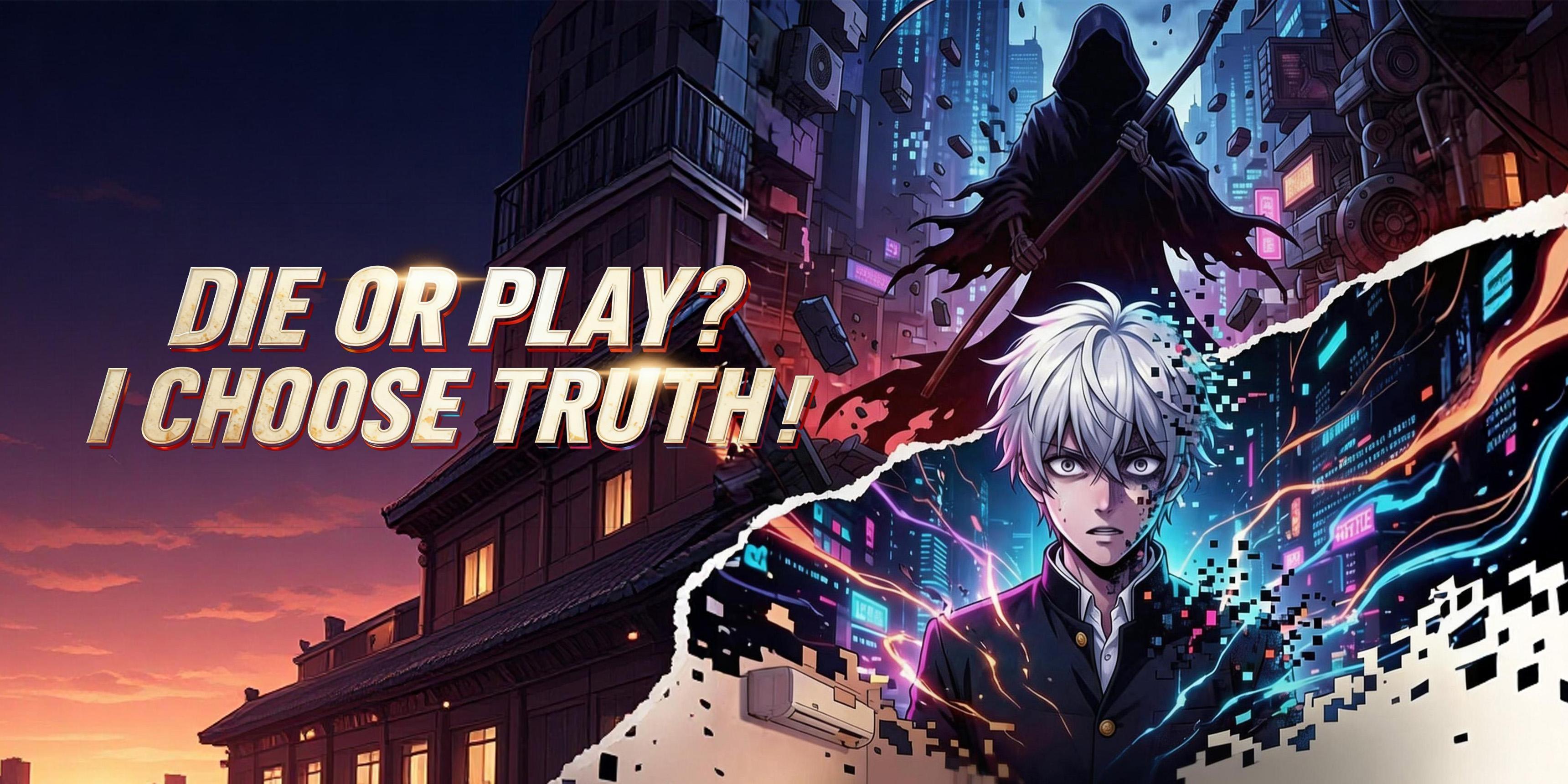
When death game stories stop being just games
Short dramas built around survival games have exploded in popularity recently. Audiences aren’t just looking for action anymore—they want tension that hits the brain as much as the nerves. That’s exactly where Die or Play? I Choose Truth! finds its edge.
Instead of relying purely on violence or shock, the story leans heavily on psychological traps. Every level forces characters to choose between survival and morality, which keeps the pacing tight while constantly shifting the emotional stakes. Viewers don’t just watch the game unfold—they start asking what they themselves would do in the same situation.
The result is the kind of short drama that’s easy to binge but hard to mentally shake off.

A hunt for a killer that turns into something far worse
At first, the premise seems straightforward: a man chasing a murderer suddenly becomes trapped inside a deadly game designed with frightening precision. Each level looks like a puzzle meant to break human instinct.
What makes the narrative interesting is how the protagonist refuses to follow the expected survival script. While others panic or betray each other, he keeps analyzing the system itself. His actions hint that he believes the game has a deeper purpose.
One turning point quietly changes everything: the moment he realizes the “players” might not actually be random victims. Someone selected them very carefully. That discovery turns the entire death game into something closer to a controlled experiment—and suddenly the real enemy isn’t inside the room.
Why these fictional games feel strangely familiar
Death game stories work because they exaggerate something people already experience in real life: pressure to choose between competing values.
In the show, players constantly face impossible decisions—save themselves, or risk everything to protect someone else. The situations may be extreme, but the emotional logic isn’t.
Modern work culture, social competition, and online judgment often push people into quieter versions of the same dilemma. The game’s rules simply strip away the polite surface and expose what people do when survival becomes the only priority.
That’s why watching the characters in Die or Play? I Choose Truth! feels less like fantasy and more like observing human behavior under a microscope.

When survival collides with truth
What makes the story linger isn’t the traps or puzzles—it’s the central question slowly forming beneath them.
Is surviving enough, if the system itself is built on manipulation?
The protagonist’s obsession with truth creates tension with other players who just want to escape alive. Some see him as reckless. Others suspect he knows more than he admits. And the deeper the game progresses, the more it feels like the rules were designed to test not intelligence, but moral limits.
The unsettling possibility: the experiment might not be about who lives, but about who refuses to look away.
A short drama that keeps tightening the psychological screws
Among survival-themed short dramas, Die or Play? I Choose Truth! stands out because it treats every level as a character test rather than just a spectacle. The tension grows from choices, secrets, and shifting alliances instead of endless action scenes.
That’s what makes the story addictive. Every answer reveals another question, and every clue hints that the truth behind the game is far darker than the players expect.
And once that hidden experiment starts to surface, it becomes impossible not to wonder: if you were inside the game, would you choose survival… or the truth?
If the premise already has your curiosity spinning, the best way to experience Die or Play? I Choose Truth! is to watch the full series on the NetShort app. The episodes move fast, the twists land hard, and there are plenty more short dramas waiting if you end up craving another late-night binge.
