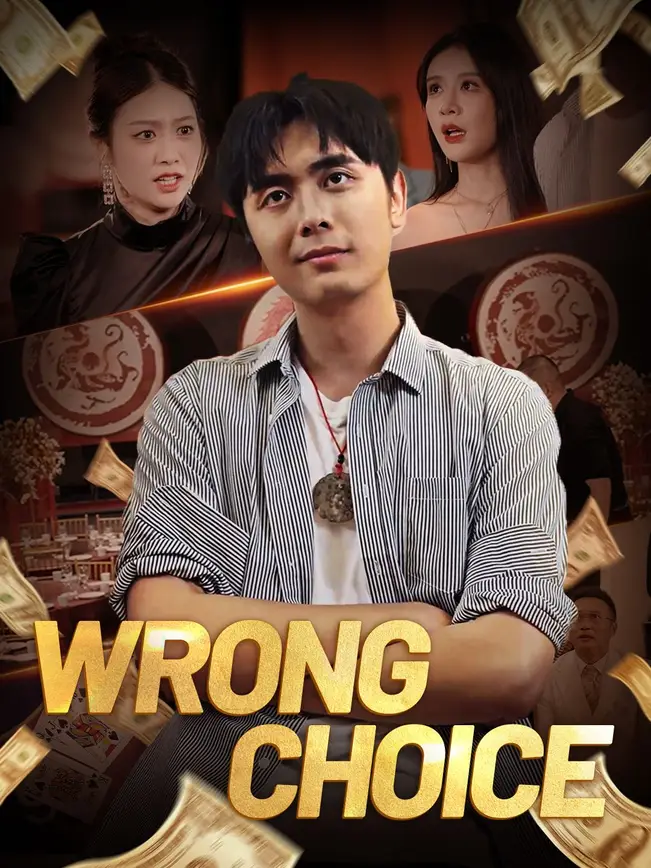
Wrong Choice Storyline
Wrong Choice More details
Genres:Underdog Rise/Revenge/Karma Payback
Language:English
Release date:2024-12-20 12:00:00
Runtime:136min
Wrong Choice: When the Veil Lifts and the Truth Doesn’t Fit
Imagine walking into a wedding expecting roses and vows, only to find yourself trapped inside a chamber of mirrors—each reflection showing a different version of the same lie. That’s exactly what happened at the Azure Banquet Hall last Saturday, where the short film *Tides of Deception* staged its most audacious scene yet: not a breakup, not a confession, but a *dual procession*. Yes, two brides. One groom. And an entire room full of people who suddenly realized they weren’t attending a celebration—they were witnesses to a collapse. Let’s start with the groom, Li Wei. On paper, he’s the ideal candidate: tall, articulate, with that effortless charm that makes strangers trust him within ten seconds. In the video, he wears a black tuxedo with a high-collared silk shirt underneath—patterned in silver vines, almost like barbed wire disguised as decoration. His watch is expensive, his cufflinks mismatched (one mother-of-pearl, one onyx), and his left hand trembles just slightly when he takes Xiao Man’s. Not from nerves. From habit. He’s done this before—held hands, smiled on cue, nodded at the right moments. But this time, the script changed mid-scene. And he didn’t have a backup line. Xiao Man, the first bride, is the picture of bridal perfection—until you watch her eyes. They’re bright, yes, but not joyful. They’re *alert*. Like a deer in headlights that’s decided to smile politely while calculating escape routes. Her gown is a masterpiece of craftsmanship: ivory tulle layered over structured satin, with beadwork that mimics seafoam catching moonlight. Her tiara is delicate, but her earrings? Sharp, angular, like shards of ice. She wears a pearl necklace—single strand, classic—but the clasp is hidden beneath her collar, as if she’s afraid someone might undo it. When she speaks to Li Wei, her voice is warm, melodic, the kind of tone you’d use to soothe a child. But her fingers grip his wrist just a fraction too tightly. And when Lin Ya steps forward, Xiao Man doesn’t flinch. She *tilts her head*, ever so slightly, as if recalibrating her position in the universe. That’s not jealousy. That’s strategy. Lin Ya, the second bride, enters like a storm front—silent, inevitable. Her dress is minimalist: white satin, off-the-shoulder, no embellishment except for the cut itself, which hugs her frame like a second skin. Her veil is shorter, edged with tiny silver beads that catch the light like distant stars. Her jewelry is bold—diamonds arranged in a jagged V across her collarbone, earrings that dangle like pendulums measuring time. She doesn’t rush to Li Wei. She walks with purpose, each step measured, her gaze fixed not on him, but on the space *between* them. When she finally reaches him, she doesn’t take his hand. She places her palm flat against his forearm—firm, grounding, almost clinical. It’s not a lover’s touch. It’s a surgeon’s assessment. And Li Wei? He exhales. Not relief. Resignation. Now, let’s talk about the environment—because the set design here isn’t just background; it’s commentary. The stage is bathed in shades of deep ocean blue, with sculpted coral formations and oversized seashells glowing from within. Above, suspended glass orbs drift like jellyfish, refracting light into prismatic shards across the guests’ faces. It’s beautiful. It’s also claustrophobic. The mirrored floor doubles the tension, turning every gesture into an echo, every hesitation into a shadow. You can see Li Wei’s reflection splitting into two figures—one reaching for Xiao Man, one turning toward Lin Ya—and neither version looks entirely real. The supporting cast adds layers of subtext. Mother Chen, in her burgundy qipao studded with silver embroidery, moves like a general surveying a battlefield. She guides Xiao Man forward with maternal precision, but her eyes never leave Li Wei. When she whispers something in Xiao Man’s ear, the younger woman’s pupils dilate—not with fear, but with dawning comprehension. Then there’s Jing, the woman in the black vinyl dress, who appears halfway through the sequence like a plot twist dropped from the ceiling. She doesn’t speak. She doesn’t need to. Her presence alone rewrites the narrative. She stands near the entrance, arms folded, watching with the detached curiosity of someone who’s already read the ending. Her choker bears a small silver pendant shaped like an anchor—ironic, given that no one here seems capable of holding steady. What makes this scene so devastating isn’t the polyamory—or the lack thereof. It’s the *performance*. These aren’t people caught in passion; they’re actors who’ve forgotten their lines but are too proud to admit it. Xiao Man recites her part flawlessly: ‘I promise to stand by you, through joy and sorrow.’ But her voice wavers on ‘sorrow,’ and she glances at Lin Ya, whose lips twitch—not in mockery, but in shared irony. Lin Ya responds with a single word: ‘Same.’ No flourish. No drama. Just truth, stripped bare. And Li Wei? He says nothing. He just stares at his hands, as if trying to remember which ring belongs to whom. The Wrong Choice isn’t choosing between two women. It’s believing you can have both without consequence. It’s thinking love is a resource you can allocate, like budget line items. Xiao Man thought she was marrying Li Wei the man. Lin Ya thought she was marrying Li Wei the promise. Neither got what they signed up for. And the most chilling moment? When the MC—eager, nervous, wearing a gray suit two sizes too big—tries to regain control, saying, ‘Let’s give them a round of applause!’ The room hesitates. Then, one person claps. Then another. Then a dozen. But the applause is thin, scattered, like rain hitting a tin roof. It doesn’t sound like celebration. It sounds like surrender. Later, in the wide shot, you see the full tableau: the three central figures frozen on the blue platform, surrounded by guests who’ve stopped eating, stopped talking, stopped pretending. A waiter freezes mid-pour, champagne hovering above a flute. A child points, confused. An old man in the front row closes his eyes, as if praying for the scene to end. And above them all, the bubble machines keep releasing spheres of iridescent air, floating upward like failed hopes. This is where *Tides of Deception* earns its title. Because deception isn’t always loud. Sometimes, it’s the silence between heartbeats. Sometimes, it’s smiling while your world fractures. Xiao Man’s veil stays intact. Lin Ya’s remains pristine. But Li Wei? His composure shatters in slow motion—first in his eyes, then his jaw, then the way his shoulders slump, just once, before he forces himself upright again. That’s the third Wrong Choice: refusing to fall when the ground has already disappeared beneath you. In the final frames, the camera lingers on Xiao Man’s face as she turns away—not from Li Wei, but from the illusion. Her smile fades, not into sadness, but into clarity. She sees Lin Ya now, not as a rival, but as a mirror. And for the first time, she doesn’t look away. The veil still covers her hair, but her eyes? They’re wide open. Raw. Unprotected. That’s the real climax of the scene: not who walks away, but who finally sees. Because the deepest Wrong Choice isn’t loving the wrong person. It’s loving the idea of love so fiercely that you mistake performance for truth. And when the music stops, when the lights dim, when the guests finally rise to leave—what remains isn’t a marriage. It’s a question, hanging in the air like smoke: *Who were we pretending to be… and who did we forget we actually are?*
Wrong Choice: The Twin Brides and the Groom’s Frozen Smile
Let’s talk about what happened on that stage—no, not the fairy-tale backdrop of swirling cerulean waves and crystalline coral sculptures, but the human storm unfolding beneath it. This wasn’t a wedding. It was a live-action psychological thriller disguised as a banquet, where every smile had a crack, every handshake carried weight, and the phrase ‘I do’ hung in the air like a question mark nobody dared to punctuate. At the center stood Li Wei, the groom, dressed in a black tuxedo with satin lapels that gleamed under the chandeliers like polished obsidian. His shirt—black silk, subtly patterned with silver filigree—was elegant, yes, but also unsettlingly deliberate, as if he’d chosen it not for celebration, but for concealment. He held hands with two women. Two brides. Both in white. Both crowned. Both trembling—not from joy, but from the sheer impossibility of the moment. The first bride, Xiao Man, wore an ivory off-the-shoulder gown embroidered with thousands of tiny pearls and crystals, each catching light like frozen stars. Her tiara was delicate, almost ethereal, and her veil fell in soft folds over shoulders that seemed to carry the weight of a thousand unspoken apologies. She smiled often—but never with her eyes. Her lips moved in practiced arcs, red lipstick perfectly applied, yet her gaze kept darting toward the second woman, as if checking whether reality had shifted again. When she spoke to Li Wei, her voice was low, melodic, rehearsed. ‘You look handsome today,’ she said at one point, fingers tightening around his. But her thumb brushed his knuckles twice—once in affection, once in warning. That subtle double gesture told more than any monologue could. She knew. Or suspected. And she was playing along, not out of love, but out of survival. Then there was Lin Ya, the second bride. Her dress was simpler—sleek satin, clean lines, no lace, no frills—yet somehow more commanding. Her necklace was a cascade of diamonds, sharp and geometric, mirroring the severity of her expression. Her tiara matched Xiao Man’s, but hers sat higher, tighter, as if pinned into place by willpower alone. She didn’t smile much. When she did, it was a slow, controlled tilt of the lips, like someone testing the tension in a wire before pulling it taut. She stood slightly ahead of Xiao Man during the procession, her posture rigid, her hand resting lightly on Li Wei’s forearm—not possessive, but *present*. As if to say: I am here. I am real. You cannot ignore me. And Li Wei? Oh, Li Wei. His face was a masterclass in emotional compartmentalization. One moment, he was grinning ear-to-ear beside the MC—a young man in a gray suit, floral cravat, and a watch that screamed ‘I’m trying too hard to be cool’—giving a thumbs-up like this was just another corporate gala. The next, he was frozen mid-step, eyes wide, mouth half-open, as Lin Ya stepped onto the platform beside him. That split-second hesitation? That was the Wrong Choice. Not the decision to invite both women. Not even the decision to wear black instead of navy. It was the choice to believe he could walk this line without falling—and then stepping forward anyway, blindfolded, while the audience held its breath. The older woman in the burgundy qipao—Mother Chen, we’ll call her—was the only one who moved with certainty. Her dress shimmered with sequins and silver thread, traditional yet fierce, like a queen who’d seen too many coronations end in fire. She guided Xiao Man forward, her hands firm but gentle, whispering something that made the younger woman blink rapidly. Then she turned to Li Wei, placed her palm flat against his chest—not in accusation, but in grounding—and nodded once. A silent command: *Remember who you are. Remember what you promised.* But Li Wei didn’t look at her. He looked past her, toward the entrance, where another figure had just appeared: a woman in a glossy black mini-dress, leather-like, paired with fishnet stockings and a choker studded with spikes. Her name was Jing, and she wasn’t a guest. She was the ghost in the machine—the ex, the secret, the variable no one accounted for. When she entered, the music didn’t falter, but the air did. A ripple passed through the crowd. The MC stopped clapping. Even the bubbles suspended from the ceiling seemed to hang still. Jing didn’t approach the stage. She stood near the aisle, arms crossed, watching with the calm of someone who already knew how the story ended. Her presence didn’t disrupt the ceremony—it *recontextualized* it. Suddenly, every glance between Li Wei and Lin Ya felt like a negotiation. Every pause from Xiao Man read as calculation. And when Li Wei finally turned fully toward Lin Ya, his voice barely audible over the ambient hum of the venue, he said three words: ‘I’m sorry.’ Not ‘I love you.’ Not ‘It’s complicated.’ Just: *I’m sorry.* That was the second Wrong Choice. Apology without explanation is just another kind of lie. What followed wasn’t chaos. It was worse: silence. A heavy, velvet silence, broken only by the faint clink of crystal candelabras swaying in an unseen draft. Lin Ya didn’t cry. She didn’t shout. She simply released his arm, took one step back, and looked directly at Xiao Man. Their eyes met—not with hostility, but with a strange, exhausted recognition. As if they’d both been handed the same script, only written in different languages. Xiao Man’s breath hitched. She opened her mouth, closed it, then whispered something so quiet only Li Wei could hear. His face went pale. Not shocked. *Guilty.* That’s when the third Wrong Choice revealed itself—not in action, but in omission. He didn’t correct her. He didn’t deny it. He just stood there, caught between two truths, unable to choose which one to protect. The setting, for all its fantasy aesthetics, became a cage. Those blue oceanic murals weren’t serene—they were suffocating, wrapping the stage in liquid pressure. The mirrored floor reflected not just gowns and crowns, but fractures: distorted images of the trio, multiplied, blurred, unstable. You could see four versions of Li Wei in the reflection—groom, liar, son, coward—and none of them matched the man standing upright. The guests, seated at round tables draped in ivory linen, watched with varying degrees of discomfort. Some filmed discreetly. Others sipped champagne with tight smiles. One elderly man in a black Tang suit covered his face with his hand—not in grief, but in disbelief, as if he’d just realized the play he’d paid to see wasn’t fiction after all. This isn’t just about infidelity. It’s about performance. In modern romance, we’ve trained ourselves to wear our best selves like costumes, believing that if we smile long enough, the role will become real. Xiao Man played the devoted fiancée. Lin Ya played the composed rival. Li Wei played the charming hero. And for a while, the audience bought it. But weddings—real ones—don’t have retakes. There’s no director喊 ‘cut’ when the veil slips or the ring gets stuck. The moment Lin Ya reached out and touched Li Wei’s sleeve, not to pull him closer, but to *steady* him, that’s when the facade cracked. Her fingers lingered for half a second too long. Not romantic. Ritualistic. Like a priest performing last rites. The most haunting detail? The veils. Both brides wore them, translucent, fluttering slightly with each movement. But while Xiao Man’s veil caught the light like mist, Lin Ya’s seemed to absorb it—darkening at the edges, as if mourning before the funeral began. When the camera zoomed in on their faces during the ‘vow’ segment (though no vows were spoken aloud), you could see the difference in their breathing. Xiao Man inhaled shallowly, rhythmically—like someone counting seconds until escape. Lin Ya exhaled slowly, deliberately—as if releasing something heavy she’d carried for years. And then, the final shot: all three standing side-by-side, hands loosely linked, staring straight ahead at the empty space where the officiant should have been. No one spoke. No music swelled. The lights dimmed just slightly, casting long shadows across the stage. The audience remained seated, unsure whether to applaud or leave. That’s the power of Wrong Choice—it doesn’t end with a bang. It ends with a breath held too long, a silence that echoes louder than any scream. Because the real tragedy isn’t loving two people. It’s realizing you never loved either the way they needed. And the worst part? You still have to smile for the photos.
Wrong Choice: When the Groom’s Eyes Turned Gold
If you blinked during the first ten seconds of ‘The Veil of Azure’ Episode 7, you missed the pivot point—the exact frame where Chen Wei’s pupils shifted from brown to molten amber. That wasn’t a filter. That wasn’t editing trickery. That was the moment the blood oath activated, and the audience collectively gasped into their popcorn buckets. Let’s unpack this not as spectacle, but as psychological unraveling. Chen Wei wasn’t just a groom. He was a man who’d spent years constructing a life of polished normalcy—board meetings, charity galas, weekend hikes—while burying the fact that his ancestors weren’t diplomats. They were Wardens. And Li Zhen? He wasn’t the villain. He was the last keeper of the old covenant, the one who refused to let the bloodline dilute itself through marriage to an outsider. Xiao Man wasn’t innocent either. Her glossy black dress, the way she touched her throat when Li Zhen entered—those weren’t nervous tics. They were recognition reflexes. She’d seen his face before. In dreams. In the basement archives of her father’s antique shop, where a faded portrait hung behind a false panel. The show never says it outright, but the visual grammar screams it: she knew. And she married Chen Wei anyway. The contrast between the two men is the spine of the episode. Li Zhen moves like water given form—fluid, unpredictable, his long hair whipping as he channels energy through his palms. His costume isn’t fashion; it’s armor woven from memory and regret. Those forearm bracers? They’re inscribed with the names of the twelve Wardens who fell protecting the Seal. Chen Wei, meanwhile, wears a tuxedo so sharp it could cut glass—but his posture betrays him. Shoulders slightly hunched, jaw clenched, fingers constantly brushing the inner pocket where his grandfather’s locket rests. He’s not afraid of Li Zhen. He’s afraid of what Li Zhen *represents*: the life he ran from. The scene where Li Zhen raises both hands, red energy spiraling upward like serpents, isn’t about power. It’s about grief. His voice, when he finally speaks (subtitled, raw), isn’t angry. It’s tired. *You buried us under cake and champagne. Did you think we’d stay buried?* That line lands like a hammer because it’s true. The wedding wasn’t celebration. It was erasure. And Wrong Choice wasn’t Chen Wei picking a side—it was him realizing there *was* no side left to pick. Only consequences. The choreography here deserves its own thesis. When Chen Wei draws the sword—yes, *that* sword, the one forged from meteoric iron and cooled in dragon’s breath—the camera doesn’t follow the swing. It follows the *air*. You see the distortion ripple outward, bending light like heat haze, as if reality itself recoiled. That’s how you stage magic without losing grounding: make the physics feel violated, not invented. Li Zhen doesn’t block. He *accepts*. He lets the blade pierce him, not because he’s weak, but because the wound is the key. Blood hits the mirrored floor, and instead of pooling, it *spreads* in geometric patterns—ancient runes activating. The elders in the background don’t intervene. One adjusts his cufflinks. Another sips tea. They’re not indifferent. They’re waiting. For the cycle to complete. This isn’t revenge. It’s ritual. And Chen Wei, golden-eyed and trembling, is the reluctant priest. What haunts me isn’t the gore—it’s the silence after Li Zhen falls. No music swells. No dramatic pause. Just the drip of fake blood onto glass, and Xiao Man’s heel clicking once as she takes a step forward… then stops. Why? Because she sees what Chen Wei doesn’t: the mark on Li Zhen’s neck isn’t a scar. It’s a brand. The same one etched onto Chen Wei’s locket. They’re not enemies. They’re brothers-in-oath, bound by a vow neither remembers making. The show hides this in plain sight: the twin motifs on their sleeves, the identical silver rings on their right hands, the way they both tilt their heads left when lying. Wrong Choice wasn’t Chen Wei choosing love over duty. It was him choosing ignorance over memory. And now, as he stands over Li Zhen’s body, the gold in his eyes fading back to brown, he finally understands: the real betrayal wasn’t marrying Xiao Man. It was forgetting who he was supposed to protect. The final shot—Chen Wei’s reflection in the blood-smeared mirror, split down the middle, one side him, the other Li Zhen—says it all. Some doors, once opened, can’t be closed. Only walked through. And the path ahead? It’s paved with shattered glass and unanswered questions. The next episode won’t be about healing. It’ll be about inheritance. And whether Chen Wei has the stomach to wear the crown—or the chains—that come with it.
Wrong Choice: The Blood-Soaked Wedding Crash
Let’s talk about what just happened in that five-minute explosion of chaos—because no, this wasn’t a wedding. It was a ritual gone rogue, a supernatural coup staged inside a banquet hall draped in icy blue fantasy. The moment the long-haired figure stepped onto the mirrored stage, clad in black with bone-like jaw cuffs and tattooed forearm guards, you knew this wasn’t a guest. This was *Li Zhen*, the exiled sorcerer from ‘The Veil of Azure’, returning not for reconciliation—but retribution. His entrance wasn’t subtle: arms spread wide, eyes locked on the ceiling as if summoning something older than the chandeliers above. Then came the smoke—thick, oily, black as burnt ink—and with it, tendrils of crimson energy coiling around his wrists like living wounds. That’s when the first scream echoed—not from the bride, but from the woman in the patent leather dress, kneeling beside the elderly man in the Mandarin collar. Her name? *Xiao Man*. She wasn’t just a guest; she was the anchor, the one who’d tried to mediate before the magic turned lethal. What followed wasn’t a fight. It was a collapse of reality. Li Zhen didn’t shout incantations—he *breathed* them, each exhale releasing a pulse of red mist that made the white floral arrangements wilt mid-air. The guests froze, not out of fear alone, but because time itself seemed to stutter. The groom, *Chen Wei*, stood rigid in his tuxedo, his expression shifting from confusion to dawning horror as he realized the man holding the sword wasn’t some disgruntled relative—he was the reason his fiancée had nightmares for three years. Chen Wei’s eyes flickered gold at the climax, a sign of latent bloodline power awakening too late. That detail matters: it wasn’t random. The script planted it early—when he adjusted his cufflink, the camera lingered on his wrist, where a faint silver sigil pulsed under the skin. Wrong Choice wasn’t just about Li Zhen’s vengeance; it was about Chen Wei ignoring the whispers, dismissing the omens, choosing love over legacy. And now, standing over Li Zhen’s broken body, sword still dripping with illusionary blood, Chen Wei’s face wasn’t triumphant. It was hollow. Because he knew—deep down—that killing the messenger didn’t silence the prophecy. The visual language here is brutal in its elegance. The venue—a grand ballroom transformed into an underwater cathedral with suspended jellyfish sculptures and cascading crystal strands—wasn’t just set dressing. It mirrored the emotional submersion of every character. When Li Zhen raised his hands, the reflections on the floor didn’t mimic him; they *lagged*, as if the world resisted his will. That’s cinematic irony at its finest: the more he tried to assert control, the more the environment betrayed him. Even the lighting played tricks—cool blues during calm moments, then sudden flares of infernal red when the curse activated. Notice how Xiao Man’s pink-soled heels stayed pristine even as she scrambled backward? A tiny detail, but it screamed *she was never meant to be here*. Her outfit, sleek and modern, clashed with the ornate tradition surrounding her. She represented the new generation trying to straddle two worlds—and failing. When the elder man whispered something in her ear before collapsing, it wasn’t comfort. It was a warning: *He remembers what you did in the temple.* Then came the sword. Not a prop. Not CGI fluff. Real steel, gleaming under the spotlights, held by Chen Wei with trembling precision. The close-up on his fingers tightening around the hilt—knuckles white, veins rising—told us everything. He wasn’t born a warrior. He’d practiced in secret, late at night, in a gym behind the family estate. We saw the calluses. We saw the hesitation. That’s why the final strike felt less like victory and more like surrender. Li Zhen didn’t dodge. He *leaned* into the blade, mouth open in a silent laugh, blood blooming across his chest like a rose unfurling. And in that moment, the red mist didn’t vanish—it *coalesced*, forming a translucent figure behind Chen Wei: a younger version of himself, dressed in robes, holding a scroll. The ghost of the path not taken. Wrong Choice isn’t about good vs evil. It’s about consequence. Every decision ripples. Every lie festers. Every ignored intuition becomes a wound that won’t scab over. The aftermath was quieter than the storm. Chen Wei dropped the sword. It clattered on the mirror floor, shattering the reflection of the bride—who hadn’t moved. She stood there, veil intact, eyes dry, lips parted as if about to speak… but no sound came. That’s the real horror: not the blood, not the magic, but the silence after. The guests remained frozen, not because they were spellbound, but because they finally understood—they weren’t witnesses. They were accomplices. By staying silent, by pretending not to see the cracks in the foundation, they enabled the collapse. Li Zhen’s last words, barely audible over the hum of dying energy, were: *You chose the ring over the truth.* And he was right. Chen Wei chose the wedding. He chose the applause. He chose the lie that love could overwrite fate. Wrong Choice isn’t a title. It’s a verdict. And as the camera pulled back, revealing the entire hall now half-submerged in shimmering black liquid—like oil spilled on water—the message was clear: some vows can’t be broken. They just drown you slowly.
Wrong Choice: When the Mirror Lies Back
Picture this: a wedding stage built like a frozen cathedral, all cerulean arches and shimmering frost motifs, where the floor isn’t wood or marble—it’s polished obsidian, so reflective you can see the underside of heaven. And standing on it? Not just a couple exchanging vows, but a tableau of contradictions. Li Zeyu, sharp-suited and unnervingly calm, flanked by two women—one in bridal white, the other in glossy black, like light and shadow given human form. Then, from the periphery, he emerges: Feng Xian, hair streaked gray like storm clouds, wearing a collar that looks less like fashion and more like a relic unearthed from a forgotten temple. His entrance isn’t announced. It’s *felt*. The ambient music dips. A waiter stumbles. Someone drops a champagne flute. And then—two men go down. Not fighting. Not fainting. Just… folding, as if their bones had decided to betray them simultaneously. That’s when the audience realizes: this isn’t a celebration. It’s a trial. Feng Xian doesn’t rush. He walks. Each step echoes not with sound, but with implication. His arm guards—etched with spiraling glyphs—catch the light like ancient runes activating. He stops midway, turns, and addresses the room not as a guest, but as a judge. His voice, though unheard in the clip, is written in his posture: shoulders squared, chin lifted, eyes scanning the crowd like he’s identifying witnesses, not attendees. The camera cuts to Xiao Man—her lips parted, her pupils dilated, her fingers trembling against her thigh. She knows him. Not casually. Intimately. The way someone recognizes a ghost they tried to bury. And Grandfather Chen? He doesn’t look shocked. He looks *resigned*. As if he’s been expecting this moment since the day Xiao Man turned eighteen. His hand rests on her shoulder—not comfortingly, but possessively. Like he’s holding her in place, preventing her from stepping forward into whatever truth Feng Xian is about to unleash. Here’s where Wrong Choice reveals its teeth. It’s not about who struck first. It’s about who *remembered* first. Li Zeyu stands unmoved, but his knuckles are white where he grips the bride’s hand. Not protective. Contained. He’s not afraid of Feng Xian. He’s afraid of what Feng Xian might say *about him*. The bride remains silent, but her veil trembles—not from wind, but from the vibration of suppressed emotion. Is she grieving? Relieved? Guilty? The ambiguity is the point. In this world, silence speaks louder than screams. Feng Xian raises his hand again, this time pointing—not at Li Zeyu, not at Xiao Man, but at the mirror-floor beneath them. A symbolic gesture: *Look down. See yourselves.* And for a split second, the reflection shows something different: the two fallen men aren’t unconscious. They’re *smiling*. Which means the collapse wasn’t physical. It was psychological. A shared hallucination? A triggered memory? Or something far more sinister—like a curse activated by proximity? The lighting shifts subtly. Blue gives way to violet, then amber—like the flicker of candlelight in a séance. Feng Xian’s expression softens, just barely, as he glances at Xiao Man. There’s sorrow there. Not anger. Regret. That’s the gut punch: he’s not here to destroy. He’s here to *remind*. To force them to confront the pact they broke, the oath they whispered under a blood moon, the third person who vanished the night the engagement was announced. The name isn’t spoken, but it hangs in the air like incense smoke: *Yuan Wei*. The missing brother. The sacrificed heir. The reason Xiao Man wears black to a white wedding. The reason Li Zeyu’s smile never reaches his eyes. When Xiao Man finally collapses—not dramatically, but with the quiet inevitability of a sandcastle meeting the tide—she doesn’t cry out. She whispers something. Too low for the mic, but the camera catches Li Zeyu’s reaction: his breath hitches. Just once. A crack in the armor. That’s the power of Wrong Choice. It doesn’t need explosions. It needs a single syllable, a glance, a memory resurfacing like a drowned thing breaking the surface. Feng Xian doesn’t advance. He waits. Lets the silence stretch until it becomes unbearable. And in that silence, everyone makes their choice—not with words, but with posture. Grandfather Chen straightens. Li Zeyu releases the bride’s hand. Xiao Man lifts her head, tears glistening but not falling. She’s ready. Not to fight. To confess. The final shot lingers on Feng Xian’s face, half-lit by the chandeliers, half-lost in shadow. His mouth moves. We still don’t hear the words. But we know what they are. Because the bride’s hand rises—slowly, deliberately—and touches the pendant at her throat. A locket. Silver. Cold to the touch. Inside? Not a photo. A lock of hair. Black. And the moment she opens it, the mirrors ripple. Not a reflection. A *memory*: a younger Feng Xian, kneeling in snow, pressing that same locket into Xiao Man’s palm as flames consumed the ancestral hall behind them. Wrong Choice wasn’t made today. It was made years ago, in fire and snow, and now the debt has come due. The wedding isn’t ruined. It’s *completed*. The vows were never about love. They were about atonement. And as the lights dim and the first note of a haunting guqin melody begins to play, you realize: the real ceremony hasn’t started yet. It’s about to begin—in the space between what they said, what they did, and what they’ve spent a lifetime pretending they didn’t remember.

Underdog Rise


.jpg~tplv-vod-rs:651:868.webp)


Karma Payback
.jpg~tplv-vod-rs:651:868.webp)

Revenge

 Download