




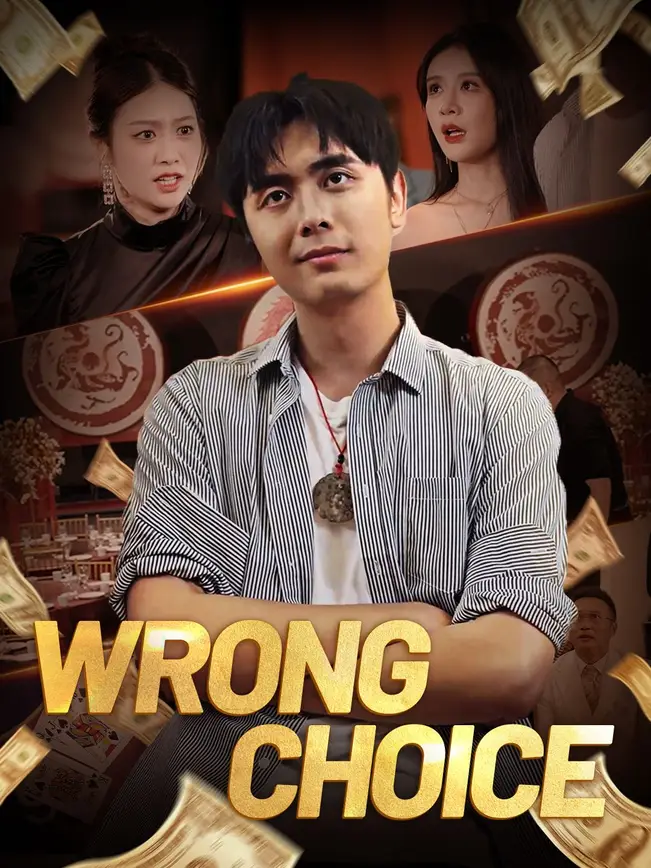
Wrong Choice Storyline
Wrong Choice More details
Genres:Underdog Rise/Revenge/Karma Payback
Language:English
Release date:2024-12-20 12:00:00
Runtime:136min
Wrong Choice: When the Veil Lifts and the Truth Doesn’t Fit
Imagine walking into a wedding expecting roses and vows, only to find yourself trapped inside a chamber of mirrors—each reflection showing a different version of the same lie. That’s exactly what happened at the Azure Banquet Hall last Saturday, where the short film *Tides of Deception* staged its most audacious scene yet: not a breakup, not a confession, but a *dual procession*. Yes, two brides. One groom. And an entire room full of people who suddenly realized they weren’t attending a celebration—they were witnesses to a collapse. Let’s start with the groom, Li Wei. On paper, he’s the ideal candidate: tall, articulate, with that effortless charm that makes strangers trust him within ten seconds. In the video, he wears a black tuxedo with a high-collared silk shirt underneath—patterned in silver vines, almost like barbed wire disguised as decoration. His watch is expensive, his cufflinks mismatched (one mother-of-pearl, one onyx), and his left hand trembles just slightly when he takes Xiao Man’s. Not from nerves. From habit. He’s done this before—held hands, smiled on cue, nodded at the right moments. But this time, the script changed mid-scene. And he didn’t have a backup line. Xiao Man, the first bride, is the picture of bridal perfection—until you watch her eyes. They’re bright, yes, but not joyful. They’re *alert*. Like a deer in headlights that’s decided to smile politely while calculating escape routes. Her gown is a masterpiece of craftsmanship: ivory tulle layered over structured satin, with beadwork that mimics seafoam catching moonlight. Her tiara is delicate, but her earrings? Sharp, angular, like shards of ice. She wears a pearl necklace—single strand, classic—but the clasp is hidden beneath her collar, as if she’s afraid someone might undo it. When she speaks to Li Wei, her voice is warm, melodic, the kind of tone you’d use to soothe a child. But her fingers grip his wrist just a fraction too tightly. And when Lin Ya steps forward, Xiao Man doesn’t flinch. She *tilts her head*, ever so slightly, as if recalibrating her position in the universe. That’s not jealousy. That’s strategy. Lin Ya, the second bride, enters like a storm front—silent, inevitable. Her dress is minimalist: white satin, off-the-shoulder, no embellishment except for the cut itself, which hugs her frame like a second skin. Her veil is shorter, edged with tiny silver beads that catch the light like distant stars. Her jewelry is bold—diamonds arranged in a jagged V across her collarbone, earrings that dangle like pendulums measuring time. She doesn’t rush to Li Wei. She walks with purpose, each step measured, her gaze fixed not on him, but on the space *between* them. When she finally reaches him, she doesn’t take his hand. She places her palm flat against his forearm—firm, grounding, almost clinical. It’s not a lover’s touch. It’s a surgeon’s assessment. And Li Wei? He exhales. Not relief. Resignation. Now, let’s talk about the environment—because the set design here isn’t just background; it’s commentary. The stage is bathed in shades of deep ocean blue, with sculpted coral formations and oversized seashells glowing from within. Above, suspended glass orbs drift like jellyfish, refracting light into prismatic shards across the guests’ faces. It’s beautiful. It’s also claustrophobic. The mirrored floor doubles the tension, turning every gesture into an echo, every hesitation into a shadow. You can see Li Wei’s reflection splitting into two figures—one reaching for Xiao Man, one turning toward Lin Ya—and neither version looks entirely real. The supporting cast adds layers of subtext. Mother Chen, in her burgundy qipao studded with silver embroidery, moves like a general surveying a battlefield. She guides Xiao Man forward with maternal precision, but her eyes never leave Li Wei. When she whispers something in Xiao Man’s ear, the younger woman’s pupils dilate—not with fear, but with dawning comprehension. Then there’s Jing, the woman in the black vinyl dress, who appears halfway through the sequence like a plot twist dropped from the ceiling. She doesn’t speak. She doesn’t need to. Her presence alone rewrites the narrative. She stands near the entrance, arms folded, watching with the detached curiosity of someone who’s already read the ending. Her choker bears a small silver pendant shaped like an anchor—ironic, given that no one here seems capable of holding steady. What makes this scene so devastating isn’t the polyamory—or the lack thereof. It’s the *performance*. These aren’t people caught in passion; they’re actors who’ve forgotten their lines but are too proud to admit it. Xiao Man recites her part flawlessly: ‘I promise to stand by you, through joy and sorrow.’ But her voice wavers on ‘sorrow,’ and she glances at Lin Ya, whose lips twitch—not in mockery, but in shared irony. Lin Ya responds with a single word: ‘Same.’ No flourish. No drama. Just truth, stripped bare. And Li Wei? He says nothing. He just stares at his hands, as if trying to remember which ring belongs to whom. The Wrong Choice isn’t choosing between two women. It’s believing you can have both without consequence. It’s thinking love is a resource you can allocate, like budget line items. Xiao Man thought she was marrying Li Wei the man. Lin Ya thought she was marrying Li Wei the promise. Neither got what they signed up for. And the most chilling moment? When the MC—eager, nervous, wearing a gray suit two sizes too big—tries to regain control, saying, ‘Let’s give them a round of applause!’ The room hesitates. Then, one person claps. Then another. Then a dozen. But the applause is thin, scattered, like rain hitting a tin roof. It doesn’t sound like celebration. It sounds like surrender. Later, in the wide shot, you see the full tableau: the three central figures frozen on the blue platform, surrounded by guests who’ve stopped eating, stopped talking, stopped pretending. A waiter freezes mid-pour, champagne hovering above a flute. A child points, confused. An old man in the front row closes his eyes, as if praying for the scene to end. And above them all, the bubble machines keep releasing spheres of iridescent air, floating upward like failed hopes. This is where *Tides of Deception* earns its title. Because deception isn’t always loud. Sometimes, it’s the silence between heartbeats. Sometimes, it’s smiling while your world fractures. Xiao Man’s veil stays intact. Lin Ya’s remains pristine. But Li Wei? His composure shatters in slow motion—first in his eyes, then his jaw, then the way his shoulders slump, just once, before he forces himself upright again. That’s the third Wrong Choice: refusing to fall when the ground has already disappeared beneath you. In the final frames, the camera lingers on Xiao Man’s face as she turns away—not from Li Wei, but from the illusion. Her smile fades, not into sadness, but into clarity. She sees Lin Ya now, not as a rival, but as a mirror. And for the first time, she doesn’t look away. The veil still covers her hair, but her eyes? They’re wide open. Raw. Unprotected. That’s the real climax of the scene: not who walks away, but who finally sees. Because the deepest Wrong Choice isn’t loving the wrong person. It’s loving the idea of love so fiercely that you mistake performance for truth. And when the music stops, when the lights dim, when the guests finally rise to leave—what remains isn’t a marriage. It’s a question, hanging in the air like smoke: *Who were we pretending to be… and who did we forget we actually are?*
Wrong Choice: The Twin Brides and the Groom’s Frozen Smile
Let’s talk about what happened on that stage—no, not the fairy-tale backdrop of swirling cerulean waves and crystalline coral sculptures, but the human storm unfolding beneath it. This wasn’t a wedding. It was a live-action psychological thriller disguised as a banquet, where every smile had a crack, every handshake carried weight, and the phrase ‘I do’ hung in the air like a question mark nobody dared to punctuate. At the center stood Li Wei, the groom, dressed in a black tuxedo with satin lapels that gleamed under the chandeliers like polished obsidian. His shirt—black silk, subtly patterned with silver filigree—was elegant, yes, but also unsettlingly deliberate, as if he’d chosen it not for celebration, but for concealment. He held hands with two women. Two brides. Both in white. Both crowned. Both trembling—not from joy, but from the sheer impossibility of the moment. The first bride, Xiao Man, wore an ivory off-the-shoulder gown embroidered with thousands of tiny pearls and crystals, each catching light like frozen stars. Her tiara was delicate, almost ethereal, and her veil fell in soft folds over shoulders that seemed to carry the weight of a thousand unspoken apologies. She smiled often—but never with her eyes. Her lips moved in practiced arcs, red lipstick perfectly applied, yet her gaze kept darting toward the second woman, as if checking whether reality had shifted again. When she spoke to Li Wei, her voice was low, melodic, rehearsed. ‘You look handsome today,’ she said at one point, fingers tightening around his. But her thumb brushed his knuckles twice—once in affection, once in warning. That subtle double gesture told more than any monologue could. She knew. Or suspected. And she was playing along, not out of love, but out of survival. Then there was Lin Ya, the second bride. Her dress was simpler—sleek satin, clean lines, no lace, no frills—yet somehow more commanding. Her necklace was a cascade of diamonds, sharp and geometric, mirroring the severity of her expression. Her tiara matched Xiao Man’s, but hers sat higher, tighter, as if pinned into place by willpower alone. She didn’t smile much. When she did, it was a slow, controlled tilt of the lips, like someone testing the tension in a wire before pulling it taut. She stood slightly ahead of Xiao Man during the procession, her posture rigid, her hand resting lightly on Li Wei’s forearm—not possessive, but *present*. As if to say: I am here. I am real. You cannot ignore me. And Li Wei? Oh, Li Wei. His face was a masterclass in emotional compartmentalization. One moment, he was grinning ear-to-ear beside the MC—a young man in a gray suit, floral cravat, and a watch that screamed ‘I’m trying too hard to be cool’—giving a thumbs-up like this was just another corporate gala. The next, he was frozen mid-step, eyes wide, mouth half-open, as Lin Ya stepped onto the platform beside him. That split-second hesitation? That was the Wrong Choice. Not the decision to invite both women. Not even the decision to wear black instead of navy. It was the choice to believe he could walk this line without falling—and then stepping forward anyway, blindfolded, while the audience held its breath. The older woman in the burgundy qipao—Mother Chen, we’ll call her—was the only one who moved with certainty. Her dress shimmered with sequins and silver thread, traditional yet fierce, like a queen who’d seen too many coronations end in fire. She guided Xiao Man forward, her hands firm but gentle, whispering something that made the younger woman blink rapidly. Then she turned to Li Wei, placed her palm flat against his chest—not in accusation, but in grounding—and nodded once. A silent command: *Remember who you are. Remember what you promised.* But Li Wei didn’t look at her. He looked past her, toward the entrance, where another figure had just appeared: a woman in a glossy black mini-dress, leather-like, paired with fishnet stockings and a choker studded with spikes. Her name was Jing, and she wasn’t a guest. She was the ghost in the machine—the ex, the secret, the variable no one accounted for. When she entered, the music didn’t falter, but the air did. A ripple passed through the crowd. The MC stopped clapping. Even the bubbles suspended from the ceiling seemed to hang still. Jing didn’t approach the stage. She stood near the aisle, arms crossed, watching with the calm of someone who already knew how the story ended. Her presence didn’t disrupt the ceremony—it *recontextualized* it. Suddenly, every glance between Li Wei and Lin Ya felt like a negotiation. Every pause from Xiao Man read as calculation. And when Li Wei finally turned fully toward Lin Ya, his voice barely audible over the ambient hum of the venue, he said three words: ‘I’m sorry.’ Not ‘I love you.’ Not ‘It’s complicated.’ Just: *I’m sorry.* That was the second Wrong Choice. Apology without explanation is just another kind of lie. What followed wasn’t chaos. It was worse: silence. A heavy, velvet silence, broken only by the faint clink of crystal candelabras swaying in an unseen draft. Lin Ya didn’t cry. She didn’t shout. She simply released his arm, took one step back, and looked directly at Xiao Man. Their eyes met—not with hostility, but with a strange, exhausted recognition. As if they’d both been handed the same script, only written in different languages. Xiao Man’s breath hitched. She opened her mouth, closed it, then whispered something so quiet only Li Wei could hear. His face went pale. Not shocked. *Guilty.* That’s when the third Wrong Choice revealed itself—not in action, but in omission. He didn’t correct her. He didn’t deny it. He just stood there, caught between two truths, unable to choose which one to protect. The setting, for all its fantasy aesthetics, became a cage. Those blue oceanic murals weren’t serene—they were suffocating, wrapping the stage in liquid pressure. The mirrored floor reflected not just gowns and crowns, but fractures: distorted images of the trio, multiplied, blurred, unstable. You could see four versions of Li Wei in the reflection—groom, liar, son, coward—and none of them matched the man standing upright. The guests, seated at round tables draped in ivory linen, watched with varying degrees of discomfort. Some filmed discreetly. Others sipped champagne with tight smiles. One elderly man in a black Tang suit covered his face with his hand—not in grief, but in disbelief, as if he’d just realized the play he’d paid to see wasn’t fiction after all. This isn’t just about infidelity. It’s about performance. In modern romance, we’ve trained ourselves to wear our best selves like costumes, believing that if we smile long enough, the role will become real. Xiao Man played the devoted fiancée. Lin Ya played the composed rival. Li Wei played the charming hero. And for a while, the audience bought it. But weddings—real ones—don’t have retakes. There’s no director喊 ‘cut’ when the veil slips or the ring gets stuck. The moment Lin Ya reached out and touched Li Wei’s sleeve, not to pull him closer, but to *steady* him, that’s when the facade cracked. Her fingers lingered for half a second too long. Not romantic. Ritualistic. Like a priest performing last rites. The most haunting detail? The veils. Both brides wore them, translucent, fluttering slightly with each movement. But while Xiao Man’s veil caught the light like mist, Lin Ya’s seemed to absorb it—darkening at the edges, as if mourning before the funeral began. When the camera zoomed in on their faces during the ‘vow’ segment (though no vows were spoken aloud), you could see the difference in their breathing. Xiao Man inhaled shallowly, rhythmically—like someone counting seconds until escape. Lin Ya exhaled slowly, deliberately—as if releasing something heavy she’d carried for years. And then, the final shot: all three standing side-by-side, hands loosely linked, staring straight ahead at the empty space where the officiant should have been. No one spoke. No music swelled. The lights dimmed just slightly, casting long shadows across the stage. The audience remained seated, unsure whether to applaud or leave. That’s the power of Wrong Choice—it doesn’t end with a bang. It ends with a breath held too long, a silence that echoes louder than any scream. Because the real tragedy isn’t loving two people. It’s realizing you never loved either the way they needed. And the worst part? You still have to smile for the photos.
Wrong Choice: When the Groom’s Eyes Turned Gold
If you blinked during the first ten seconds of ‘The Veil of Azure’ Episode 7, you missed the pivot point—the exact frame where Chen Wei’s pupils shifted from brown to molten amber. That wasn’t a filter. That wasn’t editing trickery. That was the moment the blood oath activated, and the audience collectively gasped into their popcorn buckets. Let’s unpack this not as spectacle, but as psychological unraveling. Chen Wei wasn’t just a groom. He was a man who’d spent years constructing a life of polished normalcy—board meetings, charity galas, weekend hikes—while burying the fact that his ancestors weren’t diplomats. They were Wardens. And Li Zhen? He wasn’t the villain. He was the last keeper of the old covenant, the one who refused to let the bloodline dilute itself through marriage to an outsider. Xiao Man wasn’t innocent either. Her glossy black dress, the way she touched her throat when Li Zhen entered—those weren’t nervous tics. They were recognition reflexes. She’d seen his face before. In dreams. In the basement archives of her father’s antique shop, where a faded portrait hung behind a false panel. The show never says it outright, but the visual grammar screams it: she knew. And she married Chen Wei anyway. The contrast between the two men is the spine of the episode. Li Zhen moves like water given form—fluid, unpredictable, his long hair whipping as he channels energy through his palms. His costume isn’t fashion; it’s armor woven from memory and regret. Those forearm bracers? They’re inscribed with the names of the twelve Wardens who fell protecting the Seal. Chen Wei, meanwhile, wears a tuxedo so sharp it could cut glass—but his posture betrays him. Shoulders slightly hunched, jaw clenched, fingers constantly brushing the inner pocket where his grandfather’s locket rests. He’s not afraid of Li Zhen. He’s afraid of what Li Zhen *represents*: the life he ran from. The scene where Li Zhen raises both hands, red energy spiraling upward like serpents, isn’t about power. It’s about grief. His voice, when he finally speaks (subtitled, raw), isn’t angry. It’s tired. *You buried us under cake and champagne. Did you think we’d stay buried?* That line lands like a hammer because it’s true. The wedding wasn’t celebration. It was erasure. And Wrong Choice wasn’t Chen Wei picking a side—it was him realizing there *was* no side left to pick. Only consequences. The choreography here deserves its own thesis. When Chen Wei draws the sword—yes, *that* sword, the one forged from meteoric iron and cooled in dragon’s breath—the camera doesn’t follow the swing. It follows the *air*. You see the distortion ripple outward, bending light like heat haze, as if reality itself recoiled. That’s how you stage magic without losing grounding: make the physics feel violated, not invented. Li Zhen doesn’t block. He *accepts*. He lets the blade pierce him, not because he’s weak, but because the wound is the key. Blood hits the mirrored floor, and instead of pooling, it *spreads* in geometric patterns—ancient runes activating. The elders in the background don’t intervene. One adjusts his cufflinks. Another sips tea. They’re not indifferent. They’re waiting. For the cycle to complete. This isn’t revenge. It’s ritual. And Chen Wei, golden-eyed and trembling, is the reluctant priest. What haunts me isn’t the gore—it’s the silence after Li Zhen falls. No music swells. No dramatic pause. Just the drip of fake blood onto glass, and Xiao Man’s heel clicking once as she takes a step forward… then stops. Why? Because she sees what Chen Wei doesn’t: the mark on Li Zhen’s neck isn’t a scar. It’s a brand. The same one etched onto Chen Wei’s locket. They’re not enemies. They’re brothers-in-oath, bound by a vow neither remembers making. The show hides this in plain sight: the twin motifs on their sleeves, the identical silver rings on their right hands, the way they both tilt their heads left when lying. Wrong Choice wasn’t Chen Wei choosing love over duty. It was him choosing ignorance over memory. And now, as he stands over Li Zhen’s body, the gold in his eyes fading back to brown, he finally understands: the real betrayal wasn’t marrying Xiao Man. It was forgetting who he was supposed to protect. The final shot—Chen Wei’s reflection in the blood-smeared mirror, split down the middle, one side him, the other Li Zhen—says it all. Some doors, once opened, can’t be closed. Only walked through. And the path ahead? It’s paved with shattered glass and unanswered questions. The next episode won’t be about healing. It’ll be about inheritance. And whether Chen Wei has the stomach to wear the crown—or the chains—that come with it.
Wrong Choice: The Blood-Soaked Wedding Crash
Let’s talk about what just happened in that five-minute explosion of chaos—because no, this wasn’t a wedding. It was a ritual gone rogue, a supernatural coup staged inside a banquet hall draped in icy blue fantasy. The moment the long-haired figure stepped onto the mirrored stage, clad in black with bone-like jaw cuffs and tattooed forearm guards, you knew this wasn’t a guest. This was *Li Zhen*, the exiled sorcerer from ‘The Veil of Azure’, returning not for reconciliation—but retribution. His entrance wasn’t subtle: arms spread wide, eyes locked on the ceiling as if summoning something older than the chandeliers above. Then came the smoke—thick, oily, black as burnt ink—and with it, tendrils of crimson energy coiling around his wrists like living wounds. That’s when the first scream echoed—not from the bride, but from the woman in the patent leather dress, kneeling beside the elderly man in the Mandarin collar. Her name? *Xiao Man*. She wasn’t just a guest; she was the anchor, the one who’d tried to mediate before the magic turned lethal. What followed wasn’t a fight. It was a collapse of reality. Li Zhen didn’t shout incantations—he *breathed* them, each exhale releasing a pulse of red mist that made the white floral arrangements wilt mid-air. The guests froze, not out of fear alone, but because time itself seemed to stutter. The groom, *Chen Wei*, stood rigid in his tuxedo, his expression shifting from confusion to dawning horror as he realized the man holding the sword wasn’t some disgruntled relative—he was the reason his fiancée had nightmares for three years. Chen Wei’s eyes flickered gold at the climax, a sign of latent bloodline power awakening too late. That detail matters: it wasn’t random. The script planted it early—when he adjusted his cufflink, the camera lingered on his wrist, where a faint silver sigil pulsed under the skin. Wrong Choice wasn’t just about Li Zhen’s vengeance; it was about Chen Wei ignoring the whispers, dismissing the omens, choosing love over legacy. And now, standing over Li Zhen’s broken body, sword still dripping with illusionary blood, Chen Wei’s face wasn’t triumphant. It was hollow. Because he knew—deep down—that killing the messenger didn’t silence the prophecy. The visual language here is brutal in its elegance. The venue—a grand ballroom transformed into an underwater cathedral with suspended jellyfish sculptures and cascading crystal strands—wasn’t just set dressing. It mirrored the emotional submersion of every character. When Li Zhen raised his hands, the reflections on the floor didn’t mimic him; they *lagged*, as if the world resisted his will. That’s cinematic irony at its finest: the more he tried to assert control, the more the environment betrayed him. Even the lighting played tricks—cool blues during calm moments, then sudden flares of infernal red when the curse activated. Notice how Xiao Man’s pink-soled heels stayed pristine even as she scrambled backward? A tiny detail, but it screamed *she was never meant to be here*. Her outfit, sleek and modern, clashed with the ornate tradition surrounding her. She represented the new generation trying to straddle two worlds—and failing. When the elder man whispered something in her ear before collapsing, it wasn’t comfort. It was a warning: *He remembers what you did in the temple.* Then came the sword. Not a prop. Not CGI fluff. Real steel, gleaming under the spotlights, held by Chen Wei with trembling precision. The close-up on his fingers tightening around the hilt—knuckles white, veins rising—told us everything. He wasn’t born a warrior. He’d practiced in secret, late at night, in a gym behind the family estate. We saw the calluses. We saw the hesitation. That’s why the final strike felt less like victory and more like surrender. Li Zhen didn’t dodge. He *leaned* into the blade, mouth open in a silent laugh, blood blooming across his chest like a rose unfurling. And in that moment, the red mist didn’t vanish—it *coalesced*, forming a translucent figure behind Chen Wei: a younger version of himself, dressed in robes, holding a scroll. The ghost of the path not taken. Wrong Choice isn’t about good vs evil. It’s about consequence. Every decision ripples. Every lie festers. Every ignored intuition becomes a wound that won’t scab over. The aftermath was quieter than the storm. Chen Wei dropped the sword. It clattered on the mirror floor, shattering the reflection of the bride—who hadn’t moved. She stood there, veil intact, eyes dry, lips parted as if about to speak… but no sound came. That’s the real horror: not the blood, not the magic, but the silence after. The guests remained frozen, not because they were spellbound, but because they finally understood—they weren’t witnesses. They were accomplices. By staying silent, by pretending not to see the cracks in the foundation, they enabled the collapse. Li Zhen’s last words, barely audible over the hum of dying energy, were: *You chose the ring over the truth.* And he was right. Chen Wei chose the wedding. He chose the applause. He chose the lie that love could overwrite fate. Wrong Choice isn’t a title. It’s a verdict. And as the camera pulled back, revealing the entire hall now half-submerged in shimmering black liquid—like oil spilled on water—the message was clear: some vows can’t be broken. They just drown you slowly.
Wrong Choice: When the Mirror Lies Back
Picture this: a wedding stage built like a frozen cathedral, all cerulean arches and shimmering frost motifs, where the floor isn’t wood or marble—it’s polished obsidian, so reflective you can see the underside of heaven. And standing on it? Not just a couple exchanging vows, but a tableau of contradictions. Li Zeyu, sharp-suited and unnervingly calm, flanked by two women—one in bridal white, the other in glossy black, like light and shadow given human form. Then, from the periphery, he emerges: Feng Xian, hair streaked gray like storm clouds, wearing a collar that looks less like fashion and more like a relic unearthed from a forgotten temple. His entrance isn’t announced. It’s *felt*. The ambient music dips. A waiter stumbles. Someone drops a champagne flute. And then—two men go down. Not fighting. Not fainting. Just… folding, as if their bones had decided to betray them simultaneously. That’s when the audience realizes: this isn’t a celebration. It’s a trial. Feng Xian doesn’t rush. He walks. Each step echoes not with sound, but with implication. His arm guards—etched with spiraling glyphs—catch the light like ancient runes activating. He stops midway, turns, and addresses the room not as a guest, but as a judge. His voice, though unheard in the clip, is written in his posture: shoulders squared, chin lifted, eyes scanning the crowd like he’s identifying witnesses, not attendees. The camera cuts to Xiao Man—her lips parted, her pupils dilated, her fingers trembling against her thigh. She knows him. Not casually. Intimately. The way someone recognizes a ghost they tried to bury. And Grandfather Chen? He doesn’t look shocked. He looks *resigned*. As if he’s been expecting this moment since the day Xiao Man turned eighteen. His hand rests on her shoulder—not comfortingly, but possessively. Like he’s holding her in place, preventing her from stepping forward into whatever truth Feng Xian is about to unleash. Here’s where Wrong Choice reveals its teeth. It’s not about who struck first. It’s about who *remembered* first. Li Zeyu stands unmoved, but his knuckles are white where he grips the bride’s hand. Not protective. Contained. He’s not afraid of Feng Xian. He’s afraid of what Feng Xian might say *about him*. The bride remains silent, but her veil trembles—not from wind, but from the vibration of suppressed emotion. Is she grieving? Relieved? Guilty? The ambiguity is the point. In this world, silence speaks louder than screams. Feng Xian raises his hand again, this time pointing—not at Li Zeyu, not at Xiao Man, but at the mirror-floor beneath them. A symbolic gesture: *Look down. See yourselves.* And for a split second, the reflection shows something different: the two fallen men aren’t unconscious. They’re *smiling*. Which means the collapse wasn’t physical. It was psychological. A shared hallucination? A triggered memory? Or something far more sinister—like a curse activated by proximity? The lighting shifts subtly. Blue gives way to violet, then amber—like the flicker of candlelight in a séance. Feng Xian’s expression softens, just barely, as he glances at Xiao Man. There’s sorrow there. Not anger. Regret. That’s the gut punch: he’s not here to destroy. He’s here to *remind*. To force them to confront the pact they broke, the oath they whispered under a blood moon, the third person who vanished the night the engagement was announced. The name isn’t spoken, but it hangs in the air like incense smoke: *Yuan Wei*. The missing brother. The sacrificed heir. The reason Xiao Man wears black to a white wedding. The reason Li Zeyu’s smile never reaches his eyes. When Xiao Man finally collapses—not dramatically, but with the quiet inevitability of a sandcastle meeting the tide—she doesn’t cry out. She whispers something. Too low for the mic, but the camera catches Li Zeyu’s reaction: his breath hitches. Just once. A crack in the armor. That’s the power of Wrong Choice. It doesn’t need explosions. It needs a single syllable, a glance, a memory resurfacing like a drowned thing breaking the surface. Feng Xian doesn’t advance. He waits. Lets the silence stretch until it becomes unbearable. And in that silence, everyone makes their choice—not with words, but with posture. Grandfather Chen straightens. Li Zeyu releases the bride’s hand. Xiao Man lifts her head, tears glistening but not falling. She’s ready. Not to fight. To confess. The final shot lingers on Feng Xian’s face, half-lit by the chandeliers, half-lost in shadow. His mouth moves. We still don’t hear the words. But we know what they are. Because the bride’s hand rises—slowly, deliberately—and touches the pendant at her throat. A locket. Silver. Cold to the touch. Inside? Not a photo. A lock of hair. Black. And the moment she opens it, the mirrors ripple. Not a reflection. A *memory*: a younger Feng Xian, kneeling in snow, pressing that same locket into Xiao Man’s palm as flames consumed the ancestral hall behind them. Wrong Choice wasn’t made today. It was made years ago, in fire and snow, and now the debt has come due. The wedding isn’t ruined. It’s *completed*. The vows were never about love. They were about atonement. And as the lights dim and the first note of a haunting guqin melody begins to play, you realize: the real ceremony hasn’t started yet. It’s about to begin—in the space between what they said, what they did, and what they’ve spent a lifetime pretending they didn’t remember.
Wrong Choice: The Ice Throne Crash
Let’s talk about what happened at the so-called ‘Eternal Frost Banquet’—a wedding venue that looked like it was designed by a Disney animator on a sugar rush, all icy spires, mirrored floors, and floating crystal chandeliers. But beneath the glitter? A psychological detonation. The centerpiece wasn’t the bride in her ivory gown or the groom in his sleek black tuxedo—no, it was Li Zeyu, the man in the ornate black suit with the silk-lined lapels and that faintly amused smirk he wore like armor. He didn’t flinch when the first body hit the floor. Not even when the second followed, both men in formal wear collapsing like puppets with cut strings. That’s when the real show began. Enter Feng Xian, the long-haired figure who strode down the aisle like he’d just stepped out of a Wuxia novel rewritten by Tim Burton. His outfit—a layered black ensemble with geometric-patterned arm guards, a bone-shaped gold collar that looked less like jewelry and more like a ritual artifact, and boots that echoed like war drums on the reflective surface—wasn’t costume design. It was *characterization*. Every movement he made carried weight, not just physical but narrative. When he raised his hand mid-sentence, fingers splayed like claws, the guests didn’t just turn—they *froze*. Even the waitstaff paused mid-pour. That’s power. Not loud, not violent yet—but absolute. And Li Zeyu? He watched. Not with fear. Not with anger. With something far more dangerous: curiosity. His eyes tracked Feng Xian like a chess player studying an opponent’s opening move, calculating three steps ahead while pretending to be idle. Then came the pivot—the moment Wrong Choice became inevitable. The woman in the patent-leather mini-dress, Xiao Man, who’d been standing beside the groom like a silent sentinel, suddenly gasped. Her mouth opened—not in shock, but in recognition. She knew him. Or rather, she knew *what* he was. Her hand flew to her throat, then to her chest, as if trying to steady a heart that had just remembered a trauma it thought it buried. The older man beside her—Grandfather Chen, whose traditional black jacket with silver frog buttons screamed ‘family patriarch’—reacted differently. He didn’t recoil. He *leaned in*, gripping Xiao Man’s wrist with surprising force, his gaze locked on Feng Xian like he was reading a tombstone inscription he’d hoped never to see again. That subtle tension—between memory and denial, between protection and complicity—was the real drama. The fallen men were just props. The real collapse was internal. What followed wasn’t chaos. It was choreography. Feng Xian didn’t shout. He *spoke*, voice low but carrying across the hall like a blade unsheathed. His words weren’t audible in the clip, but his cadence told the story: slow, deliberate, each syllable weighted with implication. He gestured—not wildly, but with precision, as if directing a symphony of consequences. When he pointed at Li Zeyu, the camera lingered on the groom’s face for a full three seconds. No blink. No twitch. Just stillness. That’s when you realize: Li Zeyu wasn’t surprised. He was waiting. The entire wedding, the opulent set, the carefully placed guests—it might have been staged *for* this moment. The blue backdrop wasn’t just decoration; it was a canvas for revelation. The mirrored floor didn’t just reflect bodies—it reflected duality. Every character had two versions of themselves visible at once: the public persona above, the hidden truth below. Xiao Man’s fall wasn’t accidental. She slid to her knees with theatrical grace, one hand clutching her chest, the other reaching toward Grandfather Chen—not for help, but for confirmation. His expression gave nothing away, but his grip tightened. That’s the tragedy of Wrong Choice: it’s rarely about the decision itself. It’s about the years of silence that made the decision possible. Feng Xian stood over them all, not as a villain, but as a reckoning. His presence didn’t disrupt the wedding; it exposed the fault lines already running through it. The bridesmaids in their pearl-embellished gowns looked away. The DJ stopped the music. Even the bubbles suspended in the air seemed to hang in hesitation. And Li Zeyu? He finally moved. Not toward Feng Xian. Not toward Xiao Man. He turned slightly, just enough to catch the eye of the bride beside him. She hadn’t spoken. Hadn’t moved. But her veil shifted—just a whisper—as if stirred by a breath she hadn’t taken. In that micro-expression, the entire plot cracked open. Was she in on it? Was she the reason Feng Xian came? The ice-themed decor suddenly felt less like fantasy and more like metaphor: everything beautiful, fragile, and destined to shatter under pressure. Wrong Choice isn’t a single act. It’s the accumulation of unspoken truths, the moment when the mask slips not because it’s torn off—but because the wearer finally decides to let it fall. Feng Xian didn’t crash the wedding. He held up a mirror. And what they saw? That’s why no one dared speak for nearly ten seconds after he finished speaking. The silence wasn’t empty. It was loaded. Like a gun cocked in slow motion. The real question isn’t what happens next. It’s who among them will be the first to pull the trigger—and whether Li Zeyu will stop them, or step aside. Because in this world, loyalty isn’t sworn in vows. It’s tested in the space between breaths. And right now? That space is freezing over.
Wrong Choice: When the Groom’s Best Man Dropped the Mic
If you’ve ever attended a wedding where the energy shifted like a storm rolling in—suddenly, silently, inevitably—you know the feeling. That’s exactly what unfolded at the Oceanic Elegance reception, except here, the storm didn’t arrive with thunder. It arrived with Zhou Lin adjusting his cufflinks and stepping forward like he owned the microphone no one had handed him. Let’s be clear: this wasn’t a speech. It wasn’t even a toast. It was a deposition. Delivered in a room filled with white chairs, crystal candelabras, and guests who’d paid $2,000 per head to witness ‘true love’—only to get served raw truth on a silver platter. And the centerpiece of it all? Not the bride. Not the groom. But the man in the grey suit with the floral cravat, who’d spent the last year pretending to be Li Wei’s confidant while quietly compiling evidence like a digital archaeologist unearthing buried sins. Zhou Lin didn’t walk—he *glided*. Past the seated guests, past the confused waitstaff holding trays of champagne flutes, past Xiao Man’s mother, whose smile had frozen into something resembling a porcelain mask. He stopped three feet from the stage, where Li Wei stood stiffly beside Xiao Man, his hand resting lightly on her lower back—a gesture meant to reassure, but which now read as possessive, almost desperate. Zhou Lin didn’t look at Li Wei first. He looked at Xiao Man. Directly. Long enough to make her blink. Then he cleared his throat—not nervously, but deliberately, like a conductor preparing the orchestra for the final movement. ‘Before we proceed,’ he began, voice smooth, modulated, ‘I’d like to clarify one thing: I’m not here to ruin this day. I’m here to prevent a greater ruin.’ The room held its breath. Even the ambient music—soft piano renditions of ‘A Thousand Years’—seemed to mute itself. Liu Yan, seated at Table 5, instinctively reached for her phone, then stopped. She knew better. This wasn’t content for Instagram. This was live testimony. Behind Zhou Lin, Chen Yue stood motionless, arms crossed, her black dress absorbing light like a void. She wasn’t there to speak. She was there to *witness*. And Mr. Feng, the older man in the traditional black jacket with silver frog closures, gave a barely perceptible nod—approval, or perhaps resignation. He’d seen this coming since Li Wei refused to sign the amended prenuptial addendum three months prior. The clause? ‘Full disclosure of all active business entities, including offshore holdings, within 30 days of engagement.’ Li Wei hadn’t just ignored it. He’d forged a notarized affidavit claiming compliance. Wrong Choice wasn’t choosing Chen Yue over Xiao Man. It was choosing deception over dignity—and thinking no one would check the paperwork. Zhou Lin continued, pulling a slim tablet from his inner jacket pocket. Not flashy. Not theatrical. Just functional. ‘For those wondering why I’m doing this now—I’ll tell you. Because two days ago, Xiao Man received an anonymous email containing bank transfers totaling 4.7 million RMB, routed through a shell company registered in the Cayman Islands. The beneficiary? A woman named Mei Ling. Li Wei’s former fiancée. From 2018. The same year he told Xiao Man he’d ‘never been serious with anyone before her.’ He paused, letting that sink in. ‘The transfers weren’t gifts. They were hush money. For silence. About a pregnancy. Which ended in miscarriage. Which he never disclosed. Because he feared it would ‘complicate the timeline’ of his merger negotiations.’ Gasps rippled outward, but Xiao Man remained still. Her fingers, laced in front of her, didn’t tremble. Her eyes, though—those were pools of shock slowly turning to ice. She glanced at Li Wei. He didn’t meet her gaze. Instead, he looked at Zhou Lin, lips pressed thin, jaw clenched. Not denial. Not anger. *Calculation*. He was already drafting his next move. Meanwhile, Madam Su let out a soft, broken sound—like a teacup hitting marble—and sank into her chair, one hand clutching her chest, the other reaching blindly for her husband, who wasn’t there. He’d left ten minutes earlier, citing a ‘business call.’ Convenient. Here’s what made Wrong Choice so psychologically brutal: it wasn’t just about infidelity. It was about *erasure*. Li Wei hadn’t just kept secrets—he’d rewritten history for Xiao Man, curating a narrative where he was the loyal, ambitious, clean-slate suitor. Zhou Lin didn’t just expose the lies; he reconstructed the timeline, slide by slide, using timestamps, IP logs, even geotagged photos from a private island resort in Phuket—where Li Wei had taken Mei Ling the week after proposing to Xiao Man. The irony? Xiao Man had chosen the Oceanic theme because she loved the idea of ‘depth’ and ‘transparency.’ She wanted their love to feel like open water—clear, vast, unobstructed. Instead, she got submerged in layers of deceit, each deeper than the last. And then—the pivot. Zhou Lin lowered the tablet. Looked straight at Xiao Man. ‘I’m telling you this not to hurt you. But to give you agency. You have a choice now. Walk away with your dignity intact. Or stay, and become complicit in a life built on sand.’ He didn’t say ‘divorce.’ He said ‘agency.’ A word carefully chosen. Because Zhou Lin knew Xiao Man wasn’t weak. She was *trained*. A former debate champion, fluent in contract law, raised by a mother who taught her that silence is consent. So when she finally spoke—voice steady, barely above a whisper—it cut through the room like a scalpel: ‘Did you love me?’ Not ‘Did you cheat?’ Not ‘Why?’ Just: ‘Did you love me?’ Li Wei opened his mouth. Closed it. Swallowed. And for the first time all evening, he looked afraid. Not of exposure. Of *her*. Because he realized—too late—that Xiao Man wasn’t the naive bride he’d projected onto. She was the judge. And he was on trial. Zhou Lin didn’t intervene. He simply stepped back, allowing the silence to stretch, thick and suffocating. Chen Yue exhaled, almost imperceptibly. Mr. Feng closed his eyes, as if praying for strength he no longer possessed. And Liu Yan? She finally picked up her phone—not to record, but to text her lawyer. Because she’d just realized: if Li Wei could lie to Xiao Man, what else had he lied about? Their joint investment portfolio? The charity gala he’d ‘organized’ last spring? The truth, once unleashed, doesn’t stop at one revelation. It cascades. The ending wasn’t dramatic. No shouting. No throwing of bouquets. Xiao Man simply turned, lifted the hem of her gown slightly, and walked toward the exit. Not running. Not crying. Just *leaving*. As she passed Zhou Lin, she paused. Looked him in the eye. And said, ‘Thank you for not letting me marry a ghost.’ Then she was gone. The doors swung shut behind her with a soft click—the only sound in a room suddenly hollowed out by absence. What followed was chaos, but quiet chaos. Guests murmured, some leaving, others staying to dissect the fallout like forensic analysts. Li Wei tried to speak, but no one listened. Mr. Feng approached him, placed a hand on his shoulder, and said, ‘You didn’t just lose her. You lost your credibility. In this city, that’s worse than bankruptcy.’ Zhou Lin slipped the tablet back into his jacket, adjusted his cravat, and walked toward the bar—where he ordered a single glass of sparkling water. No alcohol. He’d need a clear head for the press conference tomorrow. Because yes, this was going public. Not because of revenge. Because of accountability. The Oceanic Elegance wedding would be remembered not for its beauty, but for its rupture—the moment a best man became the truth-teller, and a bride chose self-respect over spectacle. Wrong Choice wasn’t Li Wei’s decision to hide the past. It was Xiao Man’s decision to believe the fiction. And Zhou Lin’s decision to break the silence. In the end, the most powerful act wasn’t speaking. It was *listening*—and realizing the story you’ve been told is missing half the pages. The mirrored floor reflected everything that night: tears, fury, disbelief. But the clearest image? Xiao Man, halfway to the door, pausing to remove her veil—not in defeat, but in liberation. She didn’t need it anymore. The truth was brighter than any tiara. And sometimes, the bravest thing you can do at a wedding isn’t say ‘I do.’ It’s say ‘I see you.’ Then walk away before they have a chance to lie again. Wrong Choice isn’t a single event. It’s the accumulation of small silences, ignored red flags, and the fatal assumption that love is enough to override integrity. But as Zhou Lin proved that night: when the music stops, and the lights dim, only honesty survives the reflection.
Wrong Choice: The Black Dress That Shattered the Wedding
Let’s talk about what happened at the so-called ‘Oceanic Elegance’ wedding—though by the end, it felt less like a celebration and more like a slow-motion train wreck with crystal chandeliers. The venue was breathtaking: deep cerulean backdrops, oversized jellyfish sculptures suspended mid-air, mirrored floors that doubled every gesture, every gasp, every betrayal. It wasn’t just decor—it was a stage set for emotional detonation. And at its center stood Li Wei, the groom, in a sleek black tuxedo with a subtly patterned shirt peeking through, his expression calm but eyes flickering like a man who’d already rehearsed his alibi. Beside him, the bride, Xiao Man, radiant in ivory lace, a diamond tiara catching light like a warning beacon. Her pearl necklace trembled slightly—not from nerves, but from the weight of expectation she’d carried since childhood. She’d been raised to believe this moment would be perfect. She didn’t know yet that perfection was the first casualty of Wrong Choice. Then came the entrance. Not of flower girls or musicians—but of Chen Yue. She walked down the aisle not as a guest, but as a statement. A glossy black mini-dress, thigh-high slit, patent leather finish reflecting the overhead lights like oil on water. Choker with silver crosses, arm cuffs studded with tiny spikes, hair pulled into a high ponytail that swayed with each deliberate step. Her red lips weren’t smiling—they were *waiting*. Behind her, two men followed: one older, stern-faced, in a velvet tuxedo with bowtie askew; the other, younger, in a grey suit with a floral cravat and a silver cross pinned to his lapel—Zhou Lin, the so-called ‘best friend’ who’d been texting Xiao Man’s phone under the table for weeks. The guests murmured. Some turned away. Others leaned forward, forks hovering over untouched appetizers. This wasn’t disruption—it was *revelation*. What made Wrong Choice so devastating wasn’t the dress, or even the timing. It was the choreography of silence. Chen Yue didn’t speak when she reached the stage. She simply raised both hands, fingers interlaced above her brow, forming a triangle—a gesture borrowed from old-school martial arts films, symbolizing ‘I see you.’ Then she dropped to one knee, not in submission, but in accusation. The mirrored floor captured her reflection upside-down, a ghost haunting the ceremony. Behind her, the older man—Mr. Feng, Xiao Man’s estranged uncle—knelt too, hands clasped, voice low but carrying: ‘She has proof. Real proof.’ Zhou Lin, meanwhile, remained standing, watching Li Wei with an unreadable gaze. He didn’t flinch. He didn’t deny. He just… waited. Like he knew this was coming. Like he’d been planning it. Cut to the dining area, where Xiao Man’s childhood friend, Liu Yan, sat frozen at Table 7, gripping her water glass so hard the stem cracked. She’d known something was off for months—Li Wei’s late-night calls, the way he’d glance at his phone during dinner, how he’d suddenly started wearing cologne Xiao Man hated. But she never imagined *this*. When Chen Yue knelt, Liu Yan whispered to the man beside her—her husband, a quiet architect named Zhang Tao—who only nodded, eyes fixed on the stage. He’d seen this before. In his last project, a luxury hotel in Sanya, a similar scene unfolded during a corporate gala: a woman walked in, dressed in black, and exposed a CEO’s embezzlement. The parallels weren’t lost on him. He leaned over and said, softly, ‘This isn’t about love. It’s about leverage.’ Liu Yan didn’t reply. She just watched as Xiao Man’s mother—Madam Su, in a burgundy qipao encrusted with rhinestones—stepped forward, her posture rigid, voice trembling not with anger, but with grief. ‘You were supposed to protect her,’ she said to Li Wei. ‘Not weaponize her trust.’ The real horror wasn’t the exposure. It was the *aftermath*. Li Wei didn’t shout. Didn’t beg. He simply turned to Xiao Man, took her hand—still gloved in ivory silk—and said, ‘I’m sorry. But you need to hear this from me, not them.’ His tone was eerily gentle, like he was comforting a child before delivering bad news. Xiao Man didn’t pull away. She stared at him, her pupils dilating, lips parting slightly—as if trying to reconcile the man she married with the one now standing beside a woman who clearly knew his secrets. Chen Yue rose slowly, wiping her knee with the back of her hand, then looked directly at the camera—or rather, at the hidden drone hovering near the ceiling, filming everything. Because yes, this was being recorded. Not for social media. For *insurance*. Later, we’d learn Chen Yue had been working with a private investigator for six months, tracing offshore accounts, fake business licenses, even a second passport under a different name. Li Wei hadn’t just cheated. He’d built an alternate life—one where Xiao Man was a footnote, not the protagonist. And yet… the most chilling moment came when Zhou Lin finally spoke. Not to defend Li Wei. Not to condemn him. He stepped between them, placed a hand on Li Wei’s shoulder, and said, ‘You made the wrong choice the day you agreed to marry her without telling her about the clause.’ A pause. Then, quieter: ‘The prenup wasn’t just financial. It was ethical. And you violated it.’ The room went silent. Even the string quartet stopped mid-note. Because now we understood: this wasn’t a love triangle. It was a legal trap sprung in real time. The ‘Oceanic Elegance’ wedding wasn’t just themed—it was *structured*, like a courtroom drama disguised as romance. Every candle holder, every floral arrangement, every mirrored surface—designed to reflect truth, whether invited or not. Xiao Man didn’t cry. She didn’t scream. She simply removed her tiara, placed it gently on the altar, and walked off the stage—alone. No veil. No bouquet. Just her heels clicking against the mirrored floor, each step echoing like a verdict. Behind her, Chen Yue smiled—not triumphantly, but sadly. As if she’d won, but lost something far more valuable. Mr. Feng stood, adjusted his collar, and muttered to Zhou Lin, ‘She’ll sue. And she’ll win.’ Zhou Lin nodded. ‘She already filed the papers. Before the vows.’ That’s the thing about Wrong Choice—it doesn’t announce itself with fanfare. It hides in plain sight, wrapped in satin and sentiment. You think you’re walking toward happiness, but you’re actually stepping onto a stage where everyone else already knows the script. Xiao Man believed in fairy tales. Li Wei believed in control. Chen Yue believed in justice. And Liu Yan? She believed in friendship—until she realized some truths are too heavy to carry alone. The wedding ended not with ‘I do,’ but with a single word, whispered by Madam Su as she watched her daughter disappear into the service corridor: ‘Why?’ Because the deepest wounds aren’t inflicted by strangers. They’re delivered by the people who swore they’d never let you fall. Wrong Choice isn’t a mistake. It’s a decision made in the dark, assuming no one will ever turn on the lights. But in a room full of mirrors—and witnesses—darkness doesn’t last long. The real tragedy? Xiao Man still loved him. Even after. Especially after. That’s what makes Wrong Choice so unbearable: it’s not about betrayal. It’s about loving someone who chose convenience over conscience, and expecting them to change once caught. They don’t. They just recalibrate. And the woman in the ivory gown? She walks away not broken—but rebuilt. With sharper edges. Clearer vision. And a new rule: never again will she confuse elegance with integrity. The ocean theme was fitting, after all. Deep waters hide the darkest currents. And sometimes, the most beautiful surfaces conceal the most dangerous depths. Wrong Choice wasn’t the dress, the lie, or the exposure. It was believing the story they told you—when the truth was always reflected, right there in the floor beneath your feet.
Wrong Choice: When the Mother Steals the Spotlight at the Altar
Forget the bride’s tears or the groom’s cold stare—this wedding’s true climax arrived not with a kiss, but with a raised eyebrow and a perfectly timed sigh from Madame Lin, the mother of the bride, whose burgundy velvet qipao might as well have been armor forged in ancestral expectation. The venue screamed fantasy: an underwater dreamscape of cerulean arches, luminous corals, and suspended jellyfish that pulsed like living lanterns. Yet amid this aquatic reverie, the human drama unfolded with such precision it felt less like a ceremony and more like a chamber play directed by fate itself. And Madame Lin? She wasn’t just in the cast—she *wrote* the third act. Let’s begin with the obvious anomaly: Zhang Hao. Dressed in pale gray, floral scarf knotted like a wound, he entered not as a guest but as a narrative incursion—a character who’d wandered in from a different genre entirely. His expressions shifted like weather fronts: confusion, indignation, pleading, then sudden clarity, as if he’d just remembered why he was there. He didn’t interrupt the vows; he *recontextualized* them. Every gesture—hands spread wide, leaning in, stepping forward without invitation—was calibrated to provoke, to unsettle, to force a reaction from Li Wei, who remained infuriatingly still, his black tuxedo swallowing light, his gaze fixed somewhere beyond the veil. But here’s the twist: Zhang Hao wasn’t the catalyst. He was the spark. Madame Lin was the wildfire. Watch her closely. In frame after frame, she doesn’t react *to* the chaos—she *orchestrates* it with micro-expressions. When Zhang Hao first approached, she didn’t frown. She *tilted* her head, lips parted just enough to suggest intrigue, not disapproval. When Chen Xiaoyu’s smile wavered, Madame Lin placed a hand lightly on her daughter’s arm—not comforting, but *anchoring*, as if to say, *Hold your ground. Let him speak. Let them all see.* And when Zhang Hao dropped to one knee (yes, really), her eyes narrowed—not in anger, but in assessment. Like a general reviewing troop movements before battle. She didn’t call for security. She didn’t whisper to the officiant. She simply waited, fingers interlaced, pearl ring glinting under the chandeliers, radiating the calm of someone who’s seen this script before. That’s where Wrong Choice reveals its true nature. It’s not about who said what or who grabbed whose hand. It’s about who *chose silence* when noise would’ve been easier. Madame Lin’s Wrong Choice was allowing the rupture to happen—not because she approved, but because she understood its necessity. In a culture where weddings are less about two people and more about familial alignment, her refusal to suppress Zhang Hao was revolutionary. She let the truth breathe, even if it threatened to suffocate the ceremony. And in doing so, she exposed the fragility of the entire performance: the bride’s practiced poise, the groom’s stoic facade, the guests’ polite detachment. All of it cracked under the weight of one man’s unresolved past—and one woman’s quiet defiance. Chen Xiaoyu, for her part, was caught in the crosscurrents. Her tiara stayed perfectly centered, her veil draped like a shroud of propriety, but her eyes told another story. When she looked at Li Wei, it wasn’t adoration—it was negotiation. When she glanced at Zhang Hao, it wasn’t guilt—it was recognition. And when Madame Lin leaned in, whispering something that made the bride’s lips twitch—not quite a smile, not quite a flinch—that was the moment the power shifted. The mother didn’t give permission; she granted *space*. Space for doubt, for memory, for the possibility that love isn’t always linear, and vows aren’t always final. The cinematography underscored this subtext beautifully. Low-angle shots of Madame Lin made her loom over the altar, not physically, but symbolically. Close-ups on her earrings—pearls dangling like unshed tears—mirrored Chen Xiaoyu’s necklace, suggesting lineage, inheritance, the weight of female expectation passed down like heirlooms. Meanwhile, the reflective floor doubled every figure, creating ghost versions of themselves: Li Wei’s shadow stood slightly apart from his body, Zhang Hao’s reflection looked more desperate than he did in person, and Madame Lin’s mirrored image held a faint, knowing smile no one else saw. What elevates this beyond melodrama is the restraint. No shouting matches. No dramatic exits. Just a series of glances, pauses, and subtle shifts in posture that carried the emotional payload. When Li Wei finally spoke—his voice low, measured, almost bored—he didn’t address Zhang Hao. He addressed *Madame Lin*. “You knew,” he said, not accusingly, but with the quiet certainty of someone who’s just solved a puzzle. And she nodded. Just once. That nod was louder than any scream. It confirmed everything: the letters, the meetings, the years of silence. Wrong Choice wasn’t Zhang Hao’s outburst. It was Madame Lin’s decision to let the past resurface *here*, *now*, in front of everyone, because some truths refuse to stay buried—they demand witness. The guests, meanwhile, were perfect foils. Seated at round tables draped in white, they sipped tea and exchanged glances that spoke volumes: *Is this part of the program? Should we clap?* One man in a navy blazer leaned toward his wife, murmuring something that made her cover her mouth—not in shock, but in delight. This wasn’t tragedy. It was revelation. And in that distinction lies the genius of *Ocean Whispers*: it treats emotional honesty as the ultimate luxury, rarer than diamonds, more valuable than tradition. By the final frames, the altar is still intact, the decorations untouched, but the air has changed. Chen Xiaoyu’s smile is different now—less performative, more resolved. Li Wei’s posture has softened, just slightly, as if he’s accepted the complexity rather than denied it. And Zhang Hao? He stands at the edge of the stage, no longer the intruder, but the messenger. Madame Lin turns to him, not with anger, but with something resembling respect. She doesn’t thank him. She doesn’t forgive him. She simply meets his gaze and holds it—long enough for him to understand: *You spoke. Now live with it.* That’s the real Wrong Choice: believing that love can be contained within ritual, that family can be managed through silence, that a wedding day is the end of a story rather than the first sentence of a much messier, truer one. Madame Lin knew better. She let the storm come. And in doing so, she didn’t ruin the wedding—she saved it from becoming a lie. Because sometimes, the most loving thing a mother can do is stop protecting her daughter from the truth… and start trusting her to survive it.
Wrong Choice: The Groom’s Silent Rebellion at the Oceanic Altar
In a wedding ceremony that should have shimmered with unity and grace, something far more volatile unfolded beneath the crystalline chandeliers and surreal blue coral backdrop—something that felt less like a vow exchange and more like a slow-motion collision of unspoken truths. The setting was opulent, almost theatrical: towering jellyfish sculptures suspended mid-air, mirrored floors reflecting not just the guests but the fractures in the moment itself. At its center stood Li Wei, the groom, dressed in a sleek black tuxedo with satin lapels and an open-collared shirt that hinted at rebellion even before he moved. His expression—calm, almost serene—was the first red flag. Not nervousness, not joy, but a kind of detached observation, as if he were watching someone else’s life play out on stage. Beside him, Chen Xiaoyu, radiant in her off-shoulder ivory gown, tiara catching the light like a crown of frozen stars, smiled with practiced elegance. Yet her eyes—those wide, expressive eyes—flickered between hope and hesitation, especially when she glanced toward the man in the light gray suit who kept darting into frame like a ghost from a past chapter. That man was Zhang Hao—the so-called ‘best friend,’ though his presence carried the weight of a protagonist in a different story entirely. His entrance wasn’t dramatic; it was insistent. He didn’t walk down the aisle—he *cut* across it, hands in pockets, scarf askew, voice rising in pitch and urgency as he approached the altar. His gestures were theatrical, exaggerated: pointing, pleading, even kneeling briefly—not in reverence, but in desperation. And yet, no one stopped him. Not the officiant, not the guests murmuring behind their fans, not even Chen Xiaoyu’s mother, Madame Lin, whose burgundy qipao glittered with silver embroidery and whose face cycled through disbelief, irritation, and something dangerously close to amusement. She didn’t intervene. She watched. And in that silence, the real drama bloomed. Let’s talk about Wrong Choice—not as a title, but as a motif. Every character made one. Li Wei’s Wrong Choice was staying silent while Zhang Hao spoke. He could have turned, could have said *‘Enough’*, could have taken Chen Xiaoyu’s hand and walked away—but he didn’t. He stood still, absorbing the chaos like a stone in a river, letting the current swirl around him. That passivity wasn’t neutrality; it was complicity. Meanwhile, Chen Xiaoyu’s Wrong Choice was smiling too brightly, too often—her lips painted crimson, her posture poised, but her fingers twitching at her sides, betraying the tremor beneath. When Zhang Hao reached for her wrist, she didn’t pull away immediately. She hesitated. A fraction of a second. But in wedding time, that’s an eternity. That hesitation whispered volumes: *I remember. I wonder. What if?* Madame Lin, however, may have made the most calculated Wrong Choice of all. She didn’t scold, didn’t shout, didn’t summon security. Instead, she tilted her head, pursed her lips, and let the scene unfold like a tea ceremony—measured, deliberate, laced with implication. Her eyes never left Zhang Hao, and when he finally stepped back, breathless and defeated, she gave the faintest nod—as if acknowledging a performance well-delivered, not a disruption to be punished. Was she protecting her daughter? Or was she testing her? The ambiguity was delicious, unsettling, and utterly cinematic. The camera work heightened the tension: tight close-ups on trembling lips, lingering shots on clasped hands that never quite touched, Dutch angles during Zhang Hao’s monologue that made the world feel unmoored. Even the lighting played tricks—cool blues for the oceanic theme, yes, but warm golds spilling from the side, illuminating Li Wei’s profile like a Renaissance portrait of moral ambiguity. And then there was the music—or rather, the *lack* of it. No swelling strings, no romantic piano. Just ambient hum, distant chatter, the soft clink of crystal glasses from the banquet tables below. The silence became a character itself, thick enough to choke on. What makes this sequence unforgettable isn’t the spectacle—it’s the restraint. Zhang Hao could have shouted. Li Wei could have stormed off. Chen Xiaoyu could have fainted. But they didn’t. They *contained* it. And in that containment, the emotional pressure built until it threatened to crack the very floor beneath them. The mirrored surface didn’t just reflect their images; it reflected their contradictions—Li Wei’s composed exterior versus his stormy gaze, Chen Xiaoyu’s bridal perfection versus her flickering uncertainty, Zhang Hao’s flamboyant distress versus the quiet devastation in his eyes when he finally looked away. This isn’t just a wedding interruption. It’s a psychological triptych. Three people bound by history, desire, and duty, standing on a stage designed for fairy tales while reality insists on speaking in fragments. The oceanic theme—so dreamy, so ethereal—becomes ironic: beneath the surface, currents are pulling in opposite directions. Jellyfish float peacefully, unaware of the turbulence below. And the guests? They’re not shocked. They’re *engaged*. One woman leans forward, whispering to her companion; another sips champagne with a smirk. This isn’t scandal—it’s entertainment. And perhaps that’s the deepest Wrong Choice of all: treating love like a show, and vows like lines to be delivered under spotlight. By the end, when Li Wei finally takes Chen Xiaoyu’s hand—not with passion, but with resolve—and she looks up at him, her smile returning, softer now, tinged with resignation… we don’t know if it’s love or surrender. Maybe it’s both. Maybe that’s the point. In the world of *Ocean Whispers*, where every detail is curated and every emotion staged, the most radical act isn’t speaking out—it’s choosing to stay silent, to hold the line, to wear the crown even when you’re not sure you deserve it. Wrong Choice isn’t a mistake. It’s a decision made in the dark, with only your heartbeat as a compass. And sometimes, that’s the only truth worth keeping.

Underdog Rise


.jpg~tplv-vod-rs:651:868.webp)


Karma Payback
.jpg~tplv-vod-rs:651:868.webp)

Revenge

 Download

Ep Review