




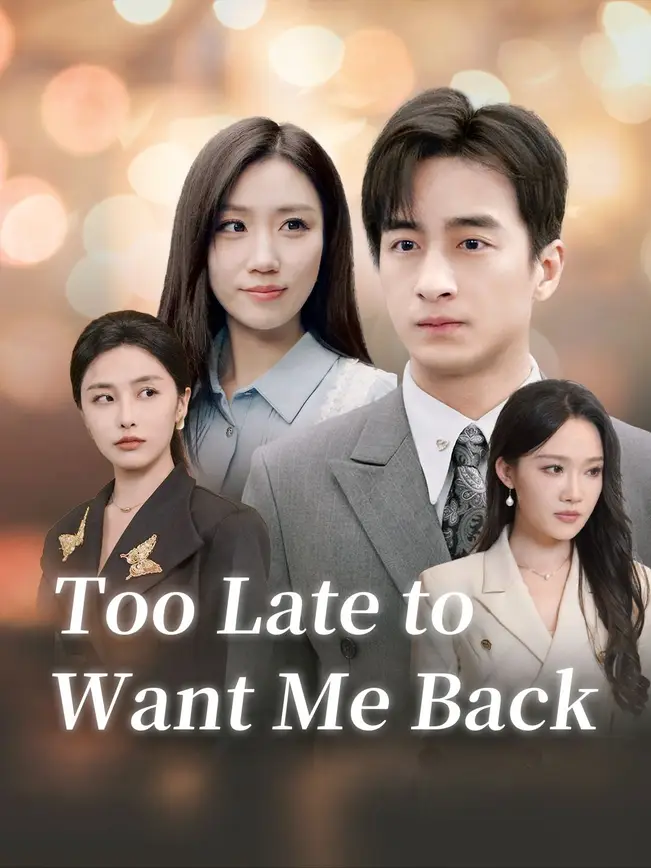
Too Late to Want Me Back Storyline
Too Late to Want Me Back More details
Genres:Karma Payback/Men Coming-of-Age/All-Too-Late
Language:English
Release date:2024-12-12 16:00:00
Runtime:61min
A Rollercoaster of Emotions and Betrayal
"Too Late to Want Me Back" is a gripping tale of betrayal and redemption. Caleb's journey from heartbreak to empowerment is both relatable and inspiring. The plot twists kept me on the edge of my seat, and the character development was top-notch
A Masterpiece of Second Chances and Drama
This short drama is a masterpiece in storytelling. The way Caleb navigates his emotions and the betrayal of his friends is beautifully portrayed. The arranged marriage subplot adds an interesting twist, making it a compelling watch. The pacing i
Heartfelt and Engaging with a Touch of Romance
I absolutely loved "Too Late to Want Me Back"! The emotional depth of Caleb's character and his journey to find love and trust again is heartwarming. The chemistry between the characters is palpable, and the storyline is engaging from start t
A Captivating Tale of Love and Revenge
This short drama is a captivating tale of love, betrayal, and revenge. Caleb's transformation from a heartbroken entrepreneur to a confident individual is inspiring. The plot is well-crafted, and the characters are relatable. The app experience was
Too Late to Want Me Back: When the Altar Becomes a Stage for Emotional Warfare
The wedding venue was a dreamscape of white and cerulean—floral arches, suspended orbs of light, a backdrop resembling a moonlit sky. It should have been pure fantasy. Instead, it became a theater of emotional warfare, where every glance carried the weight of unsaid words, and every smile hid a fracture. Li Zeyu, the groom, stood center stage, his tuxedo pristine, his boutonniere a vibrant splash of red against black—a traditional symbol of joy, now twisted into irony. His posture was perfect, his smile polished, but his eyes… his eyes kept drifting toward the left side of the aisle, where two women stood like sentinels of consequence. Too Late to Want Me Back isn’t just a phrase; it’s the refrain humming beneath the string quartet, the subtext written in the tension between breaths. Lin Xinyue, radiant in her beaded gown, held her bouquet with both hands, knuckles whitening just slightly. Her veil framed a face that cycled through emotions with astonishing subtlety: anticipation, then a flicker of uncertainty when Li Zeyu’s gaze lingered too long on Su Mian, then a swift recalibration—*no, don’t think that*, her expression seemed to plead with herself. She wore the same necklace she’d worn on their first date, a delicate silver pendant shaped like a key. Symbolism, perhaps. Or just memory. Her earrings, small starbursts of crystal, caught the light each time she turned her head—tiny flashes of warning no one else noticed. She wasn’t oblivious. She was choosing, consciously, to trust the version of Li Zeyu standing before her, not the ghost of the man who’d whispered promises to someone else in a rain-soaked café three weeks prior. Su Mian entered not as a guest, but as a presence. Her cream-colored suit was immaculate, the brooch at her lapel—a snowflake of diamonds—glinting like a challenge. She walked slowly, deliberately, her heels clicking against the white floor like a metronome counting down to inevitability. Her eyes never left Li Zeyu. Not with anger. Not with longing. With sorrow. A sorrow so deep it had calcified into resolve. When she stopped beside Chen Yanyan, the contrast was stark: Su Mian, all soft edges and restrained pain; Chen Yanyan, all sharp lines and simmering fury. Chen Yanyan’s black velvet dress wasn’t mourning—it was armor. The sequins scattered across it weren’t decoration; they were shards of broken trust, catching the light like shrapnel. Her hair was pulled back in a severe ponytail, emphasizing the sharp angle of her jaw, the set of her mouth. She didn’t cry until much later. First, she observed. She cataloged Li Zeyu’s micro-expressions: the slight tightening around his eyes when Su Mian approached, the way his fingers twitched toward his pocket, the half-second hesitation before he turned to face Lin Xinyue again. Chen Yanyan knew the script. She’d read the drafts. She’d seen the deleted scenes. The turning point came not with a shout, but with a touch. Chen Yanyan stepped forward, placed her hand on Li Zeyu’s shoulder—not comfortingly, but possessively—and leaned in. The camera zoomed tight on their profiles, capturing the exact moment his breath hitched. What did she say? We’ll never know. But whatever it was, it undid him. For the first time, his composure cracked. His lips parted, his brow furrowed, and he looked—truly looked—at Lin Xinyue, not as a prop in his performance, but as a person he was actively hurting. That look lasted less than a second. Then he straightened, smoothed his lapel, and forced a smile. Too Late to Want Me Back echoed in that split-second collapse. It wasn’t regret he felt—it was panic. The realization that the facade was thinner than he thought, and the women watching weren’t going to let him walk away unscathed. Then came the ring. Not during vows. Not in private. In front of everyone. Li Zeyu knelt, the red box in his palm like a confession he couldn’t voice. The crowd murmured, cameras flashed, Lin Xinyue’s smile widened—but her eyes, when they met Su Mian’s, held a question. *Do you see this? Is this real?* Su Mian nodded, once, slowly. Not encouragement. Acknowledgment. She was giving Lin Xinyue permission to choose, even if the choice led to ruin. Chen Yanyan, meanwhile, crossed her arms, her gaze fixed on the ring box. She knew what was inside. She’d seen the receipt. She’d traced the purchase to a jeweler Li Zeyu claimed he’d never visited. The ring was beautiful, yes—but it was also a lie wrapped in platinum. When Lin Xinyue extended her hand, the camera lingered on her fingers: smooth, elegant, but with a faint scar near the base of her thumb. A relic of a fall? Or a reminder of a fight she’d won—and lost—long before today? The placing of the ring was agonizingly slow. Li Zeyu’s fingers brushed hers, and for a heartbeat, he hesitated. His thumb grazed her knuckle, and she flinched—just barely. A micro-expression, gone in a blink. But Chen Yanyan saw it. Su Mian saw it. And in that instant, the wedding ceased to be about two people pledging forever. It became about three women holding space for a truth too heavy to speak aloud. Too Late to Want Me Back isn’t about the groom’s infidelity alone. It’s about the complicity of silence, the burden of knowledge, and the quiet courage it takes to stand in the wreckage of someone else’s choices without burning it to the ground. The embrace that followed was the final act. Li Zeyu pulled Lin Xinyue close, his face buried in her veil, his shoulders rising and falling with controlled breaths. She rested her cheek against his chest, her smile unwavering—even as a single tear escaped, rolling silently down her temple, disappearing into the lace of her sleeve. The camera cut to Su Mian, who turned away, her hand pressed to her mouth. Chen Yanyan didn’t look away. She watched them, her expression unreadable, until a tear finally traced a path down her own cheek—not for Lin Xinyue, not for Li Zeyu, but for the version of herself she’d had to become to survive this moment. The woman who knew too much. The woman who acted, but didn’t interfere. The woman who understood that some truths, once spoken, cannot be unspoken. By the end, the venue still glittered. The flowers still bloomed. The guests still clapped. But the air had changed. It was heavier now, charged with the residue of unspoken confessions. Too Late to Want Me Back isn’t a tragedy because the wedding failed. It’s a tragedy because it succeeded—because love, in this case, wasn’t destroyed by passion or betrayal, but by the quiet, relentless weight of *choice*. Lin Xinyue chose to believe. Li Zeyu chose to perform. Su Mian chose to witness. Chen Yanyan chose to ensure the truth remained visible, even if no one dared name it. And in that space between action and inaction, between speech and silence, the real story unfolded—not on the altar, but in the glances exchanged in the margins, where the most devastating dramas are always played out. The ring sparkled. The vows were spoken. But somewhere, deep in the architecture of that beautiful hall, a foundation had already begun to crack. Too Late to Want Me Back isn’t the end. It’s the beginning of a different kind of marriage—one built not on trust, but on endurance, and the haunting knowledge that some doors, once closed, can never truly be reopened.
Too Late to Want Me Back: The Groom’s Silent Betrayal and the Two Women Who Saw It All
In a wedding hall draped in icy blue florals and shimmering white light, where every petal seemed to whisper of purity and promise, something far more complex unfolded—not a celebration, but a slow-motion unraveling. The groom, Li Zeyu, stood at the altar in his impeccably tailored black tuxedo, the red-and-gold boutonniere pinned proudly over his heart, bearing the double happiness character ‘囍’—a symbol meant to herald lifelong union. Yet his eyes told another story. They darted, lingered too long on the left, then flicked away with practiced nonchalance. He wasn’t nervous. He was calculating. Too Late to Want Me Back isn’t just a title; it’s the quiet scream trapped behind his lips as he waited for the moment he’d chosen to detonate. The bride, Lin Xinyue, stood beside him in a gown encrusted with crystals that caught the light like frozen stars. Her veil fell softly over her shoulders, framing a face that shifted between serene grace, subtle confusion, and dawning dread. She held her bouquet—roses in blush and ivory—as if it were both shield and anchor. Her expression never broke into open accusation, not even when the two women entered the aisle: Su Mian in cream silk, her pearl earrings trembling with each breath, and Chen Yanyan in black velvet, her posture rigid, her gaze sharp as broken glass. These weren’t mere guests. They were witnesses to a truth no one had dared speak aloud. Su Mian’s entrance was deliberate. Her white suit, cinched at the waist with a pale green sash, radiated elegance—but her hands betrayed her. They trembled slightly at her sides, fingers curling inward as though gripping an invisible thread. When she locked eyes with Li Zeyu, her lips parted—not in greeting, but in silent protest. A single tear escaped, tracing a path through her carefully applied makeup, and she didn’t wipe it away. That tear wasn’t grief. It was recognition. Recognition that the man she once loved had become someone else entirely. Too Late to Want Me Back echoes in that tear, in the way she stepped forward—not to confront, but to *bear witness*. She knew what was coming. She had seen the texts, the late-night calls, the way his smile dimmed whenever Lin Xinyue entered the room. And yet, she came. Not to stop the wedding, but to ensure it wouldn’t be a lie unchallenged. Chen Yanyan, meanwhile, moved like a shadow given form. Her black dress, dotted with tiny silver sequins, absorbed the light rather than reflected it—a visual metaphor for her role: the keeper of secrets, the enforcer of consequences. She didn’t cry. Not at first. Her jaw remained set, her eyes fixed on Li Zeyu with the intensity of a prosecutor preparing closing arguments. When she finally reached him, she didn’t speak. She simply placed her hand on his arm—firm, not gentle—and leaned in. The camera lingered on their proximity, the tension thick enough to choke on. In that moment, we understood: Chen Yanyan wasn’t here as a friend. She was the architect of the reckoning. Perhaps she’d been the one who handed Su Mian the evidence. Perhaps she’d been the voice on the other end of the call that made Li Zeyu hesitate before slipping the ring box from his pocket. Her silence spoke louder than any accusation could. Too Late to Want Me Back isn’t just about regret—it’s about the unbearable weight of knowing you’ve already crossed the line, and there’s no turning back. Then came the proposal. Not the expected exchange of vows, but a sudden, theatrical kneeling. Li Zeyu dropped to one knee, pulling out a red velvet box with a flourish that felt rehearsed, almost desperate. The crowd gasped. Lin Xinyue’s face softened—just for a second—into something tender, hopeful. But the camera cut to Su Mian, whose breath hitched. Chen Yanyan’s eyes narrowed. Because they both knew: this wasn’t spontaneous. This was damage control. A last-ditch attempt to reframe betrayal as romance, to drown doubt in spectacle. The ring inside was stunning—a solitaire diamond flanked by pavé bands—but its brilliance couldn’t mask the tremor in Li Zeyu’s hands as he opened it. He looked up at Lin Xinyue, and for the first time, his expression cracked. Not with remorse, but with fear. Fear that she might say no. Fear that the performance might fail. Lin Xinyue didn’t refuse. She smiled. A real smile, warm and luminous, as she extended her hand. And in that gesture, the tragedy deepened. She wasn’t naive. She saw the hesitation in his eyes, the way his thumb brushed the edge of the box too many times. She saw Su Mian’s tears, Chen Yanyan’s stillness. And yet—she chose to believe. Or perhaps, she chose to *endure*. Her acceptance wasn’t surrender; it was a quiet act of defiance against the chaos threatening to consume her day. When he slid the ring onto her finger, the close-up revealed a detail no one else noticed: a tiny scratch on her knuckle, fresh and raw. Had she clenched her fist so hard earlier? Or was it from something else—something that happened before the ceremony began? The embrace that followed was supposed to be the climax. Instead, it became the breaking point. As Li Zeyu pulled Lin Xinyue into his arms, the camera panned to Su Mian, who turned away, her shoulders shaking. Chen Yanyan didn’t move. She simply watched, her expression unreadable—until a single tear finally slipped down her cheek, catching the light like a shard of ice. That tear confirmed it: she hadn’t come to destroy the wedding. She’d come to ensure it happened *exactly* as planned—so that the truth, once buried, could never be denied again. Too Late to Want Me Back isn’t about the moment of betrayal. It’s about the aftermath—the silence after the scream, the smile after the wound, the vow spoken while the heart is already elsewhere. What makes this scene unforgettable isn’t the drama, but the restraint. No shouting matches. No dramatic reveals. Just glances, gestures, the subtle shift of weight from one foot to another. Li Zeyu never admits guilt. Lin Xinyue never demands answers. Su Mian doesn’t storm the altar. Chen Yanyan doesn’t produce a smoking gun. And yet, by the final frame—where Lin Xinyue rests her head against Li Zeyu’s chest, her smile still in place, her eyes closed—the audience knows everything. The wedding proceeded. The photos will be beautiful. The guests will toast. But somewhere beneath the surface, three women carry the weight of a truth no one will name. Too Late to Want Me Back lingers not because of what was said, but because of what was swallowed, what was witnessed, and what was allowed to happen anyway. In a world obsessed with grand gestures, this scene reminds us that the most devastating moments are often the quietest—the ones where love doesn’t end with a bang, but with a sigh, a tear, and a ring placed on a hand that already knows it’s too late.
Too Late to Want Me Back: When the Bouquet Tells the Truth No One Dares Speak
There’s a moment in *Too Late to Want Me Back*—around the 00:14 mark—that feels less like cinema and more like forensic evidence. A close-up of two hands meeting over a bouquet: one delicate, manicured, wearing a diamond tennis bracelet; the other strong, slightly calloused, a silver watch glinting under the chandelier light. They clasp the stems together—not in unity, but in negotiation. The bouquet itself is a character: white roses symbolizing purity, blush ones hinting at tender affection, greenery suggesting growth… yet the ribbon binding it is sheer white organza, frayed at the edge, as if hastily tied. That fraying matters. Because in the world of *Too Late to Want Me Back*, nothing is accidental. Every crease in the fabric, every misplaced petal, every unspoken glance is a breadcrumb leading to the central question: Who is really walking down the aisle? Let’s unpack Lin Zeyu’s entrance again—not as a romantic hero, but as a man performing a role he’s been rehearsing for months. His tuxedo is flawless, yes, but the lapel pin—the red-and-gold ‘xi’ ribbon—is crooked. Just barely. A professional stylist would have fixed it. Yet no one does. Why? Because someone *wanted* it that way. The ribbon’s gold flower is slightly crushed, its petals flattened as if pressed under weight. Later, when Xiao Man pins an identical ribbon to her gown, hers is pristine. Symmetry broken. Intention revealed. This isn’t oversight. It’s signaling. Lin Zeyu isn’t nervous. He’s *waiting*. Waiting for the right cue. Waiting for the woman in black velvet to make her move. And Chen Lian *does*. She doesn’t speak during the ceremony. She doesn’t need to. Her power lies in stillness. While Yan Rui fidgets—adjusting her brooch, glancing at her phone, biting her lip—Chen Lian stands like a statue carved from obsidian, her black dress absorbing light, her eyes fixed on Lin Zeyu’s profile. When he turns toward Xiao Man, Chen Lian exhales—softly, audibly—and her shoulders relax, just an inch. That’s the tell. She expected resistance. She didn’t expect surrender. Because here’s what the video *doesn’t* show: the night before. A dimly lit lounge, whiskey glasses half-empty, Lin Zeyu and Chen Lian seated across from each other. No dialogue. Just the clink of ice, the rustle of her sleeve as she pushes a folder across the table. Inside: photos. Contracts. A timeline. Dates circled in red. *Too Late to Want Me Back* isn’t a love story. It’s a transaction disguised as tradition. And the bouquet? It’s the receipt. The genius of the director lies in how they weaponize mise-en-scène. The wedding venue is all cool blues and whites—ice palace aesthetics—yet the floral arrangements include deep burgundy peonies hidden behind the hydrangeas. Symbolism screaming into the void. The guests clap, but their smiles don’t reach their eyes. Brother Feng’s voice booms through the mic, but his knuckles are white on the stand. He knows. Everyone knows. Except Xiao Man? Or does she? Watch her during the vows: she doesn’t look at Lin Zeyu. She looks at *his hands*. Specifically, at the ring he hasn’t placed on her finger yet. Her gaze lingers there, calculating, assessing. When he finally slides it on, her fingers twitch—not in joy, but in irritation. A micro-reaction so subtle it’s easy to miss, unless you’ve seen the earlier scene in the boutique where Chen Lian tried on the *same* ring, holding it up to the light, murmuring, “It’s heavier than I thought.” Then comes the pivot: the staircase sequence. Lin Zeyu descending, flanked by Yan Rui and Chen Lian, both dressed in near-identical ivory blouses with bow ties—feminine, demure, *replaceable*. The symmetry is deliberate. They’re not friends. They’re options. Candidates. And Lin Zeyu’s demeanor shifts with each step: with Yan Rui, he’s courteous, distant; with Chen Lian, he leans in, his elbow brushing hers, his voice dropping to a murmur only she can hear. The camera catches it—the slight tilt of his head, the way his thumb rubs the inside of his wrist, a nervous tic he only does when lying. Later, in the bridal suite, Chen Lian adjusts her veil, her reflection in the mirror showing her mouth forming three words: *“You owe me.”* No sound. Just lips moving. *Too Late to Want Me Back* understands that silence is louder than any scream. The emotional climax isn’t the embrace—it’s the aftermath. After Lin Zeyu hugs Xiao Man, the camera pulls back to reveal Chen Lian turning away, her hand flying to her chest as if struck. But then—she smiles. Not sadly. *Triumphantly*. Because she’s not losing. She’s upgrading. The bouquet, now in Xiao Man’s hands, is passed to her maid of honor… who happens to be Yan Rui. And Yan Rui’s fingers brush the stems, pausing at the frayed ribbon. She doesn’t fix it. She *notes* it. Like a detective marking evidence. In the final shots, the guests mingle, champagne flutes raised, but Chen Lian and Yan Rui stand apart, whispering, their heads bent close. Xiao Man watches them from the corner, her veil half-lifted, her expression unreadable—until she catches Lin Zeyu looking at Chen Lian. His gaze lingers. Just a beat too long. And Xiao Man does something unexpected: she lifts the bouquet, not to smell it, but to *hide* her face. Behind the roses, her lips part. She doesn’t cry. She laughs. Quietly. Dangerously. The kind of laugh that says, *You think this is over?* *Too Late to Want Me Back* refuses to give us clean resolutions. There’s no last-minute confession, no dramatic interruption by a long-lost lover. The tragedy is quieter, deeper: the realization that love was never the goal. Control was. Legacy was. And the bouquet? It’s still there, sitting on a side table, petals wilting, ribbon unraveling, a silent witness to a marriage built on sand. The final frame isn’t of the couple kissing. It’s of Chen Lian’s hand resting on Lin Zeyu’s arm as they walk toward the exit—her fingers splayed, possessive, while Xiao Man trails behind, adjusting her veil with one hand and clutching the bouquet with the other, her knuckles white, her eyes fixed on the floor. The message is clear: some endings aren’t marked by divorce papers. They’re marked by the way a woman holds a dying bouquet, knowing she’s already been replaced—and she’s fine with that. Because in *Too Late to Want Me Back*, the real victory isn’t walking down the aisle. It’s being the one who decides who gets to walk it next.
Too Late to Want Me Back: The Groom’s Silent Panic and the Veil That Hid Two Brides
Let’s talk about what *really* happened in that wedding hall—not the fairy-tale entrance, not the glittering bouquet, but the micro-expressions that whispered a story far more complex than any vows could contain. In *Too Late to Want Me Back*, the opening sequence lures us in with cinematic elegance: a groom—let’s call him Lin Zeyu—steps through double doors bathed in chiaroscuro light, black tuxedo immaculate, bowtie sharp, a bouquet of white and blush roses trembling slightly in his grip. His eyes lift, not toward the altar, but upward, as if searching for divine permission—or perhaps just delaying the inevitable. That hesitation? It’s not nerves. It’s calculation. He knows something is off. And the camera knows it too, lingering on his knuckles whitening around the stems, the way his left hand drifts toward his pocket, where a silver watch gleams under the spotlight. This isn’t a man waiting for love; he’s waiting for confirmation. Then comes the bride—Xiao Man—radiant in a beaded ivory gown, veil cascading like liquid moonlight, her smile serene, almost rehearsed. She wears the traditional red-and-gold ‘xi’ ribbon pinned over her heart, the Chinese character for ‘double happiness’ stitched in gold thread. But look closer: her fingers don’t quite settle on the bouquet when she takes it from him. There’s a fractional pause, a flicker of uncertainty in her gaze as she glances past his shoulder—not at guests, but at *them*. Two women standing rigidly near the floral arch: one in cream silk with a pearl brooch shaped like a snowflake (Yan Rui), the other in black velvet, sleeves dotted with tiny crystals like fallen stars (Chen Lian). Their expressions are identical: lips parted, brows lifted, eyes wide—not with joy, but with the stunned silence of people who’ve just witnessed a script they didn’t write. The real twist unfolds not in dialogue, but in movement. When Lin Zeyu finally embraces Xiao Man, his smile is genuine—warm, crinkled at the corners—but his arms encircle her waist with the precision of someone securing a package, not claiming a soul. Meanwhile, Xiao Man’s hand rests lightly on his back, her thumb brushing the lapel of his jacket… where a faint smudge of lipstick—*not hers*—lingers near the collar. A detail only visible in slow-motion replay. And then—the cut. Suddenly, we’re in a bridal boutique, bright and sterile, where Lin Zeyu walks down a marble staircase flanked by two women in matching ivory blouses with oversized bows at the neck. One is Yan Rui, the other is Chen Lian—yes, *the same two*. But now they’re laughing, touching his arms, leaning in as if sharing a secret. Lin Zeyu checks his watch, not impatiently, but with the quiet urgency of a man running out of time. Behind them, mannequins wear gowns identical to Xiao Man’s—except one has a plunging neckline, another features sheer sleeves embroidered with silver vines. The implication hangs thick: this wasn’t a spontaneous choice. It was a selection process. A casting call for a wife. What follows is a masterclass in visual irony. Chen Lian tries on a strapless sequined gown, twirling with exaggerated delight, her veil catching the light like shattered glass. Yan Rui watches, smiling politely, but her eyes never leave Lin Zeyu’s face. He looks away—then back—then away again. His expression shifts from polite interest to something darker: recognition? Guilt? When Chen Lian extends her hand, wrist adorned with a diamond-encrusted Cartier, Lin Zeyu takes it—not with reverence, but with the practiced ease of a man accustomed to handling valuable objects. Their fingers interlock, and for a split second, the camera zooms in: her nails are painted the exact shade of coral as the lipstick stain on his jacket. *Too Late to Want Me Back* doesn’t need exposition. It shows us the evidence and lets us connect the dots. Back at the ceremony, the MC—a jovial man in pinstripes named Brother Feng—holds the mic, grinning as he recites clichés about destiny and forever. But his eyes keep darting toward the side door. Xiao Man listens, nodding, her smile unwavering, yet her pulse is visible at her throat. Lin Zeyu stands beside her, posture perfect, but his jaw is clenched so tight a muscle jumps near his ear. When Brother Feng asks, “Do you take this woman as your lawfully wedded wife?” Lin Zeyu opens his mouth—then pauses. Not for dramatic effect. For *real* hesitation. The silence stretches. Guests shift. Yan Rui’s breath catches. Chen Lian’s smile freezes, then cracks into something brittle. And in that suspended moment, the camera cuts to Xiao Man’s hands: she’s gripping the bouquet so hard the stems bend, green leaves bruising under her fingertips. She doesn’t look at him. She looks *through* him, toward the entrance—where, just for a frame, a figure in a charcoal coat appears, then vanishes. Was it real? Or did we imagine it because the tension demanded a ghost? The final act isn’t the kiss. It’s the aftermath. As guests applaud, Lin Zeyu turns to Xiao Man, leans in—and whispers something. Her eyes widen. Not with shock. With understanding. She nods once, slowly, and places her hand over his on the bouquet. Then, without breaking eye contact, she lifts her veil just enough to reveal the corner of her mouth curling—not into a smile, but into the faintest smirk of someone who’s just won a game no one knew was being played. *Too Late to Want Me Back* thrives in these liminal spaces: the breath between words, the glance that lasts too long, the bouquet held like a shield. It’s not about who said ‘I do’ first. It’s about who *knew* the truth before the ring touched the finger. And the most chilling detail? In the background, during the group applause shot, Chen Lian and Yan Rui stand side by side—yet their shadows on the wall don’t touch. They’re physically close, emotionally light-years apart. That’s the real tragedy of *Too Late to Want Me Back*: love isn’t lost. It’s never even entered the room. The wedding was just the stage. The real performance began long before the guests arrived.
Too Late to Want Me Back: When the Audience Becomes the Accuser
Let’s talk about the third act of a wedding that never truly began. Not the one with the vows and the rings and the first dance—but the one unfolding in the margins, in the glances exchanged over champagne glasses, in the way a smartphone falls like a guillotine blade onto polished stone. Too Late to Want Me Back doesn’t announce its tragedy. It *stages* it, with surgical precision, using the wedding venue itself as both set and confessional booth. From the first frame, we’re positioned not as guests, but as voyeurs—peering through the gap in those copper doors, watching Su Ran and Chen Mo step into the light like protagonists entering a trial. Su Ran’s white ensemble is immaculate, yes, but it’s the details that betray her: the brooch isn’t just decorative; it’s armor. The pearl choker isn’t delicate—it’s a tether, keeping her grounded in a world where emotions threaten to spill over. And her phone? It’s not a device. It’s a witness. She doesn’t film for posterity. She films for *evidence*. Every swipe, every zoom, every paused frame is a silent accusation she’s not yet ready to voice aloud. Chen Mo, meanwhile, is the counterpoint: all black, all restraint. Her velvet suit whispers of old money and older secrets. The rhinestones on her sleeves aren’t glitter—they’re landmines, waiting for the right pressure to detonate. She doesn’t speak often, but when she does, her words land like stones dropped into still water. In one fleeting shot, she turns to Su Ran and murmurs, “He didn’t even look at her when she walked in.” Not “he ignored her.” Not “he was distracted.” *He didn’t even look.* That phrasing is deliberate. It implies intentionality. It implies he *chose* not to see her. And that choice, more than any shouted argument, is what fractures the foundation of this entire event. Now let’s turn to Lin Xiao—the bride. Her gown is breathtaking, yes, but it’s also suffocating. The beading isn’t just ornamental; it’s a cage of light, trapping her in brilliance while her spirit dims. Her veil, usually a symbol of purity, here feels like a shroud—something she’s wearing not out of tradition, but out of obligation. When she speaks into the microphone, her voice is steady, practiced, almost *too* perfect. That’s the giveaway. Real emotion stutters. Real love trembles. What we hear is performance. And the audience—Zhou Wei, the guests, even the florist adjusting a stem in the background—they all know it. They just haven’t admitted it yet. The genius of Too Late to Want Me Back lies in its refusal to simplify. There’s no evil ex, no last-minute rescue, no dramatic interruption by a scorned lover bursting through the doors. The rupture is internal, psychological, and it spreads like ink in water. Watch how the two women in beige and pink react—not with shock, but with recognition. They’ve seen this before. Maybe they’ve lived it. Their whispered exchange—“She’s not crying. That’s worse”—is one of the most chilling lines in the entire sequence. Because tears are release. Silence is resignation. And Lin Xiao’s silence, as she stands on that stage, microphone in hand, is deafening. Then comes the fall. Not of the bride. Not of the groom. Of the phone. Su Ran’s phone. The device that held the truth, the footage, the irrefutable proof of what happened *before* the ceremony began. It drops—not accidentally, but with the weight of inevitability. The screen shatters. The recording stops. And in that moment, something shifts. Chen Mo doesn’t rush to help. She watches the pieces scatter, her expression unreadable, but her posture tells us everything: this was always going to end this way. The only question was *when*. Too Late to Want Me Back understands that modern tragedy isn’t found in grand gestures, but in the accumulation of small betrayals: the missed text, the unreturned call, the way someone’s eyes slide away when you say their name. Lin Xiao’s wedding isn’t failing because of a single event. It’s failing because of a thousand moments where love was replaced by habit, by convenience, by the slow erosion of trust that no amount of blue hydrangeas can disguise. And yet—the most haunting detail isn’t the broken phone. It’s what happens after. Chen Mo picks up the fragments, not to fix it, but to hold it. As if preserving the wreckage is the only way to honor what was lost. Su Ran doesn’t reach for it. She lets her friend carry the weight. That’s the real climax of Too Late to Want Me Back: not the collapse, but the quiet agreement to bear it together. The guests begin to leave, not in panic, but in discomfort—shifting feet, averted gazes, the awkward shuffle of people who’ve witnessed something they weren’t meant to see. Zhou Wei stands frozen, mic dangling, his role as master of ceremonies now obsolete. He was hired to orchestrate joy, but joy has vacated the premises. All that remains is the echo of a speech that sounded true but rang hollow, and the lingering scent of white roses mixed with regret. This is why Too Late to Want Me Back resonates so deeply. It doesn’t ask us to choose sides. It asks us to remember our own moments of delayed realization—the times we knew, deep down, that something was ending, but kept smiling anyway. Lin Xiao isn’t weak. Su Ran isn’t cruel. Chen Mo isn’t indifferent. They’re all just human, standing in a room full of mirrors, finally forced to look at the reflection they’ve been avoiding. The final shot isn’t of the bride or the groom. It’s of the broken phone on the floor, screen dark, lenses cracked, surrounded by petals that have fallen from the arrangements above. A single blue hydrangea rests atop the device, as if nature itself is trying to soften the blow. And in that image, Too Late to Want Me Back delivers its thesis: some endings don’t need fireworks. Sometimes, all it takes is a drop, a silence, and the courage to stop recording—and start living.
Too Late to Want Me Back: The Veil of Smiles and the Crack in the Lens
The wedding hall gleams like a frozen dream—white marble floors, cascading blue hydrangeas, fairy lights trembling like nervous breaths. At its center, a bride in a gown stitched with thousands of crystals steps forward, her veil catching the light like a halo she never asked for. Her name is Lin Xiao, and though her smile is perfect, her eyes flicker with something quieter, something older than vows. She holds the microphone not as a bride, but as a performer rehearsing lines she’s memorized too well. Behind her, a giant moon prop looms, half-veiled in mist, as if even the cosmos is unsure whether this is celebration or surrender. But the real story isn’t on stage. It’s in the corridor just outside, where two women emerge from copper doors like figures stepping out of a noir film. One wears white—not bridal white, but *power* white: a tailored blazer cinched at the waist with a silk belt, a silver brooch pinned like a badge of honor. Her name is Su Ran, and she carries her phone like a weapon, fingers already hovering over the record button. Beside her, Chen Mo stands in black velvet, sleeves dotted with tiny rhinestones that catch the light like distant stars. Her arms are crossed, her posture rigid—not defensive, but *waiting*. She doesn’t speak much, but when she does, her voice is low, deliberate, the kind that makes people lean in even when they’d rather look away. They don’t walk into the ceremony. They *enter* it—like inspectors arriving at a crime scene disguised as joy. The guests murmur, some turning to watch them with curiosity, others with recognition. A man in a pinstripe suit—Zhou Wei, the MC—glances up, his smile faltering for half a second before he smooths it back into place. He knows them. Or he thinks he does. That’s the first crack in the illusion: everyone here knows more than they’re saying. Su Ran doesn’t take a seat. She lingers near a floral arrangement, phone raised, filming Lin Xiao’s speech. Not the whole thing—just fragments. A tilt of the head. A pause too long. The way Lin Xiao’s fingers tighten around the mic when she says, “I’ve loved him since we were seventeen.” The camera zooms in, 3.7x, as if trying to find the lie in the syllables. Chen Mo watches Su Ran’s screen over her shoulder, expression unreadable, but her jaw is set—the kind of tension that precedes confession or collapse. Meanwhile, two other women stand near a table draped in ivory linen: one in beige tweed with oversized collar, the other in pale pink, clutching a sparkler like it’s a lifeline. They whisper, their voices barely audible over the soft piano music. “Did you see how she looked at him when he walked in?” the beige-clad woman asks. “Like she was remembering a different version of him.” The pink one nods, lips pressed thin. “She’s not crying. That’s worse.” Their conversation is a microcosm of the room: everyone is watching, everyone is interpreting, no one is simply *celebrating*. Lin Xiao finishes her speech. She bows slightly, a gesture both graceful and mechanical. Applause erupts—but it’s polite, not thunderous. Zhou Wei steps forward, takes the mic, and begins his next segment, but his eyes keep darting toward the entrance, where Su Ran has just lowered her phone. She turns to Chen Mo and says something quiet. Chen Mo exhales, then nods once. A decision made. Then—the drop. Su Ran’s phone slips from her hand. Not a fumble. A release. It hits the marble floor with a sharp, final sound, shattering on impact. The screen goes dark. A collective intake of breath. Lin Xiao freezes mid-step. Zhou Wei stops speaking. Even the fairy lights seem to dim. What follows isn’t chaos. It’s silence—thick, heavy, charged. Chen Mo doesn’t move to pick it up. Su Ran doesn’t flinch. She just looks at Lin Xiao, and for the first time, her expression isn’t judgmental. It’s sorrowful. As if she’s just handed over evidence she hoped she’d never need. This is where Too Late to Want Me Back reveals its true architecture: it’s not about betrayal. It’s about timing. About the unbearable weight of knowing *too late* that love isn’t built on grand gestures, but on the small silences between words—the ones you ignore until they become walls. Lin Xiao’s wedding isn’t collapsing because of an affair or a secret child. It’s collapsing because she finally sees the truth in the reflection of Su Ran’s phone screen: that the man beside her isn’t the boy she loved, and she isn’t the girl who believed in him anymore. Chen Mo steps forward then—not toward the stage, but toward the broken phone. She bends, slowly, deliberately, and picks up the shattered device. She doesn’t look at the screen. She looks at Su Ran. “You didn’t have to film it,” she says, voice barely above a whisper. Su Ran meets her gaze. “I had to remember what it looked like before it broke.” That line—so simple, so devastating—is the heart of Too Late to Want Me Back. Because memory is the only thing we can’t unsee. And sometimes, the most violent act isn’t shouting or walking out. It’s pressing record… and then letting go. The guests begin to stir, confused, uneasy. Some glance at their own phones, as if checking for signals, for proof that reality hasn’t shifted. Others avoid eye contact, suddenly very interested in their champagne flutes. Lin Xiao remains still, her smile now brittle, like sugar glass about to splinter. Zhou Wei clears his throat, tries to resume, but his voice wavers. He glances at Chen Mo, who is still holding the broken phone, and for a split second, his composure cracks. He knows. Of course he knows. He’s been the keeper of this secret for months—maybe years—and now the lid is off. Too Late to Want Me Back doesn’t rely on melodrama. It thrives in the micro-expressions: the way Chen Mo’s thumb brushes the edge of the cracked screen, as if mourning the device itself; the way Su Ran’s earrings catch the light when she tilts her head, a flash of pearl against the stark white of her blazer; the way Lin Xiao’s veil trembles when she breathes, not from emotion, but from the sheer effort of holding herself together. This isn’t a wedding. It’s an autopsy performed in real time, with floral arrangements as witnesses and a moon prop as silent judge. The blue flowers aren’t just decoration—they’re metaphors for coldness, for distance, for the emotional frost that settled long before today. The red ribbon pinned to Lin Xiao’s gown? It reads “Double Happiness,” but in this context, it feels ironic—a relic of tradition clinging to a moment that has already unraveled. And yet… there’s no villain. No clear antagonist. Su Ran isn’t jealous. Chen Mo isn’t resentful. Lin Xiao isn’t deceitful. They’re all just people who loved someone, believed in something, and woke up one day to find the script had changed without their consent. Too Late to Want Me Back understands that the most painful endings aren’t the loud ones. They’re the quiet ones—the ones where everyone stays seated, claps politely, and pretends not to hear the glass breaking underfoot.

Men Coming-of-Age


All-Too-Late
.jpg~tplv-vod-rs:651:868.webp)

Karma Payback

.jpg~tplv-vod-rs:651:868.webp)
.jpg~tplv-vod-rs:651:868.webp)

 Download

Ep Review