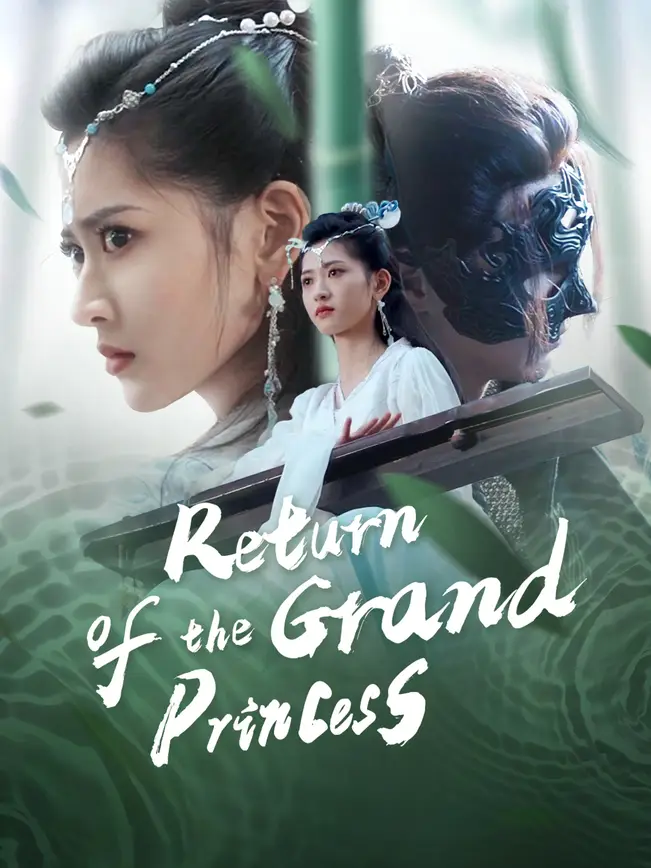
Return of the Grand Princess Storyline
Return of the Grand Princess More details
Genres:Karma Payback/Multiple Identities/Ancient Times
Language:English
Release date:2024-10-20 12:00:00
Runtime:148min
An Underdog Tale That Captivates the Soul
Return of the Grand Princess is an incredible journey of resilience and strength. The transformation of the princess from a vulnerable girl to a powerful leader is mesmerizing. Her character is so well-developed that you can't help but root for h
A Tale of Betrayal and Redemption with a Twist
This short drama is a rollercoaster of emotions! I loved how it delves into themes of betrayal and redemption. The first princess's journey is both heart-wrenching and inspiring. Her husband's betrayal was unexpected, but it added a layer o
Unexpected Twists and a Strong Female Lead
Return of the Grand Princess offers more than just a typical royal drama. The lead character's strength and intelligence shine through in every episode. The betrayal she faces serves as a catalyst for her transformation, and it's portrayed beau
A Riveting Comeback Story That Inspires
I was thoroughly impressed by the storytelling in Return of the Grand Princess. The journey of the first princess is filled with challenges, but her determination to overcome them is truly inspiring. The narrative is rich with unexpected developme
Return of the Grand Princess: When Blood Speaks Louder Than Oaths
There’s a particular kind of silence that settles after violence—not the quiet of emptiness, but the heavy, humming stillness of aftermath, where every breath feels like trespassing. That’s the air thickening in the courtyard of the Jade Serpent Temple as Su Ruyue kneels beside Elder Chen, her fingers pressed to his throat, searching for a pulse that’s already gone. But here’s the thing no synopsis will tell you: she *knows* he’s dead before she checks. She knows because his hand went limp in hers three seconds earlier. She knows because the blood pooling beneath his ear stopped moving. And yet she keeps touching him—not to confirm, but to *delay*. That’s the emotional core of Return of the Grand Princess: not the grand betrayals or political coups, but the micro-decisions we make when the world fractures around us. Do we scream? Do we run? Or do we stay, and hold the dying, even as our own soul begins to hemorrhage? Li Zeyu stands above them, sword in hand, but his stance tells a different story. His feet are planted shoulder-width apart—not aggressive, but grounded, as if bracing for an earthquake he can’t prevent. His gaze flickers between Su Ruyue’s bowed head and the blade in his grip, and for a split second at 00:17, his knuckles whiten. Not from tension, but from *relief*. He expected her to rise, to accuse, to draw her own dagger. Instead, she stays bent over the man who raised her, her hair spilling forward like a curtain hiding her face. That’s when the real tragedy hits: he wanted a fight. He needed one. Because guilt is easier to bear when it’s earned through action, not omission. But here, there’s no battle cry, no last words exchanged—just the soft rustle of silk and the distant chime of a wind bell, mocking the silence with its indifference. Let’s zoom in on Su Ruyue’s earrings—those delicate leaf-shaped pendants of carved aquamarine, dangling just below her jawline. In frame 00:03, they catch the light as she turns her head, and for a fleeting moment, they glint like tears held in suspension. Later, at 00:41, when she finally lifts her face, one earring is askew, the chain twisted, as if she’d gripped it unconsciously during her sobbing. These aren’t props. They’re emotional barometers. In classical symbolism, aquamarine represents clarity and healing—but here, it’s stained with shadow, refracting light unevenly, just like her fractured psyche. She’s not just grieving Elder Chen; she’s grieving the version of herself that believed loyalty could survive truth. And that’s what Return of the Grand Princess does so masterfully: it treats jewelry, fabric, and even the angle of a hairpin as narrative devices. Nothing is incidental. Not the way Li Zeyu’s outer robe drapes over his left arm like a shroud, not the frayed hem of Su Ruyue’s sleeve where she’s been wiping blood, not even the faint crack in the temple’s threshold stone beneath Elder Chen’s outstretched hand. Elder Chen’s death isn’t sudden. It’s *orchestrated* in slow motion. Watch his eyes at 00:29—still lucid, still *seeing*, even as his voice fades. He doesn’t beg. He doesn’t curse. He smiles. A small, tired upturn of the lips, as if remembering something sweet from decades past. And Su Ruyue, ever perceptive, leans closer, her ear near his mouth, catching the final syllables no one else hears. That intimacy is the show’s secret weapon. While other dramas shout their climaxes, Return of the Grand Princess whispers them—and the whisper cuts deeper. His last words, whatever they were, weren’t meant for the audience. They were for *her*. A private transmission across the void of impending loss. And when she pulls back at 00:34, her face is transformed: not just tear-streaked, but *unmoored*. Her pupils dilate, her breath hitches, and for the first time, she looks directly at Li Zeyu—not with hatred, but with dawning comprehension. She sees it now. The sword wasn’t meant for Elder Chen. It was meant for *herself*. Or perhaps, for the future he tried to protect her from. The cinematography here is surgical. Notice how the camera avoids close-ups of Li Zeyu’s face during the critical moments. Instead, it lingers on his hands—the calluses on his palm, the slight tremor in his wrist, the way his thumb strokes the blade’s edge as if soothing a restless spirit. That’s intentional. The show refuses to let us inside his head because his motivation isn’t meant to be understood—it’s meant to be *felt*. Like the ache in your chest when you realize you’ve become the very thing you swore to destroy. And when he finally turns away at 00:19, the shot widens, placing him small against the vast, indifferent architecture of the temple. He’s not walking toward freedom. He’s walking toward consequence. Every step echoes, not with triumph, but with the hollow resonance of inevitability. What elevates Return of the Grand Princess beyond typical period fare is its refusal to sanitize grief. Su Ruyue doesn’t compose herself. She doesn’t deliver a poetic monologue. She *shatters*. At 00:47, her mouth opens in a raw, guttural cry—no music swells, no cutaway to sky—just her, trembling, blood dripping from her lip onto Elder Chen’s robe, mingling with his own. That image—red on gold, life on legacy—is the show’s thesis statement. Power isn’t inherited; it’s *transferred*, often through trauma. And love? Love is the wound that never scabs over. It stays tender, exposed, ready to bleed anew at the slightest touch of memory. Let’s talk about the sword again—not as a weapon, but as a mirror. When Li Zeyu examines it at 00:14, his reflection is distorted along the curve of the blade: one eye clear, the other blurred, as if even his own identity is splitting down the middle. That’s the visual metaphor the series returns to again and again: no one here is whole. Not Su Ruyue, torn between filial duty and personal truth. Not Li Zeyu, caught between oath and instinct. Not even Elder Chen, who loved too wisely to survive. They’re all fragments, orbiting a collapsing center. And the temple? It’s not a sanctuary. It’s a tomb waiting to be sealed. The final frames—Su Ruyue staring into the distance, Li Zeyu descending the steps, Elder Chen’s body half-obscured by shadow—don’t resolve anything. They *deepen* the mystery. Because Return of the Grand Princess isn’t about answers. It’s about the weight of questions we carry long after the last line is spoken. Why did Li Zeyu draw the sword if he didn’t intend to use it? Was Elder Chen protecting someone else? And what did he whisper to Su Ruyue that made her stop crying and start *thinking*? Those unanswered threads are the show’s greatest asset. They don’t leave us satisfied. They leave us haunted. And in an age of bingeable, resolution-driven content, that’s revolutionary. This isn’t entertainment. It’s emotional archaeology. We dig through layers of silk and sorrow, hoping to find meaning—but sometimes, all we uncover is the truth that some wounds were never meant to heal. They were meant to remind us we lived.

Ancient Times



Multiple Identities



Karma Payback



 Download