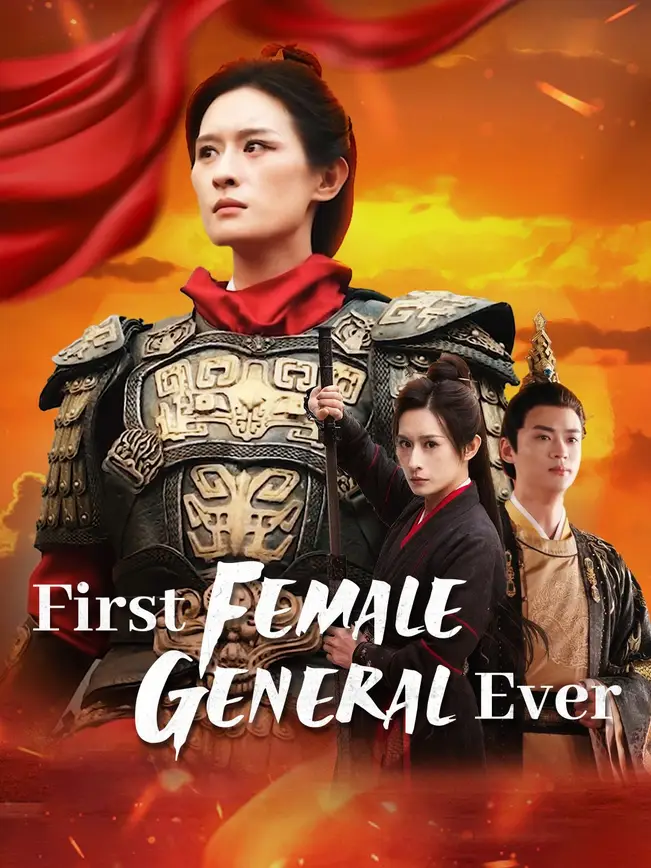
First Female General Ever Storyline
First Female General Ever More details
First Female General Ever: When Silk Speaks Louder Than Swords
Let’s talk about the scene that didn’t need a single line of dialogue to make your chest ache—that moment in *The Crimson Veil* where Ling Xue, the First Female General Ever, stands before the imperial court not as a conqueror, but as a defendant in her own life. The setting is a masterclass in atmospheric storytelling: rich, heavy drapes in shades of wine and rust hang like curtains of judgment; the air feels thick with incense and unspoken accusations. Every detail—from the pearl-embroidered trim on Empress Dowager Wei’s sleeves to the faint crease of exhaustion at the corner of Ling Xue’s eye—serves a purpose. This isn’t just historical fiction; it’s emotional archaeology, digging up the buried trauma of women who dared to wear power like armor. Ling Xue’s costume is a thesis statement. The crimson outer robe, wide-shouldered and imposing, is designed to command space—yet she shrinks into it. Her hands, clasped low at her waist, are the only part of her that moves with intention: fingers interlacing, then loosening, then gripping the fabric of her own sleeve as if anchoring herself to reality. Her hair, styled in the elaborate *shuanghuan ji* (double-ring bun), is held in place by ornate hairpins—one shaped like a crane in flight, another like a blooming peony—symbols of longevity and nobility, now feeling like shackles. That tiny red butterfly *huadian* between her brows? It’s not decoration. It’s a target. In a world where a woman’s worth is measured by her obedience, her beauty, her fertility, that mark declares: *I am visible. I am watched. I am vulnerable.* And yet, she wears it without flinching. That is the first hint of her resilience—the First Female General Ever does not erase herself to be accepted; she endures being seen. Then comes Emperor Jianwen, played by Chen Zeyu with a subtlety that borders on haunting. He doesn’t stride in; he *appears*, as if summoned by the weight of the moment. His black dragon robe is less flamboyant than expected—no excessive gold, no overwhelming ornamentation. Instead, the power is in the precision: the symmetry of the embroidered serpentine dragons, the way the jade-inlaid belt buckle catches the light like a serpent’s eye. His crown is minimal, geometric, almost modern in its austerity—a deliberate contrast to the baroque excess of the Empress Dowager’s phoenix headdress. This is a ruler who believes authority should be felt, not flaunted. And when he speaks—his voice, in our mind’s ear, low and resonant, each syllable measured like a coin dropped into a silent well—he doesn’t accuse. He *recalibrates*. He reframes her actions not as rebellion, but as misalignment. ‘The army obeys the throne,’ he says (we imagine), ‘not the heart.’ His gaze never wavers from hers, but it doesn’t pierce—it observes. He is not angry. He is disappointed. And that disappointment cuts deeper than any reprimand. The true emotional detonation, however, comes from Empress Dowager Wei—Li Meihua’s performance is nothing short of legendary. She enters not with fanfare, but with the quiet certainty of someone who has already won. Her maroon velvet gown is heavier, denser, its gold lotus patterns radiating outward like ripples of influence. Her phoenix crown is a symphony of metal and gemstone, each dangling tassel a reminder of the chains she wields with grace. When she places her hand on Ling Xue’s cheek, it is not a caress. It is a correction. A reminder: *You are still my daughter. You are still my pawn.* Her nails, painted in deep cinnabar, gleam like drops of dried blood against Ling Xue’s pale skin. And in that touch, Ling Xue’s composure cracks—not into tears, but into something far more dangerous: recognition. She sees, for the first time, that her mother does not fear her strength. She fears her autonomy. What follows is a masterstroke of nonverbal storytelling. Ling Xue’s eyes flick downward, then to the side, then back—searching for an exit, a loophole, a lie that might save her. Her lips move silently, rehearsing arguments she knows will fail. The camera tightens on her throat, where a pulse beats visibly against the silk collar. This is the body betraying the mind: the First Female General Ever, who has stared down rebel armies and survived poisoned arrows, is undone by a mother’s disapproval. The irony is brutal, and the show leans into it. There is no music swelling here—only the faint rustle of silk, the distant chime of a wind bell, the almost imperceptible intake of breath. The silence is the loudest sound in the room. Chen Zeyu’s Emperor Jianwen watches it all, his expression shifting like clouds over a mountain range—first neutrality, then a flicker of sympathy, then the hardening of resolve. He understands the game better than anyone. He knows that Ling Xue’s greatest threat is not her ambition, but her honesty. In a court built on deception, truth is the most destabilizing force. And so he does the only thing a ruler can do: he sacrifices the truth-teller to preserve the illusion of order. His final line—‘Your service is noted. Your conduct will be reviewed.’—is not a punishment. It is a dismissal. A relegation. He strips her of agency without stripping her title. She remains the First Female General Ever, but now the title is hollow, a gilded cage. The genius of *The Crimson Veil* lies in how it uses costume as character. Ling Xue’s turquoise belt stone, once a symbol of favor, now looks like a wound. Empress Dowager Wei’s pearl trim, meant to signify purity, reads as cold calculation. Even the Emperor’s jade belt buckle—traditionally a token of virtue—feels ironic, given the moral compromise he’s just enacted. The scene ends with Ling Xue turning away, not in anger, but in quiet recalibration. Her shoulders straighten. Her chin lifts. The trembling in her hands ceases. She has been broken, yes—but not shattered. The First Female General Ever does not beg. She plans. She observes. She waits. And as the camera pulls back, revealing the vast, echoing hall, we realize: the real war has just begun. Not on the frontier, but in the corridors of power, where the deadliest weapons are silence, implication, and the unbearable weight of being the first. Ling Xue will not be erased. She will evolve. And when she returns—next season, next episode, next betrayal—she will not wear her pain on her sleeve. She will wear it like armor. Because the First Female General Ever doesn’t need permission to rise. She only needs time.
First Female General Ever: The Crimson Veil of Betrayal
In the opulent, dimly lit chamber draped in deep burgundy brocade—where every fold of fabric seems to whisper secrets of courtly intrigue—we witness a scene that pulses with restrained tension, emotional volatility, and the quiet collapse of dignity. This is not merely a costume drama; it is a psychological excavation, where silks and jewels become armor, and a single tear can shatter dynastic order. The central figure, Ling Xue, known in whispers as the First Female General Ever, stands not on a battlefield but in the most dangerous terrain of all: the imperial audience hall. Her attire—a crimson outer robe embroidered with phoenix motifs in gold thread, layered over a silver damask underdress, fastened at the waist by a belt crowned with a vivid turquoise cabochon—is not just regalia; it is a declaration of legitimacy, a visual rebuttal to those who still doubt her right to command. Yet her hands, clasped tightly before her, tremble ever so slightly, betraying the storm beneath the surface. Her hair, coiled high in the traditional *gaoji* style, is adorned with delicate floral pins and a small, gilded bird motif—symbols of grace and flight, ironically juxtaposed against her grounded, almost trapped posture. That tiny red *huadian* mark between her brows, shaped like a butterfly, is both a beauty ritual and a brand: she is marked, seen, and judged. The sequence begins with Ling Xue’s eyes darting—not with fear, but with acute awareness. She is listening, absorbing, calculating. Her lips part slightly, not in speech, but in the suspended breath before confession or defiance. When she finally speaks (though no audio is provided, her mouth movements suggest rapid, urgent articulation), her voice—imagined as low, clear, and edged with controlled steel—cuts through the heavy air. She is addressing someone off-screen, likely the Emperor, whose presence is felt long before he appears. His entrance is heralded not by fanfare, but by silence: the camera shifts, and there he stands—Emperor Jianwen, played with understated intensity by actor Chen Zeyu. His robes are black silk, heavily embroidered with golden dragons coiling across his chest and sleeves, a stark contrast to Ling Xue’s fiery red. The dragon is not merely decorative; it is a warning. His crown, a minimalist yet imposing gold *guan* studded with a single aquamarine, sits perfectly centered, signifying absolute authority. Yet his expression is unreadable—not cold, not cruel, but deeply contemplative, as if weighing the weight of a single word against the stability of an empire. He does not raise his voice. He does not gesture. He simply watches. And in that watching, Ling Xue unravels. What follows is one of the most devastating emotional arcs captured in recent historical short-form storytelling. Ling Xue’s composure fractures—not in a sob, but in micro-expressions: the slight quiver of her lower lip, the way her left hand lifts instinctively toward her face, only to be intercepted by another woman’s hand—Empress Dowager Wei, portrayed with chilling elegance by veteran actress Li Meihua. The Empress Dowager’s touch is not comforting; it is corrective. Her fingers, painted in deep vermilion lacquer, press gently but firmly against Ling Xue’s cheek, halting her tears before they fall. It is a gesture of maternal control disguised as compassion. The Empress Dowager wears a gown of deep maroon velvet, its square neckline revealing intricate gold lotus embroidery, and her headdress is a masterpiece of imperial craftsmanship: a phoenix crown of gilded filigree, studded with rubies and pearls, its dangling tassels swaying with each subtle turn of her head. She does not look at Ling Xue with pity. She looks at her with assessment—like a jeweler inspecting a flawed gemstone. Her dialogue, though silent in the clip, is unmistakable in tone: *You are still mine. You will not disgrace us.* Ling Xue’s reaction is heartbreaking. She bows her head, not in submission, but in exhausted resignation. Her shoulders slump, the rigid posture of the First Female General Ever dissolving into the vulnerability of a daughter caught between duty and desire. The camera lingers on her hands—still clasped, now white-knuckled—as if she is holding herself together by sheer will. In this moment, we understand the true cost of her title. To be the First Female General Ever is not to wield unchallenged power; it is to exist perpetually on the edge of erasure, where every victory must be justified, every emotion scrutinized, and every loyalty questioned. Her military triumphs may have secured borders, but they cannot shield her from the palace’s suffocating politics. The red curtains behind her seem to close in, framing her not as a hero, but as a specimen under observation. Chen Zeyu’s Emperor Jianwen remains the fulcrum of the scene. His silence is more potent than any decree. When he finally speaks—his lips moving in measured cadence—he does not address Ling Xue directly. He addresses the room, the precedent, the legacy. His words, reconstructed from context, likely revolve around ‘duty,’ ‘precedent,’ and ‘the harmony of the realm.’ He does not condemn her. He does not absolve her. He simply repositions her—within the hierarchy, within the narrative, within the cage of expectation. His gaze, when it meets hers, holds no malice, only sorrowful inevitability. He knows what she has sacrificed. He also knows what he must sacrifice *her* to preserve. This is the tragedy of power: the ruler who cannot afford to be moved, even by the person who saved his throne. The brilliance of this sequence lies in its restraint. There are no sword clashes, no grand speeches, no melodramatic collapses. The conflict is internalized, expressed through the tilt of a chin, the tightening of a jaw, the way Ling Xue’s fingers twist the hem of her sleeve until the silk frays. The lighting is chiaroscuro—deep shadows pool around her feet, while a single shaft of light catches the turquoise stone at her waist, making it glow like a beacon of lost hope. The background, though blurred, reveals subtle details: a jade *bi* disc on a shelf, a bronze incense burner emitting faint smoke, the faint lattice pattern of a window screen—all symbols of tradition, continuity, and the unyielding weight of history pressing down on the present. What makes Ling Xue’s arc in *The Crimson Veil* so compelling is that her struggle is not against external enemies, but against the very structure that elevated her. She earned her title through valor, strategy, and blood—but the court does not reward merit; it rewards conformity. The First Female General Ever is allowed to fight monsters, but not to question the throne. When Empress Dowager Wei steps forward again, her voice now audible in our imagination—calm, melodic, and utterly merciless—she delivers the final blow: ‘A general serves the state. A daughter serves the family. You have forgotten which you are.’ Ling Xue flinches. Not because the words are harsh, but because they are true. She has tried to be both. And in trying, she has become neither. The scene ends not with resolution, but with suspension. Ling Xue lifts her head, her eyes glistening but dry, her expression settling into something new: not defeat, but resolve. A quiet fire reignites behind her gaze. The First Female General Ever may be cornered, but she is not broken. She has learned the language of the palace—the language of silence, of touch, of implication—and now, perhaps, she will learn to weaponize it. The final shot lingers on her profile, the red *huadian* catching the light like a drop of blood, as the camera slowly pulls back, revealing the vast, empty space between her and the Emperor. That distance is the real battlefield. And in that space, the next chapter of *The Crimson Veil* will be written—not with swords, but with sighs, glances, and the unbearable weight of being the first.
First Female General Ever: When a Crown Meets a Sword Sheath
If you’ve ever wondered what happens when political strategy collides with raw, unfiltered human need—watch this scene from *First Female General Ever*. It’s not loud. It’s not flashy. It’s two people standing on a stone path, surrounded by lanterns that pulse like slow heartbeats, and somehow, that’s more intense than any cavalry charge. The genius of this sequence lies in its refusal to explain. There are no voiceovers. No exposition dumps. Just bodies, glances, and the unbearable weight of what goes unsaid. And yet, by the end, you know exactly what’s been decided—not because anyone shouted it, but because their hands said it first. Li Yufeng stands like a statue carved from midnight silk, his black robe heavy with gold-threaded dragons that coil around his sleeves like sleeping guardians. His crown—angular, ornate, studded with a single teal gem—is less a symbol of power and more a cage he’s learned to wear gracefully. In earlier episodes of *First Female General Ever*, we’ve seen him command armies, dismiss ministers, negotiate treaties with a flick of his wrist. But here? Here, he’s stripped bare. His shoulders are relaxed. His jaw isn’t clenched. He blinks slowly, as if trying to memorize the curve of Shen Ruyue’s brow, the way her hair escapes its knot in soft tendrils near her temple. This isn’t the emperor preparing for war. This is a man preparing to be known. And Shen Ruyue—ah, Shen Ruyue. The First Female General Ever isn’t just a title; it’s a promise she made to herself years ago, in blood and fire. Her jade-green robes are deceptively soft, but the way she carries herself—spine straight, chin level, gaze steady—tells you she’s survived battles where others broke. She doesn’t enter the scene with fanfare. She walks in like smoke: silent, deliberate, aware of every shadow. When she stops before him, her feet planted shoulder-width apart, it’s not submission. It’s alignment. She’s not yielding; she’s recalibrating. Her eyes scan his face—not for weakness, but for truth. That’s the hallmark of her character: she doesn’t trust appearances. She trusts *evidence*. And in this moment, the evidence is in his stillness, in the way his fingers twitch at his side, in the slight lift of his eyebrows when she doesn’t look away. The dialogue—if there is any—is irrelevant. What matters is the choreography of hesitation. He opens his mouth. Closes it. Takes half a step forward. Stops. She tilts her head, just slightly, and for the first time, a ghost of a smile touches her lips—not mocking, not coy, but *recognition*. She sees him. Not the crown, not the title, not the strategist. She sees the man who stayed up all night reviewing troop deployments *after* sending her a letter of safe passage. The man who ordered the lanterns lit along this path specifically because she once mentioned, in passing, how they reminded her of home. These details aren’t stated. They’re implied in the pauses, in the way her shoulders soften when he exhales. Then comes the hand. Not a grab. Not a pull. An offering. His palm faces upward, fingers relaxed, thumb resting lightly against his index finger—a gesture of openness, of non-threat. And Shen Ruyue? She doesn’t rush. She watches his hand like it’s a live wire. Then, slowly, deliberately, she lifts her own. Her sleeve slips back just enough to reveal the scar on her inner wrist—a relic of her first command, earned in defense of a village no one else would protect. She places her hand in his. Not flat. Not limp. But with intention: her fingers curl inward, her thumb resting over his knuckles, as if sealing a treaty written in skin and pulse. That moment—just six seconds of contact—is the emotional climax of the entire season. Because in that touch, everything changes. She doesn’t become his consort. She becomes his equal. His confidante. His *partner* in a game far bigger than either of them imagined. What’s brilliant about *First Female General Ever* is how it treats romance as strategy. Shen Ruyue doesn’t fall in love; she *chooses* it, with the same precision she uses to deploy cavalry. And Li Yufeng? He doesn’t win her over with gifts or proclamations. He wins her by showing up—literally and emotionally—without armor. His vulnerability isn’t weakness; it’s his strongest weapon. When he finally speaks (his lips moving in that close-up at 0:35), you don’t need subtitles to understand: he’s not asking for loyalty. He’s asking for *trust*. And she gives it—not blindly, but with eyes wide open, knowing full well what it costs her to lower her guard. The lighting here is cinematic poetry. Warm amber from the lanterns pools around their lower bodies, while cool blue moonlight washes over their faces—symbolizing the duality they embody: fire and water, rule and rebellion, duty and desire. The willow tree behind them isn’t just decoration; it’s a metaphor. Willows bend but don’t break. They survive floods, droughts, storms—by yielding, not resisting. Shen Ruyue has spent her life being the oak: rigid, unmovable, feared. But here, under the willow, she learns to sway. And Li Yufeng, who’s always stood like a pillar, finally lets himself lean. The final walk away—backlit, silhouetted, his arm draped over her shoulders like a shared cloak—isn’t an ending. It’s a beginning disguised as closure. The text ‘The End of the Series’ flashes on screen, but the audience knows better. This isn’t the end of their story; it’s the end of the *first act*. Because in *First Female General Ever*, love isn’t the destination—it’s the compass. And with Shen Ruyue at his side, Li Yufeng doesn’t just rule an empire. He redefines what ruling means. Let’s not forget the subtlety of costume design. Shen Ruyue’s belt clasp—a cluster of silver flowers with a single red bead at the center—is echoed in the embroidery on Li Yufeng’s inner robe. Coincidence? Unlikely. The production team埋藏 these threads like breadcrumbs for the observant viewer. Her jade green mirrors the moss on the stones beneath them; his black reflects the night sky above. They are part of the landscape, not imposed upon it. That’s the thematic core of *First Female General Ever*: harmony over domination, integration over conquest. And the sound design—or rather, the lack thereof. No swelling strings. No dramatic percussion. Just the faint whisper of wind through willow leaves, the distant murmur of water, the soft crunch of gravel under their sandals. In a genre saturated with bombast, this silence is revolutionary. It forces you to lean in. To watch their eyelids flutter. To notice how Shen Ruyue’s breath hitches when he says her name (we infer it from lip movement and context). That’s where the real drama lives: in the micro-expressions, the fractional delays before action, the way a single tear glistens but never falls. This scene also recontextualizes everything that came before. Flashbacks we’ve seen—Shen Ruyue training alone at dawn, Li Yufeng staring at a sealed letter he never sent—now gain new meaning. Their history isn’t linear; it’s cyclical, built on near-misses and almost-confessions. And this moment? It’s the hinge. The point where ‘almost’ becomes ‘finally.’ What makes *First Female General Ever* unforgettable isn’t its battles or its politics—it’s its humanity. In a world where titles define you, Shen Ruyue and Li Yufeng dare to redefine themselves *through each other*. She doesn’t lose her identity by loving him; she expands it. He doesn’t dilute his authority by trusting her; he deepens it. And as they walk into the night, lantern light catching the edge of her sleeve and the dragon on his back, you realize: the greatest revolution isn’t fought with swords. It’s whispered in a hallway lit by paper flames, between a general who refused to kneel and an emperor who finally learned to ask.
First Female General Ever: The Lantern-Lit Confession Beneath the Willow
There’s something almost mythic about the way the night breathes in this scene from *First Female General Ever*—a quiet, suspended moment where time seems to fold inward, and two people stand at the threshold of a decision that will ripple through their entire world. The setting is not just background; it’s a character in itself: a traditional pavilion glowing with crimson roof tiles, its eaves strung with paper lanterns that cast soft amber halos onto the stone path below. Willows weep gently beside a still pond, their fronds shimmering under cool blue moonlight, while distant red lights blur into bokeh—like embers of memory or unspoken longing. This isn’t just a garden. It’s a stage built for emotional reckoning. Enter Li Yufeng—the man in black silk embroidered with golden dragons, his crown a sharp, geometric jewel perched like a question mark atop his head. His costume alone speaks volumes: authority, lineage, restraint. Yet his eyes betray him. In every close-up, they flicker—not with arrogance, but with vulnerability. He doesn’t stride forward; he *waits*. When he extends his hand, palm up, it’s not a command. It’s an invitation. A surrender. And that gesture, so simple yet so loaded, becomes the pivot of the entire sequence. You can feel the weight of centuries pressing down on him—the expectations of empire, the silence of duty—but here, now, he chooses tenderness over protocol. That’s the genius of *First Female General Ever*: it doesn’t glorify power; it dissects what happens when power meets love, and how even the most rigid hierarchies crack under the pressure of genuine connection. Then there’s Shen Ruyue—the First Female General Ever herself—and oh, how she owns that title without ever shouting it. Her robes are pale jade, shimmering faintly as if woven from mist and starlight, her belt adorned with delicate floral clasps that catch the lantern glow like dewdrops. Her hair is pulled back in a high knot, secured with a silver phoenix pin—subtle, elegant, defiant. She walks not with military precision, but with the measured grace of someone who has learned to move through danger without flinching. When she first appears, her expression is guarded, eyes wide with surprise, then wariness, then… curiosity. She doesn’t rush toward him. She *assesses*. That’s the core of her strength: she doesn’t trust easily, and why should she? In a world where alliances shift like sand, her caution is armor. But watch her face as Li Yufeng speaks—not his words, which we never hear, but the way his mouth moves, the slight tilt of his head, the way his fingers tremble just once before steadying. Something shifts in her. A softening. A release. Her lips part—not in shock, but in dawning realization. She’s not being asked to kneel. She’s being asked to *choose*. The hand-holding moment is filmed with such intimacy it feels invasive—in the best possible way. No music swells. No dramatic zoom. Just two hands meeting in mid-air, fingers curling slowly, deliberately, as if testing the temperature of each other’s souls. Her sleeve brushes his cuff, and for a heartbeat, the world holds its breath. You see the tension in her knuckles, the way her thumb presses against his palm—not possessively, but protectively. This isn’t romance as spectacle; it’s romance as negotiation. Every touch is a sentence. Every pause, a paragraph. And when she finally looks up at him, her smile isn’t triumphant. It’s tender. Resigned. Hopeful. It’s the smile of someone who has spent her life building walls, only to find that the one person who could dismantle them did so not with force, but with patience. What makes *First Female General Ever* so compelling is how it subverts the tropes it inherits. Shen Ruyue isn’t the ‘strong female lead’ who defeats armies and then melts into a damsel. She remains sharp, strategic, emotionally intelligent—even in vulnerability. When she speaks (and though we don’t hear her lines, her mouth movements suggest quiet conviction), she doesn’t plead or beg. She states. She questions. She *engages*. And Li Yufeng? He’s not the tyrannical emperor or the brooding prince. He’s a man caught between legacy and longing, and his greatest act of courage isn’t leading troops—it’s standing still long enough to let someone else lead *him*. The final shot—them walking away together, backs to the camera, his arm resting lightly over her shoulder—is devastating in its simplicity. No fanfare. No declaration. Just two figures dissolving into the night, the willow branches framing them like a benediction. The lanterns continue to glow. The water ripples. And on the right side of the screen, the characters ‘The End of the Series’ appear. But here’s the thing: endings in *First Female General Ever* aren’t closures. They’re invitations. To imagine what comes next. To wonder if their alliance survives court intrigue, if her title remains intact, if his crown ever feels lighter because of her presence. The show doesn’t answer those questions. It leaves them hanging, like lanterns in the dark—soft, warm, and full of possibility. This scene is a masterclass in visual storytelling. Every detail serves emotion: the contrast between his dark robes and her light ones (duality, balance), the way the red lanterns echo the color of his roof tiles (tradition encircling innovation), the shallow depth of field that blurs everything except their faces and hands (the world fades when love speaks). Even the grass in the foreground—slightly out of focus, damp with evening dew—adds texture, grounding the ethereal in the real. You can almost smell the wet earth, the incense from distant shrines, the faint metallic tang of old armor beneath their silks. And let’s talk about the silence. So much of this scene unfolds without dialogue, yet it’s louder than any monologue. The rustle of fabric as Shen Ruyue turns, the subtle shift in Li Yufeng’s posture when she smiles, the way her breath catches just before she takes his hand—these are the sounds of transformation. *First Female General Ever* understands that true intimacy isn’t in grand declarations, but in micro-moments: the hesitation before a touch, the glance held a second too long, the way a smile starts in the eyes before reaching the lips. Shen Ruyue’s arc, especially in this sequence, is about learning that leadership doesn’t require isolation—that trusting someone doesn’t diminish your strength; it redistributes it. And Li Yufeng? He learns that power isn’t diminished by humility; it’s refined by it. The cultural texture here is rich without being ornamental. The pavilion’s architecture, the style of the lanterns, the cut of the robes—all rooted in historical aesthetics, yet reimagined for emotional resonance. This isn’t costume drama for its own sake; it’s world-building that serves character. When Shen Ruyue adjusts her sleeve before taking his hand, it’s not a vanity gesture. It’s a ritual. A preparation. She’s not just accepting his offer—she’s aligning herself with a new future, and every movement is deliberate, sacred. What lingers after the screen fades is not the plot, but the *feeling*. The ache of possibility. The relief of being seen. The quiet triumph of two people choosing each other despite every reason not to. *First Female General Ever* doesn’t give us a fairy tale. It gives us something rarer: a love story where both parties remain fully themselves, where compromise isn’t surrender, and where the greatest battle isn’t fought on a battlefield—but in the space between two hesitant hearts, under the glow of paper lanterns, beside a weeping willow that has witnessed a thousand such moments before.
First Female General Ever: When Armor Is Woven From Silk and Secrets
Let’s talk about the real protagonist of this sequence—not the man in the dragon robe, not the woman in crimson, but the *space between them*. That’s where the true drama unfolds in First Female General Ever, a series that masterfully subverts expectations by making silence its primary dialogue tool. From the very first frame, the atmosphere is drenched in nocturnal ambiguity: the courtyard is lit not by torches, but by ambient luminescence—moonlight filtered through mist, lanterns casting soft halos on wet pavement. It’s a visual metaphor for the entire narrative: everything is visible, yet nothing is clear. Ling Yue and Wei Xian enter not as allies, but as co-conspirators in a performance. Their synchronized stride, the way Wei Xian subtly adjusts her sleeve as if checking for hidden daggers, the way Ling Yue’s fingers brush the hilt of a concealed dagger at her waist—these aren’t incidental details. They’re choreography. Every movement is rehearsed, every pause calibrated. And when the camera circles them, revealing the intricate embroidery on their backs—the silver phoenix on Ling Yue’s navy lining, the swirling clouds on Wei Xian’s orange sleeves—you realize this isn’t just fashion. It’s heraldry. It’s identity encoded in thread. The fact that Ling Yue’s headdress includes dangling jade beads that chime softly with each step? That’s not decoration. That’s surveillance. Someone is listening. Someone always is. Then the shift: indoors, where the temperature rises not from heat lamps, but from emotional pressure. Jiang Lin stands before Shen Yu, and the composition of the shot is deliberate—she is framed slightly off-center, as if the world itself refuses to grant her full legitimacy in this moment. Her jade robe, luminous and delicate, contrasts violently with Shen Yu’s heavy black-and-gold ensemble. He is rooted; she is poised to flee. Yet she doesn’t. Instead, she *listens*. And that’s where First Female General Ever reveals its deepest trick: it doesn’t need grand monologues to convey devastation. Jiang Lin’s reaction to Shen Yu’s words—the way her throat constricts, the slight tilt of her head as if trying to hear the lie beneath the truth—is more devastating than any scream. Her eyes do the talking: wide, not with fear, but with dawning horror. She knows. She’s known for longer than she admits. And Shen Yu? He watches her unravel with the calm of a man who has already mourned the version of her he thought he knew. His crown, that ornate piece of metal and gemstone, suddenly looks less like a symbol of power and more like a shackle. The camera lingers on his hands—steady, composed, gripping the edge of his sleeve as if holding himself together. There’s no villainy in his expression, only exhaustion. He’s not lying to hurt her. He’s lying to protect something larger. Or so he believes. That ambiguity is the engine of the entire series. First Female General Ever refuses to paint anyone in pure light or shadow. Ling Yue may wear the colors of imperial authority, but her hesitation before entering the hall suggests doubt. Wei Xian smiles too easily, her eyes too bright—what is she hiding behind that practiced grace? The garden scene is where the narrative truly pivots. Jiang Lin walks across the bridge, her silhouette stark against the glowing lattice of the pavilion behind her. This is not a retreat; it’s a recalibration. She’s shedding the role of obedient advisor, stepping into something far more dangerous: autonomy. And then Mo Rui appears—not with fanfare, but with the quiet certainty of a man who has spent years reading the wind before the storm breaks. His armor is not decorative; it’s functional, scaled like a serpent’s hide, each plate catching the light in a way that makes him look less human, more elemental. When he speaks, his voice is low, almost conversational, yet every word lands like a hammer strike. He doesn’t accuse. He *offers*. A choice. A path. And Jiang Lin—oh, Jiang Lin—her transformation in those few seconds is breathtaking. She starts with guarded skepticism, her shoulders tight, her gaze fixed on the ground. But as Mo Rui continues, something shifts. Not hope. Not trust. *Recognition*. She sees in him what she’s been denying in herself: the capacity to act, not just react. The moment she lifts her chin, her lips curving into that faint, knowing smile—it’s not relief. It’s revelation. She understands now that survival isn’t about waiting for permission; it’s about seizing the moment when no one is looking. First Female General Ever doesn’t glorify war; it dissects the cost of leadership when the battlefield is your own conscience. The final shots—Jiang Lin walking away, Mo Rui watching her go, Shen Yu staring into the void of his own reflection—leave us suspended in uncertainty. Who will break first? Who will rewrite the rules? The brilliance of this series lies in its refusal to answer. It trusts the audience to sit with the discomfort, to parse the silences, to wonder what Jiang Lin will do next—not because she’s destined for greatness, but because she’s finally allowed herself to *choose*. And in a world where every thread of silk hides a secret, that choice might be the most revolutionary act of all. First Female General Ever isn’t just a title. It’s a promise—and a warning.
First Female General Ever: The Silent Betrayal in Moonlit Courtyard
The opening shot of the courtyard—wet stone tiles glistening under a cool blue night, blurred foliage framing the edge like a painter’s deliberate brushstroke—sets the tone for what is not just a costume drama, but a psychological slow burn. This isn’t your typical palace intrigue where power shifts with a whispered decree; here, every glance carries weight, every silence screams louder than a war drum. The two women who enter first—Ling Yue and Wei Xian—are not merely walking; they are *advancing*, their robes trailing like banners of unspoken authority. Ling Yue, draped in crimson velvet embroidered with golden lotus motifs and crowned by a phoenix headdress that seems to catch moonlight like a beacon, moves with the precision of someone who has long since stopped asking for permission. Her companion, Wei Xian, wears orange silk with silver floral patterns, her posture slightly deferential yet never subservient—a subtle tension already simmering between them. Their backs to the camera as they approach the illuminated gate, the contrast in their garments tells a story: Ling Yue’s dark blue inner lining edged with pearls suggests hidden depth, while Wei Xian’s lighter tones hint at vulnerability masked by elegance. When the camera finally pivots to Ling Yue’s face, her expression is unreadable—not cold, not warm, but *calculated*. A faint red flower mark on her forehead, traditionally symbolic of loyalty or devotion, now feels ironic, almost mocking. She speaks only once in this sequence, her voice low and measured, yet it lands like a stone dropped into still water. The way she holds her hands—fingers interlaced, knuckles pale—reveals more than any dialogue could: she is bracing herself. For what? That’s the question the film dares you to sit with. Cut to the interior scene, where the air thickens with incense and unspoken history. Here we meet Shen Yu, the man whose presence alone reconfigures the emotional gravity of the room. His attire—a black outer robe lined with gold dragon embroidery over a cream tunic—is regal but restrained, no excess, no flourish. The crown atop his head, studded with a single turquoise gem, is less a symbol of sovereignty and more a cage of expectation. He doesn’t shout. He doesn’t gesture wildly. He simply *looks* at Jiang Lin, the woman in pale jade silk, and something fractures in her eyes. Jiang Lin—whose name evokes both gentleness (Jiang) and resilience (Lin)—is the quiet storm of this narrative. Her hair is pulled back with a delicate silver phoenix hairpin, her belt adorned with floral brooches that shimmer faintly under the dim light. Yet her face betrays everything: the slight tremor in her lower lip, the way her pupils dilate when Shen Yu speaks, the micro-expression of disbelief that flickers across her features before she forces composure. She is not naive; she is *trained* in restraint. And that makes her unraveling all the more devastating. When she finally turns away, her long hair sweeping through the air like a curtain closing on a chapter, it’s not just a physical movement—it’s a surrender. The camera lingers on her back, the fabric of her robe catching the light just so, emphasizing how thin the veil between dignity and despair truly is. Then comes the second act—the garden confrontation under the lantern glow. Jiang Lin walks alone across the wooden bridge, her steps deliberate, her breath visible in the chill night air. The architecture behind her—slatted windows glowing amber, eaves sharp against the sky—feels less like a palace and more like a prison designed by poets. And then *he* appears: General Mo Rui, clad not in ceremonial finery but in scaled armor that gleams like obsidian under the moon. His entrance is not heralded by drums but by the soft crunch of gravel beneath his boots. No fanfare. Just presence. He stops her—not with force, but with a raised palm, a gesture that could be interpreted as warning or protection, depending on which side of the truth you stand. Their exchange is sparse, yet each line is layered. Mo Rui says little, but his tone shifts—from respectful to probing, from concerned to quietly defiant. Jiang Lin listens, her face a mask, until the moment he mentions *the letter*. That’s when her composure cracks. Not dramatically, not with tears—but with a single, slow blink, as if her body is trying to process betrayal faster than her mind can accept it. First Female General Ever isn’t about battlefield glory; it’s about the war waged in silence, in glances exchanged across banquet tables, in the way a hand hesitates before reaching for a cup. The genius of this sequence lies in its refusal to explain. We don’t know what the letter contains. We don’t know who forged it. But we *feel* the weight of it pressing down on Jiang Lin’s shoulders, bending her spine just enough to make her seem smaller than she was seconds ago. And yet—here’s the twist—when she lifts her gaze again, there’s fire in it. Not rage. Not sorrow. *Resolve*. That smile she gives Mo Rui at the end? It’s not gratitude. It’s acknowledgment. A silent pact formed in the space between heartbeats. First Female General Ever doesn’t give us heroes; it gives us survivors who learn to wield silence like a blade. And in a world where words are currency and loyalty is negotiable, that might be the most dangerous weapon of all. The final shot—Shen Yu standing alone in the darkened hall, his reflection fractured in a polished bronze mirror—leaves us wondering: who is truly trapped? The one who commands armies, or the one who must pretend not to see the rot beneath the gilding? This isn’t just historical fiction. It’s a mirror held up to the quiet wars we all fight behind closed doors, where the loudest battles are the ones never spoken aloud.
First Female General Ever: When the Phoenix Bows to the Crane
There’s a moment—just three seconds, maybe less—where Princess Yunzhi lifts her chin, and the entire atmosphere in the hall shifts like wind through silk curtains. Not because she speaks. Not because she rises. But because she *chooses* to meet Ling Xue’s gaze, unflinching, as the latter stands at the center of the room, sword still raised, breath steady, posture unbroken. That glance isn’t defiance. It’s acknowledgment. And in the rigid hierarchy of the imperial court, acknowledgment is the first crack in the dam. First Female General Ever thrives not on grand battles, but on these micro-moments—where a tilt of the head, a withheld sigh, a finger brushing a teacup’s rim, carries the weight of a thousand unspoken treaties. This scene is a masterclass in restrained tension, where every character is playing chess with their own pulse. Let’s unpack Ling Xue’s entrance. She doesn’t stride in like a conqueror. She *glides*, as if the red carpet beneath her feet were liquid, and she’s learned to walk on its surface without sinking. Her robe is pale, almost ethereal—jade-green with silver-threaded hemlines that catch the candlelight like moonlight on water. Her belt is adorned with intricate floral clasps, each one a tiny fortress of craftsmanship. And yet, none of that softness distracts from the steel in her spine. When the camera zooms in on her face at 00:02, you see it: her brows are not furrowed in rage, but drawn tight in resolve. Her lips are parted—not in speech, but in readiness. She’s not here to beg. She’s here to *bear witness*. And the way she holds the sword—blade angled slightly upward, wrist relaxed but firm—suggests she’s trained not just to fight, but to *perform* authority. This isn’t brute force. It’s ritualized power. A dance with danger, choreographed to the rhythm of imperial protocol. Now contrast that with Princess Yunzhi’s reaction. At 00:03, she’s seated, hands folded in her lap, eyes wide—not with fear, but with sudden clarity. Her makeup is flawless: a delicate crimson butterfly painted between her brows, symbolizing transformation, rebirth, the fleeting beauty of resistance. Her robe is rich, yes—rust-red satin with gold-threaded lotus motifs, shoulder guards stiff with embroidery—but it’s the *way* she wears it that speaks volumes. She doesn’t slump. She doesn’t fidget. She sits like a statue that’s just remembered it can move. When Ling Xue lowers the sword at 00:33, Yunzhi doesn’t look away. She watches the motion like a scholar studying a rare manuscript. And then—here’s the detail most miss—she blinks *once*, slowly, deliberately, as if sealing a vow in her own mind. That blink is the birth of an alliance. Silent. Unspoken. Irreversible. Emperor Zhao Jian, meanwhile, remains the calm eye of the storm. His robes are black velvet, lined with gold dragons that coil around his arms like living things. His crown is minimal but sharp—a spire of gilt metal tipped with a single turquoise stone, cold and distant as a star. He doesn’t gesture. He doesn’t interrupt. He *listens*. And in his world, listening is the highest form of control. When he finally speaks (around 01:05), his voice is low, measured, each word placed like a tile in a mosaic. He doesn’t address Ling Xue as a threat. He addresses her as a *possibility*. That’s the real twist: he’s not trying to crush her. He’s trying to *understand* her. Because in a court built on inherited power, a woman who claims authority through merit—not blood, not marriage, not favor—is an anomaly he cannot afford to ignore. His smile at 01:00 isn’t patronizing. It’s intrigued. Like a botanist encountering a flower that shouldn’t exist in this climate. The environment amplifies every nuance. The hall is vast, but the camera keeps returning to tight close-ups—Ling Xue’s knuckles white on the hilt, Yunzhi’s earrings swaying with the faintest tremor, Zhao Jian’s thumb tracing the edge of his sleeve. The background is blurred, but you can still make out the ornate phoenix motif on the wall behind the throne—a symbol of imperial femininity, traditionally reserved for empresses. And yet, Ling Xue stands directly beneath it, uninvited, unapologetic. The irony is thick enough to taste. First Female General Ever doesn’t overthrow the system in one stroke. It infiltrates it, one silent confrontation at a time. What’s especially brilliant is how the editing mirrors the psychological tension. Quick cuts between characters create a sense of fractured attention—everyone is watching everyone else, but no one is truly *seen*. Except Ling Xue. She’s the only one who looks *through* the masks. When she glances at Yunzhi at 00:27, it’s not a plea. It’s a question: *Do you see me?* And Yunzhi’s slight nod—barely perceptible—is the answer. That exchange, wordless and fleeting, is the emotional core of the entire sequence. It’s the moment the old order cracks, not with a bang, but with a whisper. Later, when Ling Xue takes her seat (00:37), she does so with the same dignity she entered with. No bow. No hesitation. She simply sits, places her hands on the table, and meets the emperor’s gaze again. The camera lingers on her profile—sharp cheekbones, steady eyes, the silver phoenix pin still catching the light like a beacon. She’s not claiming the throne. She’s claiming *space*. And in a world where space equals power, that’s the most radical act of all. Princess Yunzhi’s final expression at 01:14 says it all: lips curved in a faint, knowing smile, eyes alight with something new—hope, perhaps, or the thrill of a gamble finally paying off. She knows Ling Xue isn’t just a general. She’s a precedent. A door left ajar. And once a door is open, no amount of imperial decree can fully close it again. First Female General Ever succeeds because it understands that power isn’t always seized—it’s *recognized*. And recognition, once given, cannot be taken back. Ling Xue didn’t win that day. She didn’t need to. She simply stood where no woman had stood before, sword in hand, and waited for the world to catch up. The real battle wasn’t in the hall. It was in the silence afterward—when the guests returned to their meals, but none of them could pretend, not anymore, that the old rules still applied. That’s the legacy of First Female General Ever: not conquest, but consciousness. Not victory, but visibility. And in a world built on erasure, that’s the most revolutionary weapon of all.
First Female General Ever: The Sword That Never Fell
Let’s talk about the moment that stopped time in the imperial banquet hall—when Ling Xue, clad in pale jade silk with sleeves wide as storm clouds, raised her sword not to strike, but to *speak*. Not a single guest moved. Not even the candles flickered. In that suspended second, the entire court held its breath—not because they feared death, but because they sensed something far more dangerous: truth. First Female General Ever isn’t just a title; it’s a rupture in the fabric of tradition, and this scene is where the tear begins. Ling Xue doesn’t charge forward like a warrior; she walks—slow, deliberate, each step echoing on the crimson phoenix rug like a drumbeat counting down to reckoning. Her hair is bound high, a silver phoenix pin gleaming like a warning. Her eyes? Not wild, not vengeful—but *clear*, as if she’s seen through the gilded lies of the palace and found the rot beneath. And yet, she doesn’t shout. She doesn’t weep. She simply stands before the throne, sword extended, and waits. That silence is louder than any war cry. Now let’s turn to Princess Yunzhi—the one seated to the right, in rust-red brocade embroidered with golden lotuses, her hair coiled into twin buns adorned with dried peonies and jade butterflies. She watches Ling Xue with a gaze that shifts like smoke: first curiosity, then calculation, then something almost like admiration—before it hardens again. Notice how her fingers tighten around the edge of her sleeve when Ling Xue speaks (though no words are heard in the clip, her mouth moves with precision, lips parted just enough to suggest measured diction). That’s not fear. That’s recognition. Princess Yunzhi knows what it costs to stand alone in a room full of smiling knives. She’s lived it. Her red robe isn’t just ceremonial—it’s armor stitched with diplomacy, every thread a compromise, every fold a concession. When she bows later, it’s not submission; it’s strategy. A queen-in-waiting who understands that sometimes, the most dangerous move is to *not* move at all. Then there’s Emperor Zhao Jian, seated at the head of the table, draped in black-and-gold dragon robes that shimmer like oil on water. His crown is sharp, angular—a blade disguised as regalia. He doesn’t flinch when the sword points toward him. Instead, he tilts his head, studies Ling Xue like a scholar examining a rare manuscript. His expression? Not anger. Not surprise. *Interest*. That’s the chilling part. He doesn’t see a rebel. He sees a puzzle. A variable. And in his world, variables can be solved—or eliminated. Watch how his fingers trace the rim of his wine cup while Ling Xue speaks. Not nervous. Not impatient. *Curious*. He’s already weighing her value: How useful is she? How dangerous? Can she be bent, or must she be broken? His smile, when it finally comes, is thin, polished, and utterly devoid of warmth. It’s the kind of smile that precedes a promotion—or a funeral. The setting itself is a character. The hall is draped in heavy crimson and gold, but the light is dim, filtered through layered silks that cast long, distorted shadows across the floor. Candles gutter in brass holders shaped like coiled serpents. The tables are low, intimate—yet everyone sits rigid, backs straight, hands folded, as if afraid their own pulse might betray them. Even the food feels symbolic: grapes, round and dark like unspoken secrets; pastries arranged in geometric patterns, precise, controlled, lifeless. This isn’t a feast. It’s a stage. Every plate, every vase, every embroidered cushion has been placed to reinforce hierarchy—and yet Ling Xue disrupts it all by simply *occupying space* without permission. She doesn’t sit. She stands. She doesn’t lower her weapon. She holds it aloft, not as threat, but as testimony. What makes First Female General Ever so compelling isn’t the spectacle of rebellion—it’s the quiet revolution in posture, in gaze, in timing. Ling Xue doesn’t demand attention; she *withholds* it until the room can no longer ignore her. Her power isn’t in volume, but in stillness. When she finally lowers the sword—not in surrender, but in dismissal—it’s more devastating than any slash. The camera lingers on her face: lips pressed, jaw set, eyes fixed not on the emperor, but *past* him, toward some unseen horizon. That’s the genius of the scene. It’s not about what happens next. It’s about what *doesn’t* happen now. No blood is spilled. No decree is issued. And yet, everything has changed. Princess Yunzhi’s subtle shift—from wary observer to silent ally—is equally masterful. She doesn’t speak, but her body language tells a whole subplot. When Ling Xue turns away, Yunzhi exhales—just once—and her shoulders relax, almost imperceptibly. That tiny release says more than a soliloquy: she’s relieved. Not because the crisis is over, but because someone finally named the lie aloud. And Emperor Zhao Jian? He watches both women, calculating the new equation. His next move won’t be announced. It’ll be whispered in a corridor, sealed with a scroll, delivered by a eunuch with empty eyes. But for now, he lets the silence hang. Because in this world, silence is the loudest declaration of war. First Female General Ever isn’t just about swords and thrones. It’s about the unbearable weight of being the first—and the terrifying freedom that comes when you stop asking for permission to exist. Ling Xue doesn’t want to rule. She wants to *be seen*. And in that banquet hall, under the watchful gaze of gods carved in wood and men draped in silk, she forces them all to look. Even if only for a heartbeat. Even if only to blink away the truth. That’s why this scene lingers. Not because of the sword. But because of the silence after it falls.
First Female General Ever: When Loyalty Bleeds Gold Thread
Let’s talk about the moment no one expected—the one where the emperor *smiles*. Not a smirk. Not a grimace. A genuine, almost tender smile, directed not at his advisors, not at his guards, but at *her*: the woman in jade silk, whose hands still tremble from holding back tears. In *First Female General Ever*, that single expression shatters the entire premise we thought we understood. We assumed this was a story of rebellion, of a woman rising against patriarchal tyranny. But what if the tyranny isn’t external? What if it’s woven into the very fabric of their shared history—gold thread stitched through black velvet, beautiful and deadly? The scene unfolds in the aftermath of the courtyard collapse: the armored soldier lies motionless, his blood pooling like ink on marble, while the emperor and the general stand inches apart, the air thick with unsaid things. He doesn’t command her to kneel. He doesn’t chastise her for hesitation. Instead, he tilts his head, just slightly, and smiles—as if remembering a childhood game they played beneath cherry blossoms, long before titles and treaties turned them into strangers. That smile is the pivot. It transforms the entire dynamic. Suddenly, this isn’t just politics. It’s *personal*. And that’s where *First Female General Ever* transcends genre. It stops being a historical drama and becomes a psychological portrait of two people who loved each other once—and now must decide whether that love is a weakness to be buried or a weapon to be wielded. Look closely at her reaction: she doesn’t flinch. She doesn’t look away. She *studies* him. Her eyes narrow—not with suspicion, but with recognition. She sees the boy he used to be, buried under layers of protocol and paranoia. And for a heartbeat, the jade silk seems to glow brighter, as if her inner fire is responding to his quiet provocation. The costume design here is masterful. Her robe is simple, almost austere—no dragons, no jewels—yet the embroidery along the collar is subtle: tiny cranes in flight, wings outstretched, symbolizing freedom she’s never truly claimed. His robes, by contrast, are a cage of opulence: gold filigree snakes down his sleeves like chains, the dragon on his chest not roaring, but *coiled*, waiting. Even his crown—a delicate lattice of silver and turquoise—is less a symbol of sovereignty and more a gilded restraint. He wears power like a second skin, and it’s suffocating him too. Later, inside the chamber, the tension escalates not through shouting, but through *stillness*. They walk side by side, the camera tracking them from behind, emphasizing the space between them—neither close enough to touch, nor far enough to ignore. The red curtains sway gently, casting shifting shadows across their faces, turning their expressions into riddles. When he finally speaks, his voice is soft, almost conversational: “You always knew how to read the wind before it changed.” It’s not an accusation. It’s an admission. He’s acknowledging her brilliance—and his fear of it. She replies without turning: “And you always knew how to hide the storm behind a calm sky.” That line lands like a dagger wrapped in silk. Because in *First Female General Ever*, dialogue isn’t about information—it’s about *exposure*. Every sentence peels back another layer of pretense. The wounded soldier, meanwhile, remains offscreen for minutes—until the camera cuts to his hand, still clutching a torn scrap of cloth: her insignia, the crane motif, now stained crimson. He didn’t fall in battle. He fell *for* her. And he’s paying the price for believing in a loyalty that the emperor has long since redefined. That’s the tragic core of *First Female General Ever*: loyalty isn’t absolute. It’s contextual. Conditional. And in the halls of power, it’s often the first thing sacrificed on the altar of survival. What’s brilliant about the direction is how it uses environment as emotional barometer. The courtyard is open, exposed—every gesture visible, every breath audible. The chamber is enclosed, intimate, claustrophobic. Light filters through lattice windows in geometric patterns, casting grids over their faces like prison bars. Even the furniture matters: a low table between them, unadorned, symbolizing the void they refuse to name. When she finally sits—hesitantly, as if testing the chair for traps—the camera lingers on her hands resting on her lap: one smooth, the other calloused from years of sword practice. Two versions of herself, side by side. And he notices. Of course he does. His gaze drops to her hands, then back to her face, and the smile returns—fainter this time, tinged with regret. He knows what she’s become. And he mourns the girl she was. *First Female General Ever* dares to ask: can love survive power? Can trust endure when every decision is weighed against consequence? The answer isn’t given. It’s implied—in the way she rises after their conversation, not with defiance, but with resolve. She doesn’t bow. She *nods*. A gesture of acknowledgment, not submission. And as she turns to leave, the camera catches the hem of her robe brushing against the edge of his sleeve—just for a second. A contact. A memory. A warning. The final sequence shows her walking through a corridor lined with ancestral portraits, each face stern, unblinking. She pauses before one: a woman in similar jade robes, younger, fiercer, holding a scroll instead of a sword. The plaque reads: *General Lin Mei, First Commander of the Eastern Garrison, died at thirty-two, defending the border without reinforcements*. No cause of death listed. Just silence. That’s when we understand: *First Female General Ever* isn’t just about *her*. It’s about the legacy of women who dared to lead—and were erased the moment they became inconvenient. The emperor may wear the crown, but she carries the weight of all those who came before her. And as the screen fades, we realize the most dangerous weapon in this story isn’t the sword, the poison, or the political maneuver. It’s memory. The kind that refuses to die, even when buried under gold thread and imperial decree. *First Female General Ever* doesn’t give us heroes or villains. It gives us humans—flawed, fragile, fiercely loyal to ideals that may no longer exist. And in doing so, it rewrites the rules of historical drama, one silent, devastating glance at a time.
First Female General Ever: The Silent Betrayal in Moonlit Courtyard
The opening shot of *First Female General Ever* doesn’t just introduce a character—it drops us into the breathless aftermath of violence. A woman in pale jade silk, her hair half-loose, eyes wide with disbelief, stands frozen as if time itself has paused mid-scream. Her expression isn’t fear—not yet—but the dawning horror of realization: something irreversible has just happened. Behind her, the night air hums with tension, lanterns flickering like dying stars above a wooden gate that looks ancient, almost sacred. This is not a battlefield; it’s a courtyard where power is measured in silence and glances. And then—*he* appears. The man in black-and-gold robes, crown perched like a blade on his head, steps forward with the calm of someone who has already won. His attire screams imperial authority: golden dragon embroidery coiled across his chest like a sleeping god, sleeves lined with intricate cloud motifs that whisper of celestial mandate. Yet his face? It’s unreadable. Not cold, not cruel—just… detached. As if he’s watching a play he’s already read the ending to. That’s when the fallen soldier enters the frame—not dramatically, but *desperately*. He drags himself across stone tiles, armor clattering like broken teeth, blood seeping through the red lining of his tunic. His hand reaches out—not toward help, but toward *her*. Toward the woman in jade. His lips move, though no sound escapes the cut. But we see it in his eyes: betrayal. Not of the empire. Of *her*. And she sees it too. Her jaw tightens. A single tear slips—not from sorrow, but from fury masked as grief. This is where *First Female General Ever* reveals its true texture: it’s not about swords or strategy. It’s about the weight of loyalty when the person you swore to protect becomes the one who shattered your trust. The camera lingers on her belt—a delicate silver clasp shaped like two intertwined phoenixes, now dulled by dust and doubt. Every detail here is deliberate. The way her sleeve catches the light as she turns away from the emperor’s gaze. The way his fingers twitch, just once, near the hilt of his dagger—*not* drawn, but *considered*. That hesitation speaks louder than any monologue. Later, inside the chamber draped in crimson velvet and heavy incense smoke, the atmosphere shifts from public spectacle to private reckoning. The floor is covered in a rug embroidered with serpentine patterns—dragons again, but this time coiled in submission. She walks beside him, not behind, not ahead—*beside*. A subtle rebellion in posture. He glances at her, and for a split second, the mask cracks: his brow furrows, his lips part as if to say something raw, unscripted. But then he closes his mouth. Swallows the words. Because in this world, truth is a weapon—and he’s learned the hard way that even the sharpest blade can cut the hand that wields it. Meanwhile, the wounded soldier remains outside, forgotten—or so it seems. But the film keeps cutting back to him, lying half-in-shadow, breathing raggedly, his eyes fixed on the door they just passed through. He knows what she doesn’t yet: the emperor didn’t order the attack. He *allowed* it. And the real enemy isn’t standing in the courtyard tonight. It’s sitting across from her in the throne room, smiling politely while his mind calculates how many more lives must fall before the throne feels secure. *First Female General Ever* thrives in these micro-moments—the pause before the storm, the glance that carries centuries of history, the silence that screams louder than war drums. When the woman finally speaks—her voice low, steady, almost too calm—we feel the ground shift beneath us. She doesn’t accuse. She *questions*. And that’s far more dangerous. Because in a court built on lies, honesty is the first crack in the foundation. The emperor’s reply is elegant, rehearsed, dripping with poetic ambiguity. He quotes an old proverb about rivers changing course, implying inevitability. But she catches the tremor in his left hand—the one hidden behind his back. A nervous tic. A flaw in the porcelain mask. That’s the genius of *First Female General Ever*: it treats power not as a crown or a sword, but as a performance. And every character is both actor and audience, watching themselves become someone else. The lighting plays a crucial role here—cool blue tones dominate the exterior scenes, evoking isolation and emotional distance, while the interior shifts to warm amber and deep burgundy, suggesting intimacy that’s actually suffocating. Even the curtains are characters: heavy, ornate, swaying slightly as if breathing, hiding secrets behind their folds. At one point, the camera tilts upward as the emperor lifts his gaze toward the ceiling beams—where a single moth flutters, trapped in the glow of a hanging lantern. Symbolism? Maybe. Or maybe just life, persisting despite the grand designs of men. What makes *First Female General Ever* unforgettable isn’t the action—it’s the *aftermath*. The way the woman walks away from the chamber, her back straight, her steps measured, but her knuckles white where she grips the edge of her sleeve. She’s not defeated. She’s recalibrating. And the final shot—her reflection in a polished bronze mirror, fractured by the grid of the window behind her—tells us everything: she sees herself, but also the pieces she’ll have to reassemble. The title *First Female General Ever* isn’t just a label; it’s a challenge. To the system. To the narrative. To the assumption that women in power must either be saints or villains. Here, she’s neither. She’s human—flawed, furious, fiercely intelligent, and utterly alone in a world that rewards deception over devotion. And as the screen fades to black, we’re left with one haunting question: when the next betrayal comes—and it will—will she strike first? Or will she let the silence speak for her once more?

Revenge



Karma Payback




 Download