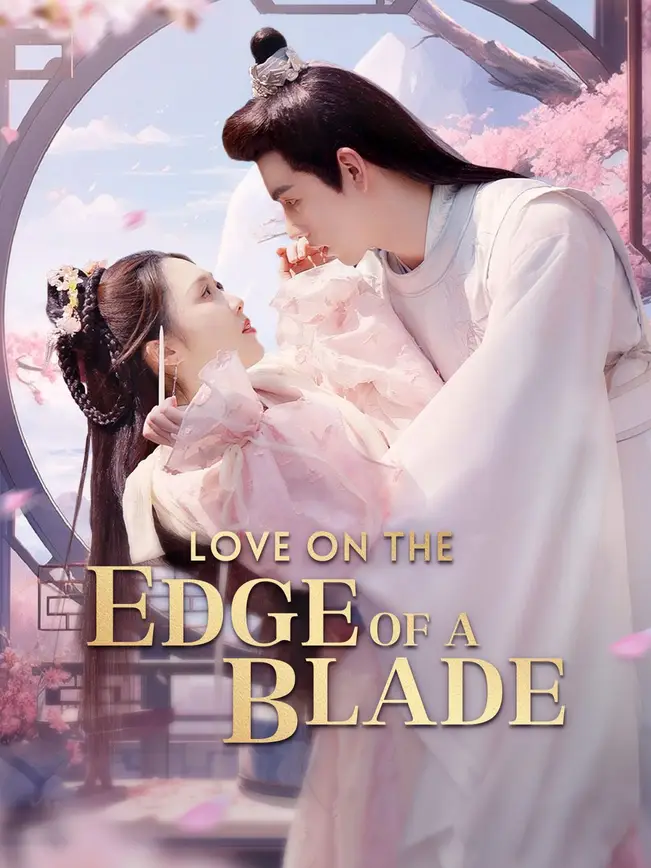
Love on the Edge of a Blade 的剧集简介
Love on the Edge of a Blade 的更多详情
Love on the Edge of a Blade: The Silence Between Sword and Sigh
There’s a particular kind of tension that only historical drama can conjure—the kind where a single dropped teacup echoes louder than a war drum. In *Love on the Edge of a Blade*, that cup shatters in frame seven, and the aftermath lingers longer than any dialogue ever could. We see Mo Yun, pale and trembling, slumped against Lin Xue, her dark robes soaked at the hem—not with wine, but with something darker. Lin Xue’s fingers press into her collarbone, not to heal, but to steady. Her own red sleeves are immaculate, save for the faint smudge of blood near the cuff, a detail the camera lingers on for exactly two seconds before cutting away. That’s the language of this show: visual punctuation. Every stain, every tilt of the head, every unblinking stare is a sentence in a grammar no subtitle can translate. Wei Jian enters not with fanfare, but with the quiet certainty of inevitability. He doesn’t rush. He doesn’t shout. He simply rises from his stool, adjusts the rope belt at his waist, and takes three measured steps forward. His sword remains sheathed, yet its presence is felt in the way the other men instinctively shift their weight, how Yuan Mei’s breath catches just slightly when he passes her. She’s the only one who meets his eyes without flinching—and that’s telling. While Zhou Yan stands rigid in his ceremonial red, his expression caught between outrage and confusion, Yuan Mei watches Wei Jian like she’s reading a letter she’s memorized but never dared open. Her peach-colored robe, embroidered with chrysanthemums and cranes, seems almost defiant in its softness against the harsh geometry of the wooden gate behind her. That gate, by the way, bears a faded double-happiness emblem—partially covered by a torn red ribbon, as if someone tried to conceal it, then gave up. Symbolism isn’t subtle here; it’s woven into the fabric of every scene. What’s fascinating is how *Love on the Edge of a Blade* treats trauma not as spectacle, but as texture. Mo Yun doesn’t scream. She doesn’t collapse dramatically. She *stutters*—her breath comes in short, uneven bursts, her fingers curling into fists at her sides, then relaxing, then curling again. Lin Xue kneels beside her, not to lift her up, but to sit at her level, matching her rhythm. Their faces are inches apart, foreheads nearly touching, and in that intimacy, we see the fracture: Lin Xue’s eyes are dry, focused, while Mo Yun’s glisten with unshed tears that refuse to fall. It’s not weakness—it’s resistance. She won’t give the moment the satisfaction of a sob. And Lin Xue respects that. She doesn’t offer platitudes. She simply says, in a voice barely above a whisper, ‘I’m here.’ Two words. No grand declaration. Just presence. That’s the emotional core of the series: love as witness, not rescue. Meanwhile, Zhou Yan’s arc unfolds in micro-expressions. At first, he looks stunned—his mouth slightly open, brows knitted in disbelief. Then, as Wei Jian approaches, his jaw tightens. Not anger. Something colder: recognition. He knows this man. Not as a guest. Not as a guard. As a ghost from a chapter he thought he’d closed. The camera catches the slight tremor in his hand as he reaches for the jade pendant at his neck—a habit, we’ll learn later, he only does when lying to himself. And when Lin Xue finally lifts her head and locks eyes with Wei Jian, Zhou Yan’s posture shifts. He doesn’t step forward. He doesn’t intervene. He *waits*. That’s the tragedy of his position: he’s the groom, the center of the ceremony, yet he’s become the observer in his own story. The red robe that should signify power now feels like a cage. Yuan Mei’s intervention is masterfully understated. She doesn’t shout ‘Stop!’ She doesn’t throw herself in front of anyone. She simply steps into the negative space between Wei Jian and Lin Xue, her hands raised—not in surrender, but in offering. Her voice, when it comes, is calm, almost musical, yet each word lands like a pebble dropped into still water. ‘The tea is still warm,’ she says. A non sequitur. Or is it? In their world, tea is protocol. Tea is truce. Tea is the last thread holding civility together. By invoking it, she forces a pause—not because she believes it will change anything, but because she knows that in that pause, choices are made. Wei Jian halts. Not because he’s persuaded, but because he respects the ritual. Even a broken one. The cherry blossoms, of course, are more than backdrop. They bloom violently, petals swirling in the breeze like confetti thrown at a funeral. In one shot, a petal lands on Mo Yun’s cheek, and she doesn’t brush it away. She lets it rest there, a fragile contrast to the blood on her lip. Later, as Wei Jian walks away, the camera follows him from behind, and we see a single blossom catch in the weave of his grey robe—unseen by him, noticed by us. That’s the show’s signature: the tiny detail that carries the weight of revelation. *Love on the Edge of a Blade* understands that in a world governed by honor and obligation, the most dangerous thing isn’t the sword at your side. It’s the silence between heartbeats—the moment when you choose whether to speak, to strike, to forgive, or to walk away. And walk away he does. Wei Jian disappears through the gate, the red ribbon snapping behind him like a severed tie. But the scene doesn’t end there. The camera lingers on Lin Xue, who helps Mo Yun to her feet. Their hands remain clasped—not in prayer, but in pact. Zhou Yan watches them, then turns slowly toward the altar, where a single unlit candle waits. He doesn’t light it. He just stares at it, as if waiting for someone else to decide whether the ceremony continues. Yuan Mei moves to stand beside him, not touching, but close enough that their sleeves brush. She says nothing. Neither does he. The wind picks up. Petals swirl. Somewhere offscreen, a child laughs—innocent, unaware. That laugh is the final note of the sequence: life insists on continuing, even when the world feels poised to shatter. *Love on the Edge of a Blade* doesn’t promise resolution. It promises reckoning. And in that reckoning, every character must answer one question: when the blade is at your throat, do you fight, flee, or finally speak the truth you’ve carried like a stone in your chest? The show’s brilliance lies in refusing to answer for them. It leaves the silence hanging—thick, sacred, and utterly devastating.
Love on the Edge of a Blade: When the Sword Meets the Crimson Veil
The opening frames of *Love on the Edge of a Blade* strike like a sudden gust—chaos wrapped in silk, grief draped in gold. A woman in deep indigo robes, her face streaked with blood and tears, collapses into the arms of another woman whose crimson gown is embroidered with phoenixes and lotus vines, each stitch shimmering under the soft light of blooming cherry blossoms. This isn’t just sorrow; it’s collapse. Her breath hitches, lips trembling, eyes squeezed shut as if trying to erase what she’s seen—or what she’s done. The woman holding her, adorned with a golden phoenix crown and dangling earrings heavy with rubies, doesn’t speak. She simply presses her cheek against the other’s temple, fingers tightening on her shoulders—not to restrain, but to anchor. There’s no comfort in this embrace, only shared weight. Behind them, the world moves: men in coarse grey robes rush past, stools overturned, bowls shattered on gravel paths. One man, wearing a wide-brimmed woven hat tied beneath his chin, rises slowly from a low stool, hand resting on the hilt of a black-wrapped sword at his side. His expression is unreadable—not cold, not kind, but *waiting*. He watches the crimson-clad woman, then glances toward the entrance where red banners flutter like wounded birds. That moment—stillness amid motion—is where *Love on the Edge of a Blade* truly begins. Cut to a different angle: a young man in layered orange and peach silks stands frozen mid-step, her long hair pinned with a single white blossom. Her mouth opens slightly, not in shock, but in dawning realization. She knows something the others don’t—or perhaps she’s just realized how little she knew. Her gaze locks onto the grey-robed swordsman, who now turns fully toward her. He removes his hat with one hand, revealing a topknot bound tightly, his face lined with years that haven’t softened him. He smiles—not kindly, but with the quiet amusement of someone who’s seen too many tragedies unfold in slow motion. That smile lingers for three full seconds before he speaks, though we never hear his words. Instead, the camera cuts to Lin Xue, the woman in crimson, who lifts her head just enough to meet his eyes. Her expression shifts: from anguish to calculation, from protector to strategist. In that glance, we understand—this isn’t just a wedding disrupted. It’s a reckoning disguised as ceremony. The setting itself tells a story. Wooden beams, thatched roofs, stone slabs laid unevenly across the courtyard—all suggest a rural estate, perhaps a border town where tradition holds tighter than law. Red ribbons hang everywhere, not just for celebration, but as markers of status, of binding vows. Yet the air feels thick with unspoken threats. A clay wine jar sits half-empty on a table beside a porcelain teapot, its lid askew. Chopsticks lie scattered. Someone has fled—or been dragged away. The man in grey, whose name we later learn is Wei Jian, walks deliberately toward the gate, sword still in hand but not drawn. His posture is relaxed, almost ceremonial, yet every step echoes with intent. When he pauses near the ornate wooden door, carved with a double-happiness symbol now partially obscured by a torn red cloth, he tilts his head as if listening to something beyond sound. Is it memory? A whisper from the past? Or merely the wind through the pines behind him? Back to the injured woman—her name is Mo Yun, according to the script notes embedded in the costume design (a subtle nod to her role as the ‘cloud-bound’ outsider). She coughs once, a wet, ragged sound, and blood trickles from the corner of her mouth. Lin Xue wipes it away with the sleeve of her robe, staining the gold thread. No flinch. No hesitation. This is not the first time she’s cleaned blood from someone she loves. Meanwhile, the groom—Zhou Yan, tall and sharp-featured, dressed in imperial-red brocade with gold cloud motifs—steps forward, his voice finally breaking the silence. He says only two words: ‘Why her?’ Not ‘Why now?’ or ‘What happened?’ But *why her*—as if Mo Yun’s presence, her injury, her very existence, is the anomaly in this carefully staged tableau. His tone isn’t accusatory; it’s bewildered. He expected betrayal, yes—but not *this* kind of vulnerability. Not the sight of Lin Xue cradling Mo Yun like a fallen sister, not the way Wei Jian watches them both with the calm of a man who already knows the ending. Then comes the pivot: the woman in peach—Yuan Mei—steps between Wei Jian and the group. Her hands rise, palms outward, not in surrender, but in interruption. She speaks quickly, her voice melodic but edged with steel. The camera circles her, catching the way her sleeves ripple like water, how her belt knot remains perfectly symmetrical despite the chaos. She’s not pleading. She’s negotiating. And in that moment, *Love on the Edge of a Blade* reveals its core tension: loyalty isn’t binary here. It’s layered, contradictory, worn like overlapping robes. Lin Xue protects Mo Yun—but does she also resent her? Zhou Yan stands rigid, his ceremonial crown still perched precariously on his head, as if he fears removing it might break the illusion of control. Wei Jian, meanwhile, lets out a soft chuckle—low, almost private—and tucks his sword back into its sheath. Not because the threat is over. Because the real battle has just moved indoors, into the realm of silence and implication. What makes this sequence so gripping isn’t the violence—it’s the restraint. No one draws steel outright. No one shouts. Yet the air crackles with unsaid confessions. When Mo Yun finally opens her eyes, they’re clear, focused—not on her wound, but on Wei Jian’s retreating back. A flicker of recognition. A history buried under years and distance. Later, in a whispered aside during the banquet scene (visible only in the background blur), Yuan Mei murmurs to Lin Xue: ‘He came for the letter. Not the bride.’ That single line reframes everything. The wedding was never the point. It was the stage. The cherry blossoms aren’t just decoration; they’re a countdown. Petals fall steadily, marking time slipping away. And as the camera pulls back for the final wide shot—Zhou Yan standing alone near the altar, Lin Xue helping Mo Yun to her feet, Wei Jian vanishing through the gate, Yuan Mei watching them all with folded hands—we realize *Love on the Edge of a Blade* isn’t about love conquering all. It’s about love surviving *despite* the blade. Despite the lies. Despite the fact that sometimes, the person who holds you when you fall is the same one who planted the knife in your back. The genius of the show lies in its refusal to simplify. Every character wears contradiction like embroidery: beauty and brutality, duty and desire, truth and performance. And in that delicate balance—where a single tear can be both grief and strategy, where a sword at the hip signals protection as much as threat—*Love on the Edge of a Blade* earns its title not through spectacle, but through silence. Through the unbearable weight of what goes unsaid, even as the world burns around them.
Love on the Edge of a Blade: When Red Silk Hides a Knife
There’s a moment—just after the third toast, when the sunlight slants low through the bamboo canopy—that the entire atmosphere of *Love on the Edge of a Blade* shifts. Not with fanfare, not with a shout, but with the quiet click of a jade cup setting down on wood. Shen Yuer places hers gently, deliberately, as if laying down a gauntlet. Across the courtyard, Xiao Lan lifts her own cup—not to drink, but to examine the rim. Her fingers trace the curve, and for a heartbeat, her expression softens. Then hardens. The transformation is so subtle it could be missed by anyone not watching closely. But the camera is watching. Always watching. And in that instant, we understand: this isn’t a wedding. It’s a reckoning disguised as celebration. Li Wei stands tall in his crimson robe, the gold embroidery catching light like fire on snow. Yet his posture is off—his shoulders slightly hunched, his left hand resting not at his side, but near his waist, where a dagger might once have hung. He doesn’t carry one now. But the habit remains. His eyes keep returning to the orchard gate, where pink blossoms tremble in the breeze. He’s not looking for guests. He’s looking for absence. For the woman who walked away without a word, leaving only the echo of her footsteps on gravel. Xiao Lan didn’t flee. She withdrew. Strategically. Purposefully. Her departure wasn’t defeat—it was repositioning. And everyone in that courtyard knows it, even if they pretend otherwise. The guests are a mosaic of tension. The man in the woven hat—Master Feng, we later learn from context—sips his wine with closed eyes, as if tasting not liquid, but memory. His wife, seated beside him, reaches for his arm, but he doesn’t turn. Instead, he murmurs something too low to catch, and her face pales. Nearby, a young scholar in grey robes laughs too loudly, his gaze darting between Shen Yuer and the empty seat. He’s nervous. Not because of the ceremony, but because he remembers what happened three years ago, when Xiao Lan challenged Li Wei to a duel beneath the same cherry tree now blooming behind them. No one died. But something did. An innocence. A trust. A future. What’s remarkable about *Love on the Edge of a Blade* is how it weaponizes stillness. The red gift boxes—stacked like bricks of fate—remain untouched throughout the scene. No one opens them. Not yet. They’re not gifts. They’re liabilities. Each tied with a ribbon that, if pulled, would release a truth too dangerous to speak aloud. The servant girl in peach silk moves like smoke, refilling cups, adjusting sleeves, her movements precise, her expression blank. But watch her hands. When she passes Shen Yuer the wine flask, her thumb brushes the bride’s wrist—just once—and Shen Yuer flinches. Not visibly. Internally. A ripple. A crack in the porcelain mask. Then comes the pouring. Shen Yuer takes the celadon flask, her fingers steady, her smile radiant. But her eyes—oh, her eyes—are locked on Xiao Lan’s back as she walks away. The wine flows smoothly into the cup, clear and green-tinged, like spring water. Yet when Shen Yuer lifts it, her wrist trembles. Just enough. Li Wei notices. Of course he does. He always does. He reaches out—not to steady her hand, but to cover it with his own. A gesture of support? Or suppression? The camera holds on their joined hands, the red silk of his sleeve overlapping hers, the gold threads intertwining like serpents. And in that frame, we see it: beneath Shen Yuer’s sleeve, a thin scar runs from wrist to elbow. Old. Healed. But undeniable. A mark from a blade. Not an accident. A choice. Xiao Lan, meanwhile, has reached the edge of the grove. She stops. Turns. Not to look back at the courtyard, but at the sky—where a single crow circles, silent, black against the pale blue. She raises her cup—not to drink, but to offer it to the air. A libation. A farewell. A vow renewed. Her lips move, soundless, but the subtitles (if we imagine them) would read: *I let you go once. I won’t again.* Then she drinks. Not the wine. She tips the cup, pours its contents onto the earth, and drops the vessel. It shatters. Not loudly. Just a soft, final sound—like a heart breaking in slow motion. Back at the courtyard, Shen Yuer gasps. Not from shock, but from recognition. She knows that sound. She’s heard it before. In a different life. Under a different name. Li Wei turns to her, concern etched into his brow, but she shakes her head—once, sharply—and forces a smile. “It’s nothing,” she says, her voice light as silk. But her eyes are wet. Not with tears. With resolve. This is the genius of *Love on the Edge of a Blade*: it understands that the most violent moments aren’t the ones with blood. They’re the ones where no one moves, no one speaks, and everything changes anyway. The red drapes flutter in the breeze, casting shadows that dance like ghosts across the stone path. The guests continue eating, laughing, pretending. But their laughter is thinner now. Their smiles tighter. Even the children playing near the gift boxes pause, sensing the shift in the air—like animals before a storm. And then, the unexpected twist: the servant girl in peach approaches Shen Yuer, bowing low, and whispers something in her ear. Shen Yuer’s face goes still. Then, slowly, she nods. She takes the empty cup from Xiao Lan’s abandoned seat, walks to the center of the courtyard, and raises it—not to toast, but to declare. Her voice carries, clear and calm: “Let the wine speak what we dare not say.” She doesn’t drink. She pours the remainder onto the ground, mirroring Xiao Lan. And in that act, the unspoken becomes spoken. The oath is renewed. Not between husband and wife. Between women. Between survivors. Li Wei watches, stunned. He thought he was the center of this story. He was wrong. The true axis of *Love on the Edge of a Blade* has always been Xiao Lan and Shen Yuer—the two women bound by love, loss, and a secret that predates even the red silk. The wedding was never about him. It was a stage. And now, the real performance begins. As the sun dips below the pines, casting long shadows that stretch like blades across the gravel, Shen Yuer turns to Li Wei and says, softly, “The feast is over. The game begins.” And for the first time, he doesn’t know what comes next. Because in *Love on the Edge of a Blade*, the most dangerous weapon isn’t steel. It’s silence. And the women have just learned how to wield it.
Love on the Edge of a Blade: The Crimson Vow That Never Broke
In the quiet grove where pine needles whisper secrets and cherry blossoms drift like forgotten promises, *Love on the Edge of a Blade* unfolds not as a spectacle of swords and blood, but as a slow-burning ritual of restraint—where every gesture is measured, every glance weighted with unspoken history. The courtyard, draped in crimson silk and flanked by rustic pavilions, feels less like a wedding venue and more like a stage for a trial: not of love, but of loyalty. At its center stand Li Wei and Shen Yuer—two figures whose red robes shimmer with gold-threaded phoenixes, symbols of imperial favor yet also cages of expectation. Their hands, raised in synchronized motion during the jiao bei ceremony, do not tremble—but their eyes do. Li Wei’s fingers tighten around his jade cup just slightly too long; Shen Yuer’s smile lingers a beat past politeness, her gaze flickering toward the woman in indigo who sits stiffly at the outer table, her posture rigid as a drawn blade. That woman—Xiao Lan—is the ghost in the room. She wears no bridal finery, only deep navy brocade trimmed with silver medallions, her hair pinned with twin iron-tipped hairpins that gleam like hidden daggers. When the bride pours wine from the celadon flask into the small cups, Xiao Lan does not reach for hers immediately. She watches. Not with envy, but with calculation. Her lips part once—not to speak, but to exhale, as if releasing something heavy she’s carried for years. In that moment, the camera lingers on her earlobe, where a single drop of red lacquer dangles like a tear frozen mid-fall. It’s not jewelry. It’s a signal. A remnant of an old oath, perhaps one sworn beneath the same trees now blooming pink overhead. The guests murmur, clink cups, laugh too loudly—performing joy while their eyes dart between the couple and Xiao Lan. One man, wearing a wide-brimmed woven hat stitched with blue thread, sips his wine and lowers his cup with deliberate slowness. His expression is unreadable, but his knuckles are white. He knows something. Everyone does, in fragments. The red gift boxes stacked near the bamboo table aren’t just dowry—they’re sealed memories. Each tied with a knot that, if untied improperly, would unravel a story no one dares speak aloud. Shen Yuer catches Li Wei’s eye as he lifts his cup to drink, and for half a second, her smile vanishes. Not anger. Not sorrow. Something sharper: recognition. As if she’s just realized he’s not drinking *to* her, but *through* her—to someone else, somewhere else, in another time. Later, when the couple descends the platform steps, Shen Yuer stumbles—not because of her heavy skirt, but because her foot catches on the hem of Xiao Lan’s sleeve, which has been subtly extended across the path. No one sees it. But the camera does. And in that micro-second, Xiao Lan’s hand tightens on her own cup, her thumb pressing into the rim until the porcelain threatens to crack. Yet she doesn’t look up. She doesn’t need to. The tension isn’t in the shouting—it’s in the silence between breaths. In the way Li Wei glances back, not at Shen Yuer, but at the empty space where Xiao Lan had stood moments before. Because she’s gone. Vanished into the orchard, leaving only the faint scent of plum blossom and iron. This is where *Love on the Edge of a Blade* earns its title. Not in the clash of steel, but in the unbearable weight of what remains unsaid. The red silk drapes are not just decoration—they’re bindings. The wine isn’t celebration; it’s a test. Every guest is complicit. Every smile is a mask. Even the servant girl in pale peach, holding the tray with trembling hands, knows more than she lets on. Her eyes follow Xiao Lan’s retreat, and when she turns back to the couple, her lips form a silent word: *Wait.* What makes this sequence so devastating is how ordinary it appears. A wedding. A toast. A few guests chatting. But beneath the surface, the ground is shifting. Li Wei’s crown pin—a delicate golden crane—catches the light as he bows, and for a frame, the reflection in its polished surface shows not the courtyard, but a younger Xiao Lan, standing beside him in simpler clothes, holding a sword instead of a cup. A memory? A vision? Or a warning? The film refuses to clarify. It trusts the audience to feel the fracture before they see it. Shen Yuer, meanwhile, becomes the most fascinating study in controlled collapse. She laughs when others laugh. She raises her cup with grace. But her fingers never quite relax. Her embroidery—golden vines coiling around a central phoenix—mirrors the pattern on Li Wei’s robe, yet hers ends in thorns, not blossoms. A detail only visible in close-up, when the wind lifts the edge of her sleeve. She knows. She must know. And yet she continues. Because in *Love on the Edge of a Blade*, survival isn’t about winning—it’s about enduring the silence long enough to choose your next move. When she finally speaks, her voice is soft, almost musical: “The wine is sweet today.” But her eyes are fixed on the path where Xiao Lan disappeared. And Li Wei, for the first time, doesn’t meet her gaze. He looks down at his cup—and sees not wine, but water. Clear. Still. Reflective. Like a blade freshly polished, waiting. The final shot lingers on the empty stool where Xiao Lan sat. On the table before it, her untouched cup. Inside, a single petal floats—pink, delicate, impossibly fragile. And beside it, etched into the wood grain of the table leg, a tiny mark: two intersecting lines, forming a character that means *oath*. Not broken. Not fulfilled. Just… suspended. Waiting for the next breath. The next choice. The next edge of the blade.
Love on the Edge of a Blade: When Armor Hides More Than Flesh
The first image of *Love on the Edge of a Blade* doesn’t show a battlefield. It shows exhaustion. Not the kind that comes from fighting—but the kind that comes from *holding back*. Three soldiers in gleaming black-and-gold armor lie scattered near a wooden crate, their postures telling a story no script could match. One sits upright, spear propped beside him like a companion, his helmet tilted just enough to reveal eyes that scan the perimeter—not with panic, but with the weary vigilance of men who’ve stood guard too long. His fingers rest lightly on his knee, not gripping, not relaxed—*poised*. The other two lie flat, faces turned away, breathing measured and shallow. They’re not unconscious. They’re *performing* collapse. A theatrical surrender to fatigue, perhaps, to lull observers into complacency. Or maybe it’s deeper: a silent protest, a refusal to stand while their commander makes a choice they cannot endorse. The red-tasseled halberd lying nearby isn’t discarded carelessly; it’s placed with intention, its vibrant silk a visual scream against the muted earth tones. In *Love on the Edge of a Blade*, even inaction is a statement. Then Li Zhen enters—not striding, but *materializing*, as if the forest itself parted to let him through. His costume is a masterclass in visual hierarchy: the silver-gray fur collar isn’t just warmth; it’s a declaration of status, soft yet impenetrable. Beneath it, layers of brocade in deep browns and golds swirl with motifs that suggest both imperial lineage and martial tradition. His hair, styled in a high topknot secured by a phoenix hairpin, is immaculate—not a strand out of place. This is a man who controls his environment down to the angle of his eyebrows. And yet, when he turns to face Su Rong, that control wavers. Just for a fraction of a second. His eyes narrow, not in anger, but in assessment. He’s reading her like a scroll he’s seen before but can’t quite decipher. Su Rong stands opposite him, her peach-and-crimson gown flowing like liquid sunset. Her hands are clasped before her, fingers interlaced so tightly the knuckles whiten—a physical manifestation of internal pressure. Her hair, long and glossy, is adorned with flowers that seem too delicate for the tension in the air. Yet she doesn’t flinch. She meets his gaze, and in that exchange, we see the core conflict of *Love on the Edge of a Blade*: not good versus evil, but truth versus survival. Their dialogue—if there is any—is buried beneath layers of subtext. Li Zhen’s lips move, but the sound is swallowed by the rustle of bamboo. What matters is what his body says: the slight tilt of his head, the way his shoulders shift from defensive to contemplative, the moment his hand drifts toward the hilt of his sword—not to draw it, but to *reassure himself* it’s there. Su Rong responds not with words, but with micro-expressions: a blink held a beat too long, a swallow that travels visibly down her throat, the subtle tightening of her jaw when he speaks a certain phrase. She’s not afraid of him. She’s afraid of what he might *do*—and what she might have to become to stop him. The camera circles them, capturing their profiles, their reflections in polished armor, the way sunlight catches the edge of Li Zhen’s hairpin like a warning flare. This isn’t romance. It’s negotiation. A high-stakes dance where one misstep could shatter everything. Then, the soldiers rise. Not all at once. First one, then another, then the third—each movement synchronized, precise, devoid of urgency. They kneel, spears planted vertically, red tassels swaying like pendulums marking time. One soldier, the one who was seated, rises last. He doesn’t look at Li Zhen. He looks at Su Rong. And in that glance, we glimpse something raw: recognition. Loyalty. Maybe even guilt. He places his spear on the ground with deliberate care, the metal kissing the dirt like a vow being sealed. Li Zhen doesn’t thank him. He doesn’t need to. The gesture is understood. In *Love on the Edge of a Blade*, respect is shown through action, not applause. The silence that follows is heavier than armor. Su Rong exhales—softly, almost imperceptibly—and for the first time, her shoulders drop. Not in defeat, but in resignation. She knows the die is cast. The scene cuts sharply—not to a palace, not to a war camp, but to a sun-drenched courtyard where life pulses openly. People move with purpose, tables are set, laughter echoes faintly. And there, half-hidden behind a wooden beam, is Chen Mo. His entrance is understated, yet it recalibrates the entire tone. He wears no armor, no finery—just a simple gray robe, a woven straw hat that shades his eyes, and a quiet intensity that commands attention without demanding it. He watches the courtyard not as a participant, but as an archivist of moments. His hands, when they enter frame, are the focus: weathered, capable, moving with the rhythm of someone who’s done this a thousand times. He selects a green plum, slices it with a small knife, and squeezes the juice into a celadon bottle sealed with a red cloth. The act is meditative. Ritualistic. The camera lingers on the droplets falling, the way the red fabric absorbs the moisture like a sponge soaking up secrets. This isn’t just preparation. It’s encoding. Chen Mo isn’t preparing drink. He’s preparing consequence. What elevates *Love on the Edge of a Blade* beyond typical historical drama is its refusal to explain. We don’t know why the soldiers feigned collapse. We don’t know what’s in the crate. We don’t know why Chen Mo chooses *this* moment, *this* plum, *this* bottle. And yet, we understand. Because the show trusts us to read the language of the body, the weight of a glance, the symbolism of color and texture. The red tassels on the halberds echo the red sash on Su Rong’s waist—tying violence and virtue together in a single thread. The silver fur on Li Zhen’s collar mirrors the pale silk of Chen Mo’s robe, suggesting a hidden kinship between power and humility. Even the bamboo grove isn’t just backdrop; its vertical lines frame the characters like prison bars, reinforcing the theme of entrapment—by duty, by love, by history. Li Zhen’s final expression—half-smile, half-sigh—as he turns away from Su Rong is the perfect encapsulation of the series’ ethos. He’s not victorious. He’s not defeated. He’s *compromised*. And Su Rong, watching him go, doesn’t cry. She closes her eyes, takes one slow breath, and adjusts the folds of her sleeve. A small act. A monumental one. In *Love on the Edge of a Blade*, the real battles are fought in the quiet spaces between words, where armor hides not just flesh, but fear, hope, and the unbearable weight of choosing who you’ll become when no one is watching. Chen Mo, meanwhile, seals the bottle, tucks it away, and steps back into the shadows—ready to deliver whatever truth has been bottled, whenever the moment demands. The edge of the blade isn’t just steel. It’s the line between who we are and who we must pretend to be. And in this world, love doesn’t soften the blow. It sharpens the point.

Tragic Love





Second Chance


 立即下载
立即下载