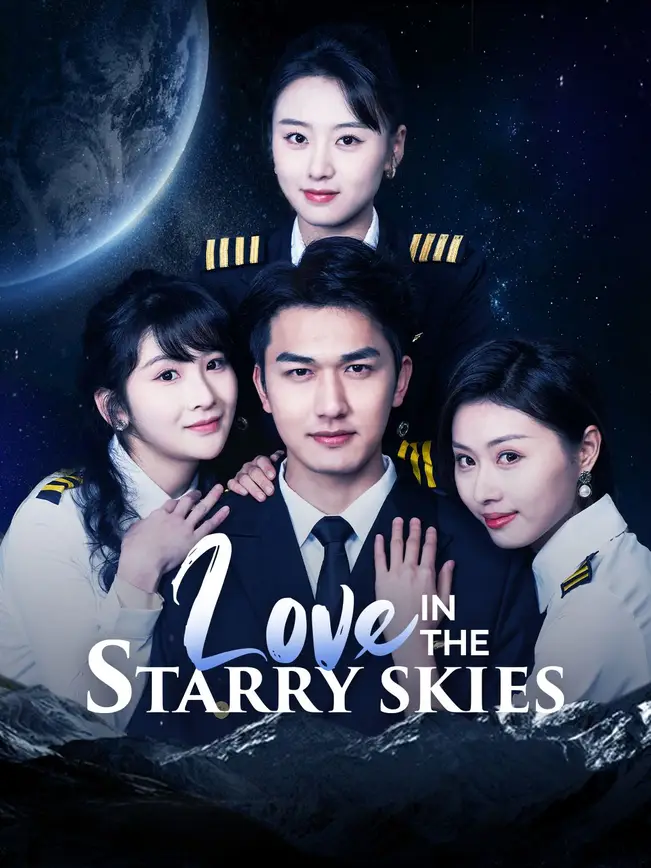
Love in the Starry Skies Storyline
Love in the Starry Skies More details
Genres:Family Drama/Karma Payback/All-Too-Late
Language:English
Release date:2025-02-11 21:30:00
Runtime:84min
Emotional and Captivating Storyline
I absolutely loved this short drama! The storyline is captivating, and the emotional depth is incredible. Luke's journey is portrayed with such authenticity. The way the drama explores themes of loss, betrayal, and redemption is commendable. It's a beautifully crafted piece that resonates deeply. Ku
Epic Drama with a Stellar Cast
"Love in the Starry Skies" is an urban family drama that hits all the right notes. The cast delivers powerful performances, especially Luke's transformation. The narrative is engaging, with enough twists to keep you guessing. It's a touching story of overcoming adversity and finding love. Highly rec
A Tale of Redemption and Hope
This short drama is a masterpiece in storytelling! The blend of family, sacrifice, and redemption is beautifully woven. Luke's character development is profound, and his relationship with Sophia is heartwarming. The suspense around Leo's schemes adds a thrilling edge. A must-watch for those who love
A Heartfelt Journey Through the Stars 🌟
Wow, "Love in the Starry Skies" really took me on an emotional rollercoaster! Luke's journey from despair to hope is beautifully portrayed. The way he overcomes betrayal and finds love again is truly inspiring. The characters are well-developed, and the plot twists kept me hooked till the end. Defin
Love in the Starry Skies: When the Bedside Becomes a Battlefield
There is a particular kind of horror reserved for hospital rooms—not the kind born of illness or pain, but the kind that creeps in through the cracks of ordinary daylight, disguised as routine, as courtesy, as *care*. In *Love in the Starry Skies*, that horror is embodied not by a villain in shadow, but by three people standing in a sunlit doorway: Chen Yu, Jiang Wei, and a nurse whose name we never learn, yet whose silence speaks volumes. The scene is deceptively simple: two women lie in adjacent hospital beds, both wearing the same blue-and-white striped pajamas, both covered by crisp white blankets, both staring upward—as if the ceiling holds answers none of them dare voice aloud. But the symmetry is a trap. What appears to be shared vulnerability is, in fact, a meticulously staged imbalance of power, and Ling Xiao is the only one who sees the wires. Let’s begin with Ling Xiao—not as a victim, but as an observer trapped in her own body. Her hair spills across the pillow, dark and unruly, contrasting sharply with the clinical neatness of the room. Her eyes, though red-rimmed, are sharp, calculating. She does not flinch when Chen Yu enters. She does not gasp when Jiang Wei follows. Instead, she watches—her gaze moving from Chen Yu’s polished shoes to the way Jiang Wei’s fingers tighten around her handbag strap, to the nurse’s hesitant step forward. Every micro-expression is a data point in her internal audit of betrayal. When a tear finally slips free, it is not the first. It is the *tenth*. The ninth was swallowed. The eighth was blinked away. This one? This one is permission—to feel, to break, to acknowledge that the world she knew has dissolved like sugar in hot tea. And yet, even in that moment of collapse, Ling Xiao’s hand remains steady on the blanket, fingers interlaced, as if holding herself together through sheer willpower. That detail—so small, so human—is what elevates *Love in the Starry Skies* beyond cliché. It tells us she is not broken. She is recalibrating. Chen Yu, meanwhile, performs competence like a second skin. His suit fits perfectly. His posture is upright. His voice, when he finally speaks, is calm, almost soothing—“We need to talk.” But his eyes betray him. They dart toward Jiang Wei, then back to Ling Xiao, then away again, as if afraid of what he might see in her reflection. He is not lying outright; he is *omitting*, and omission is the most insidious form of deception. He does not deny Jiang Wei’s presence. He does not explain the second bed. He simply stands there, a monument to unresolved tension, waiting for Ling Xiao to supply the narrative he refuses to articulate. And in that waiting, he reveals his true fear: not that she’ll leave him, but that she’ll *see* him—not the man he presents to the world, but the man who chose convenience over courage, comfort over truth. Jiang Wei is the most fascinating figure in this triad. She does not wear the armor of defiance nor the cloak of remorse. She wears silk and silence. Her blouse, with its knotted collar, suggests both elegance and constraint—a woman who knows how to present herself, but perhaps not how to be seen. When she glances at Ling Xiao, it is not with malice, but with something colder: recognition. She knows Ling Xiao is watching. She knows the game is up. And yet, she does not retreat. She holds her ground, her posture relaxed but unyielding, as if she has already won the war and is merely waiting for the formal surrender. Her earrings—small gold hoops—catch the light with every subtle turn of her head, like tiny beacons signaling *I am here. I belong. You do not.* That is the real wound Ling Xiao absorbs: not that Chen Yu betrayed her, but that Jiang Wei *replaced* her so seamlessly, so effortlessly, that the transition required no fanfare, no explanation—just a quiet shift in the furniture of their lives. The nurse, often overlooked, is the linchpin. She moves with practiced efficiency, adjusting a monitor, checking a chart, her movements smooth, her expression neutral. But neutrality in this context is complicity. She knows why there are two women in matching pajamas. She knows why Chen Yu visits one bed but not the other. And she says nothing. Her silence is not ignorance—it is policy. In *Love in the Starry Skies*, institutions do not protect the vulnerable; they protect the narrative. The hospital room, with its floral arrangement and framed abstract art, is not a sanctuary. It is a curated space where truths are managed, not revealed. The flowers are fresh, yes—but they are also cut, detached from roots, beautiful only in their temporary perfection. Just like the life Ling Xiao thought she had. What follows is not a confrontation, but a dissolution. Chen Yu places a hand on Jiang Wei’s elbow—not possessive, but protective—and they turn to leave. Ling Xiao does not call out. She does not beg. She simply watches them go, her breath slowing, her fingers unclenching just enough to let the blanket slip an inch. And in that slip, we see it: the first flicker of resolve. Because *Love in the Starry Skies* understands something profound—that the most dangerous moment for a liar is not when the truth is spoken, but when the betrayed stops reacting. Ling Xiao’s silence is not defeat. It is strategy. She is gathering evidence. She is mapping the fault lines. She is remembering every word Chen Yu ever said, every promise he made, every time he looked away when she asked a question he didn’t want to answer. And when the door clicks shut behind them, the room does not feel emptier. It feels charged. Like the air before lightning strikes. The final shots linger on Ling Xiao’s face—not in despair, but in dawning clarity. Her lips part, not to speak, but to breathe in the weight of her new reality. The striped pajamas, once a symbol of rest and recovery, now feel like a uniform of erasure. But she does not remove them. She keeps them on. Because in *Love in the Starry Skies*, the most radical act of resistance is sometimes just staying in the frame—refusing to be edited out, refusing to let the story end without her voice. And somewhere, offscreen, a phone buzzes. A message arrives. A file downloads. A name surfaces. Ling Xiao’s eyes narrow—not with anger, but with purpose. The battle was not fought in the doorway. It begins now, in the quiet aftermath, where the real work of truth-telling always begins.

All-Too-Late




Karma Payback




Family Drama


 Download